
Related videos:
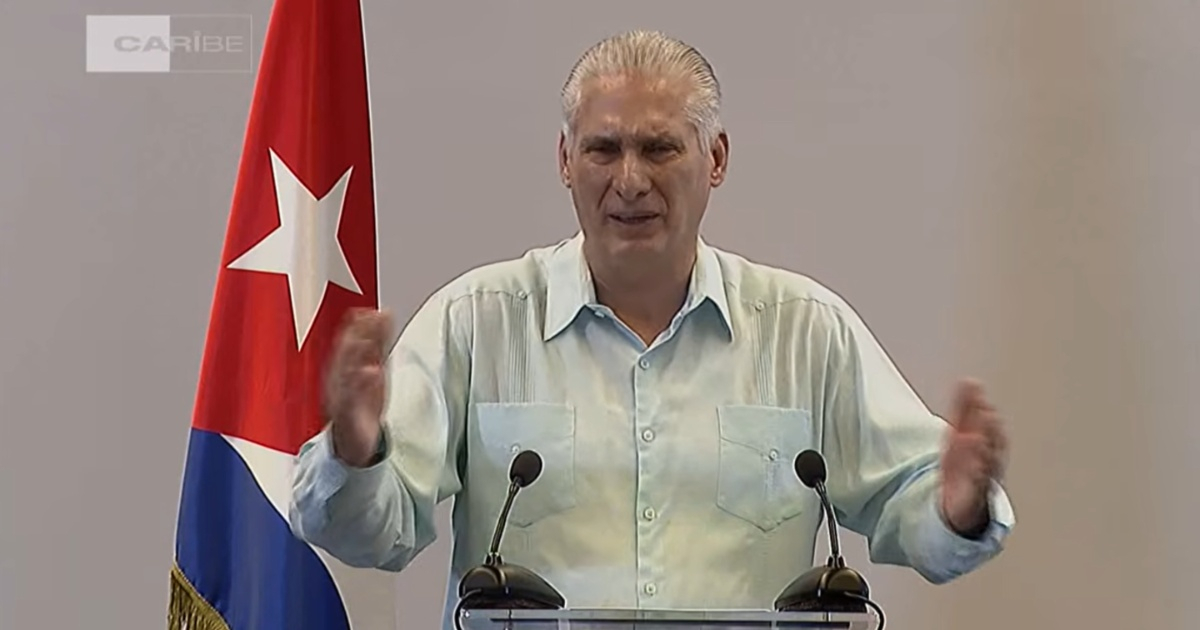
Miguel Díaz-Canel acknowledged this Wednesday that "the situation of the National Electroenergy System has been particularly tense in recent days," in a message posted on his official Facebook account, where he projected a deficit of over 2,000 MW for the nighttime peak of that same day.
The figure confirms the most challenging moment of the year for the Cuban electrical system. On Tuesday, the real maximum impact reached 2,113 MW at 8:40 PM, according to the Electric Union, with an availability of only 1,230 MW against a demand of 3,250 MW.
Díaz-Canel attributed the worsening exclusively to the U.S. embargo, stating that due to a lack of fuel, Cuba ceased to generate 1,100 MW this Wednesday.
“Such a dramatic worsening has a single cause: the genocidal energy blockade imposed by the U.S. on our country, threatening irrational tariffs on any nation that supplies us with fuel,” he wrote.
The leader also acknowledged the extent of the fuel shortages: Cuba needs at least eight ships per month, but in April, only one arrived.
"The arrival at a Cuban port of just one fuel ship, out of the eight that are needed each month, helped to reduce the deficit and, in turn, the blackouts that, although not completely eliminated, were alleviated," he acknowledged.
What the regime omits is that the energy crisis has structural roots spanning decades, exacerbated by the dependence on external subsidies that the dictatorship's economic model never addressed.
Venezuela, which sent up to 46,500 barrels daily, interrupted its supply from November 2025. Russia made its last shipment in October of that year. Mexico suspended its shipments in January 2026.
While Díaz-Canel was publishing his message, residents of San Miguel del Padrón were staging a pot-banging protest in front of the municipal government headquarters demanding "Electricity and food!".
On Tuesday night, another cacerolazo in Reparto Bahía erupted with shouts of “Down with the dictatorship!,” and in the early hours of Wednesday, residents of Marianao took to the streets with bonfires.
This Wednesday, graffiti reading "Homeland and Life" and messages against Díaz-Canel appeared on electrical infrastructure in Arroyo Naranjo. The Cuban Observatory of Conflicts recorded 1,133 protests in April 2026, an increase of 29.5% compared to April 2025.
The regime has responded to the protests with militarization and arrests. At least 14 people have been detained in Havana since March 6 related to the pot-banging protests. The energy crisis overlaps with a devastating food shortage: 33.9% of Cuban households reported hunger in 2025, according to the Food Monitor Program.
On Tuesday, President Donald Trump described Cuba as a "failed nation" and promised to discuss the island "at the right time." Secretary of State Marco Rubio announced on May 7 new sanctions against GAESA and 12 regime officials, and offered $100 million in conditional humanitarian aid.
Díaz-Canel concluded his statement with a promise of resilience: "Always willing to engage in dialogue on equal terms, we will continue to resist and create, increasingly convinced that we must leap with our own efforts above the enormous difficulties, united as a nation, and resolute in facing the toughest challenges."
Filed under: