
Related videos:
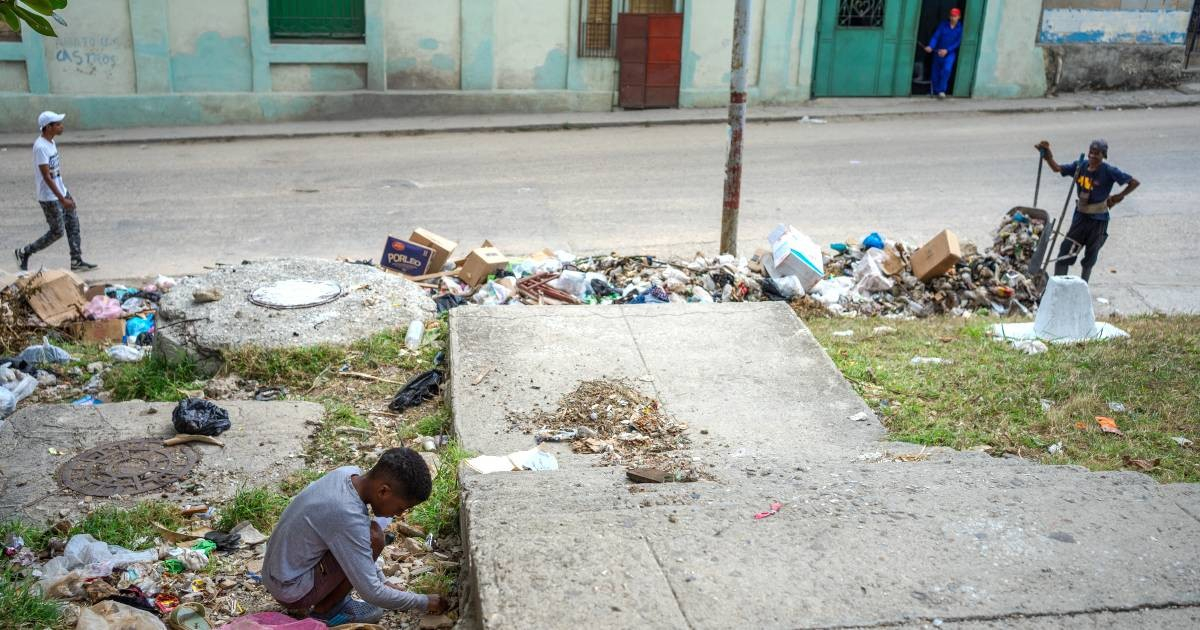
The Cuban photographer Alina Sardiñas published a powerful testimony on her Facebook profile this Tuesday, accompanied by four photographs that document the state of collapse of the Cuban streets, with a phrase that sums up her experience walking through them: "I walk through the streets feeling a mix of terror and wonder."
Sardiñas, with over three decades of experience in documentary photography and residing between Havana and Madrid, does not attribute the deterioration he captures to any natural phenomenon.
"It was not the strong and sustained winds of a hurricane, nor the sea that pushed and flooded the city, nor an earthquake. It was the weight of heartbreak, the hatred towards people and towards beauty," he writes in his post.
The images accompanying the text depict residential buildings with peeling walls, hanging electrical wires, and vegetation growing in cracks, alongside streets littered with trash and debris.
One of the photographs captures a child searching for items among the trash, while another shows graffiti with the phrase "Long live Fidel!" painted on the worn facade of a dilapidated building next to a café.
Sardiñas points to this paradox as evidence of a deliberate choice by the regime: "Seeing the slogans of the past surviving on crumbling walls is proof that propaganda was chosen over a dignified life."
Regarding the dumpsters that appear in her photos, the photographer is emphatic: "The dumpsters are not a temporary waste; they are the sediment of neglect that has become state policy."
Sardiñas' testimony reflects an urban crisis that is documented and acknowledged even by officials of the regime itself. Havana generates between 24,000 and 30,000 cubic meters of solid waste daily, but only 44 out of 106 collection trucks are operational due to a lack of diesel, leaving up to 23,814 cubic meters uncollected each day.
The Minister of Science, Technology and Environment, Armando Rodríguez Batista, admitted in September 2025 that "this trash is not contained; it is spread all over Havana," and in December of the same year the regime acknowledged its inability to clean the capital or finance its sanitation.
The deterioration of housing exacerbates the situation: approximately 1,000 buildings collapse annually in Havana, the housing deficit exceeds 805,000 units, and only 65% of the housing stock is in good condition, according to figures from the Ministry of Construction.
In 2025, several landslides resulted in fatalities, including the death of a seven-year-old girl in Old Havana and two individuals in Central Havana.
Sardiñas' testimony adds to a wave of viral complaints from Cubans and tourists documenting the urban collapse of the island, including an Italian tourist who described Cuba as the "dirtiest country" she has visited.
Sardiñas concludes his publication with a phrase that encapsulates his perspective: "Cuba is not a romantic ruin; Cuba is what happens when you no longer matter."
Filed under: