
Related videos:
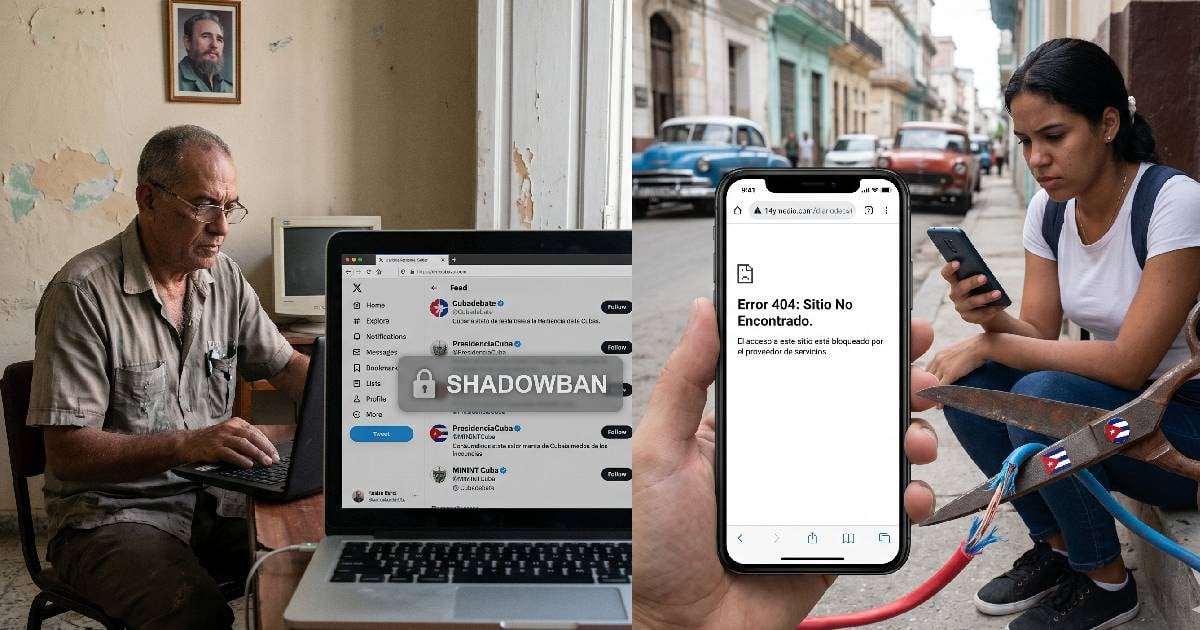
The official digital portal Cubadebate accused the social network X this Friday of censoring institutional accounts of the regime since March 2026, in what it describes as an "algorithmic war" driven by the United States government.
The study, conducted by the Media Observatory of Cubadebate, claims to have analyzed over 600,000 mentions on X of 10 government accounts, including @partidopcc, @presidenciacuba, and @minint_cuba, between January 1 and May 13, 2026, and identified "an abrupt, widespread, and synchronized" decline in their reach and digital visibility.
The research links the phenomenon to the so-called shadowban, a form of censorship that does not eliminate content but reduces its circulation in searches, recommendations, and trends, and compares it to documented patterns against Palestinian voices during the war in Gaza.
The Observatory cites the academic study Silencing & Surging, published in April by researchers from universities in Canada, Germany, the United Kingdom, and the United States, which analyzed 295 direct testimonies and concluded that the shadowban operates as a "probabilistic strangulation": "the content does not disappear completely, but is suffocated within the algorithmic architecture."
The irony of the accusation is hard to overlook, as the very government that claims algorithmic censorship on X imposes direct, systematic, and documented censorship against independent media within the island.
Cuba ranks 160th out of 180 countries in the 2026 World Press Freedom Index by Reporters Without Borders, published on April 30th, the second worst in the Americas, after Nicaragua.
The Cuban Institute for Freedom of Expression and the Press recorded 128 attacks against the press in February 2026 alone, a 172.3% increase compared to the same month the previous year, including 40 arbitrary detentions and four physical assaults.
At least 23 independent media sites, including 14ymedio, CubaNet, Diario de Cuba, El Toque and CiberCuba itself, remain blocked on the island, according to Freedom House and Digital Guardians.
The journalist Yoani Sánchez, founder of 14ymedio, was detained on January 28, 2026 by State Security agents to prevent her from attending a diplomatic reception, and stated on May 3 that "the poor quality of communications is not just a technical problem, it is a strategy."
The journalist Ángel Cuza Alfonso, from CubaNet, was arrested on April 30 in front of his daughter in Havana, during one of the many police operations against activists and reporters that have been reported in recent weeks.
The regime also blocked the recent independent survey promoted by over 20 independent media outlets in April, which, despite the blockade, gathered more than 41,000 responses, yielding devastating results for the government.
The report from Cubadebate comes at a time when the regime rejected the U.S. offer of free satellite internet via Starlink, as announced by the Department of State.
The official outlet Razones de Cuba, while criticizing the proposal, inadvertently acknowledged that the satellite network is "inherently resistant to physical attacks or government interdiction," revealing the true reason for the rejection: the fear of losing control over communications.
Filed under: