
Related videos:
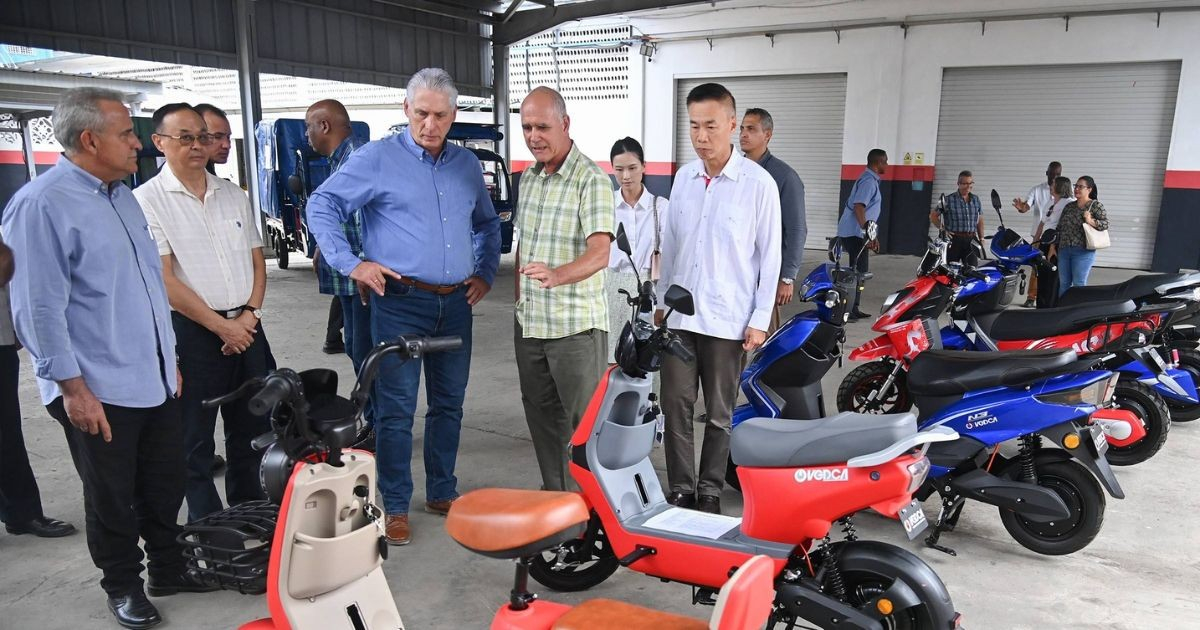
Miguel Díaz-Canel visited the VEDCA (Electric Vehicles of the Caribbean) plant this Friday, a joint Chinese-Cuban company located about 15 kilometers west of Havana, and referred to it as a "jewel" in front of its executives, while the country experiences consecutive days with over 70% of its territory without electricity.
The official account of Presidencia de Cuba on Facebook shared the visit under the slogan “Thinking Big,” featuring photos of the leader touring the assembly hall and engaging in conversation with Chinese workers and technicians.
"You have a little gem in your hands, and it must be protected," Díaz-Canel told the director of VEDCA, a company that already assembles bicycles, motorcycles, and electric tricycles and plans to start assembling electric cars in August.
The official also described VEDCA as "a bastion of cooperation with China" and an example of "energy transition, innovation, and socialist efficiency," before concluding his visit with a statement worthy of framing: "In such difficult times, here one can breathe development and resilience."
What he didn't mention is that those "very difficult times" include power outages of up to 22 hours a day in some circuits of Havana, and that just two days before his visit, on May 14, Cuba broke its own historical record of electricity deficit with 2,153 MW without generation at 9:30 PM, leaving more than 70% of the country without power simultaneously.
The day before, on May 13, the deficit had reached 2,113 MW, surpassing the previous record of 2,075 MW set in March.
The Minister of Energy and Mines, Vicente de la O Levy, publicly admitted that Cuba was "without fuel," lacking both fuel oil and diesel, relying solely on associated gas to generate electricity, after the country did not receive fuel ships between December 2025 and March 2026.
In that context, VEDCA's flagship proposal —for the factory to achieve "total independence from the national electrical system" through solar panels— sounds more like a joke than an industrial plan.
The figures from VEDCA that the regime proudly announces do not withstand much scrutiny in their real context: the company invoiced over 12 million dollars in 2024 and grew from 1,000 to 10,000 annual units, according to the Presidency. By 2026, it aims to produce more than 20,000 units and generate about 40 million dollars, according to the official newspaper Trabajadores. In 2024, the plant was operating far below its capacity due to financial, logistical, and market issues.
Electric tricycles from VEDCA are being sold in the informal market for over 3,000 dollars, and in official stores between 1,300 and 2,550 dollars, in a country where the average state salary does not exceed 50 dollars per month.
For those who can afford an electric tricycle, there's the detail that charging it requires electricity — that extremely scarce resource that the regime has been unable to guarantee for years — and that installing a solar panel on the vehicle costs 800 additional dollars.
VEDCA was established in 2019 as a partnership between the Chinese company Tianjin Dongxing Industrial Group Co. Ltd., which holds 58% of the investment, and the Cuban company Minerva. From its inception until January 2023, it had produced 2,500 electric motorcycles, 1,500 tricycles, and 1,000 electric children's cars, accumulating six million dollars in profits.
While Díaz-Canel "thinks big" among electric bicycles and solar panels, the National Electroenergetic System is still struggling to fully recover: on May 15, the Electric Union announced the full restoration of service after record blackouts, although Cubans know well that this "restoration" usually lasts only until the next thermoelectric plant fails.
Filed under: