
Related videos:
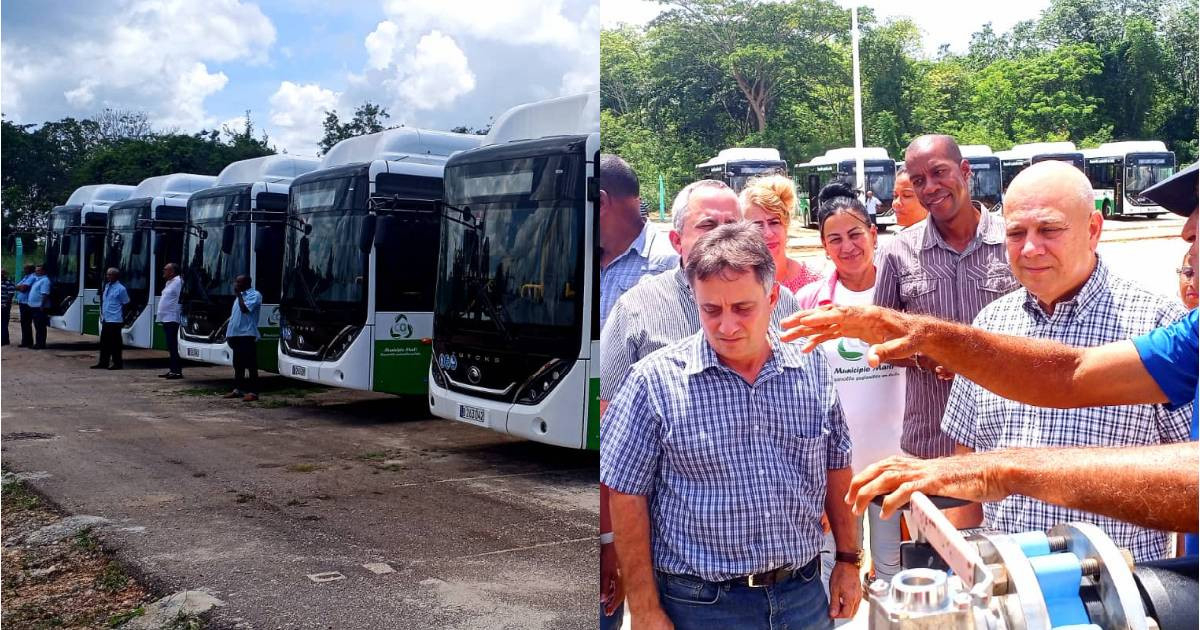
The Secretary of Organization of the Central Committee of the Communist Party of Cuba Roberto Morales Ojeda toured the facilities of the "Carbon Neutral" project on Saturday in the municipality of Martí, in the province of Matanzas, where the government promotes a biogas plant that converts pig manure into fuel for five buses.
The visit was accompanied by the First Secretary of the Provincial Committee of the PCC, Mario Sabines Lorenzo, the member of the Secretariat of the Central Committee Jorge Luis Broche Lorenzo, and the governor Marieta Poey Zamora, as highlighted by the official newspaper Girón.
The project, funded by the European Union and implemented by the United Nations Development Programme (UNDP), aims to transform Martí into a model of sustainable development based on a circular economy and low emissions, with an investment exceeding 5.8 million dollars.
The heart of the initiative is a biomethane plant, claimed to be the only one in Cuba, powered by large-scale biodigesters located alongside pig farming facilities that convert manure into biogas, the source pointed out.
Experts explained to Morales Ojeda that the gas is purified by removing carbon dioxide and hydrogen sulfide to obtain a high-purity fuel, which travels through 14 kilometers of underground piping to supply five Yutong buses and several vans intended to connect the municipality with neighboring towns.
The plan would benefit more than 22,000 residents and is structured around three pillars: renewable public transport using biomethane, promotion of agroecology on rural farms, and strengthening local government management.
Morales Ojeda acknowledged that innovation "positions the province of Matanzas at the forefront of biogas utilization in Cuba and the implementation of renewable energy sources."
However, the project carries a structural contradiction that the authorities did not mention during the visit. The main pig farm operates with just 1,000 pigs out of an installed capacity for 15,000, reflecting the collapse of national pork production, which fell from over 200,000 tons in 2018 to just 9,300 in 2024.
The technical manager of the project, Wilber Oliva Rodríguez, admitted in April that "the main issue right now is managing enough raw materials to sustain production."
To compensate for the shortage of pig manure, the project turns to cattle excrement and other organic waste, and even plans to process sargassum.
The public reaction to the initiative has been skeptical since it was announced. "A $5 million investment to fuel 5 buses?", questioned Cuban internet users, while others doubted its feasibility due to the shortage of pigs.
"How are they going to make it work if there are hardly any pigs left in this country?" others asked.
The energy context surrounding the project is devastating. Public transportation in Cuba only meets 42% of its planned targets, and bus production has plummeted from 473 units in 2019 to a mere 12 projected for 2026, according to data acknowledged by the government itself.
Filed under: