
Related videos:
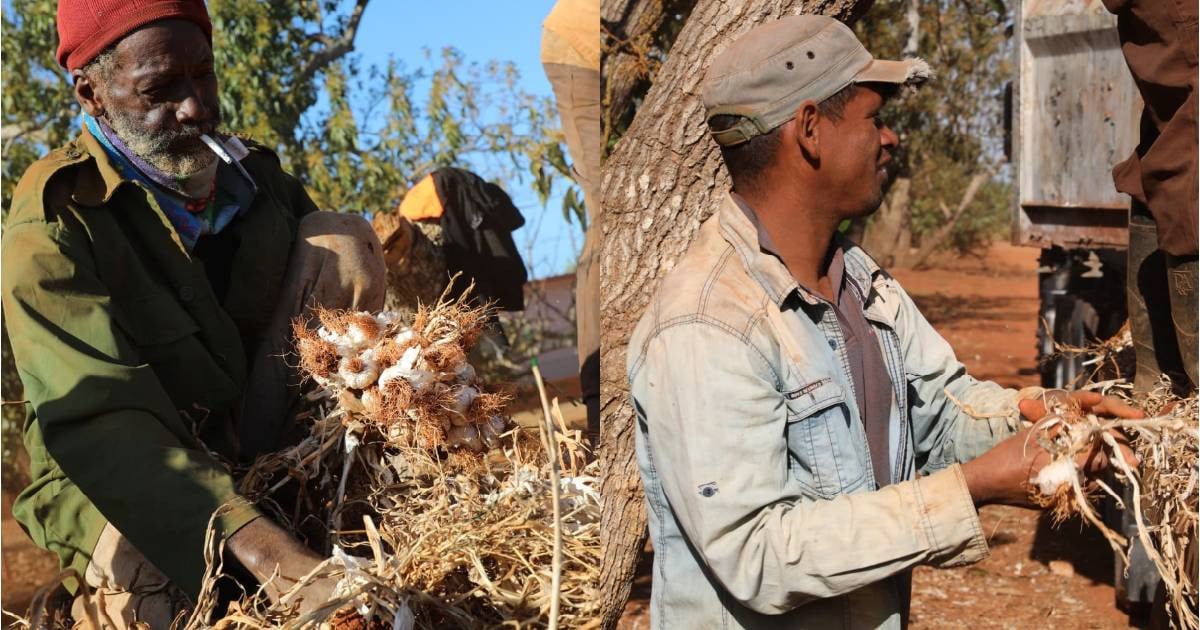
Thousands of temporary workers without contracts, lacking social security and mostly without updated documentation, effectively support the planting and harvesting in the province of Artemisa, one of Cuba's four agricultural production hubs, while the State is unable to register, protect, or replace them, reported this Sunday by the official newspaper El artemiseño.
According to data from the National Office of Statistics and Information (ONEI), 24.4% of those informally employed in Cuba across a range of activities are temporary workers in agriculture, livestock, hunting, and forestry.
In Artemisa, there are about 20 brigades of this kind, each with no fewer than 10 workers, acknowledged Norberto González Pedraza, the Agriculture delegate in the province.
However, the actual figures are unknown even to the authorities themselves. The local National Tax Administration Office registers only about 200 people as day laborers, while the Ministry of Labor and Social Security reports just four managers of illegal labor and approximately 908 workers.
These workers, mostly internal migrants from Holguín, Santiago de Cuba, and Guantánamo, are paid in cash and refuse any form of bank payment. Their refusal is not ideological but practical.
"We prefer to get paid in cash. What’s the point of a card? There's not even an ATM to withdraw money. Going to the bank costs no less than 500 pesos, and they only give you a thousand per person. Moreover, businesses don’t accept transfers; they only take cash," explained Yudelkis Rodríguez Cabrera, a 34-year-old laborer from Santiago de Cuba who formed his own crew in Güira de Melena.
The statement illustrates the collapse of the banking system imposed by the Central Bank of Cuba since 2023, which in the agricultural sector has become completely inoperative due to a lack of ATMs and connectivity.
José Antonio Martínez, known as Cheo, arrived from Holguín 31 years ago and works in Güira de Melena. "We charge about 3,000 pesos for a day's work for each of us for the garlic. For sweet potato weeding, I charge 200 pesos per furrow and can manage more than five in a couple of hours," he shared.
His work philosophy is straightforward: "I work on the side. What matters to me is having food to eat today."
The net income of these day laborers exceeds that of formal employment precisely because they do not pay taxes to the state nor contribute to social security, creating a paradox that the authorities acknowledge but cannot resolve.
Willian Ernesto González, owner of the La Rosa farm in Artemisa, puts it straightforwardly. "Without them, we cannot move forward!"
Delegate González Pedraza warns about future consequences. "By failing to take responsibility in the present, they condemn tomorrow, creating a problem that will impact the state's social assistance funds in the not-so-distant future," he analyzed
The situation is framed within a agricultural crisis that has left markets empty on Farmers' Day, this May 17. Rice production fell from 304,000 tons in 2018 to just 111,000 in 2025, while root vegetables decreased by 44%, eggs by 43%, and milk by 37.6%.
The regime approved Resolution 80 in 2021 to regularize the figure of the agricultural workforce manager, and in 2024, it complemented this with Decree Law 80.
But the gap between the norm and reality remains vast, as farmers produce without guarantees and the payment defaults from the state collection system discourage any formalization.
A temporary worker from Granma documented by the newspaper Trabajadores summarized the situation with a phrase that captures an entire generation of Cuban laborers: "Legally, I do not exist for my retirement."
Filed under: