
Related videos:
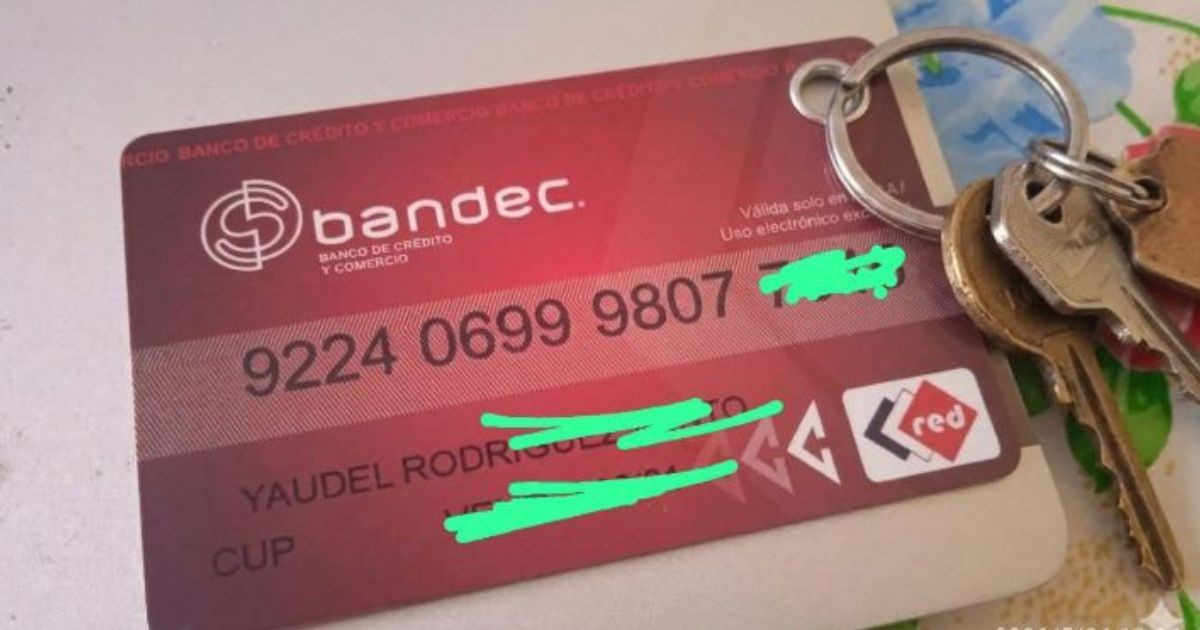
A resident of Unión de Reyes, a municipality in the province of Matanzas, posted a complaint on Facebook that brutally summarizes the failure of banking in Cuba: his salary card is useless to him, so he turned it into a keychain.
Yaudel Rodríguez Vento on his Facebook profile three specific failures that render the policy ineffective: the bank has no cash, establishments do not accept online payments, and when they do accept transfers, they do so "only with exorbitant fees."
This adds a fourth flaw that exacerbates everything: the inspectors responsible for enforcing the regulations "turn a blind eye" to the violations.
"I don't know how it is in other places, but in Unión de Reyes, banking clearly doesn't work," Rodríguez wrote.
The result is a situation that directly impacts the finances of "everyday Cubans": "Workers spend months with their salaries trapped on their cards. Many end up sleeping in the bank's doorways in an attempt to withdraw money the following day."
The Cuban coined the term "EMBARCARIZATION" —a play on words between "bancarization" and "embarcar," which in popular Cuban speech means to not find a solution— to ironically describe the policy.
And he suggested an alternative use for his BANDEC card in Cuban pesos: "Well, I have an idea to use my cards; I suppose I could make a little keychain with them."
In this regard, she shared an image of her card transformed into a keychain.
The complaint is not an isolated case. The Bandec branch in Unión de Reyes operates with the cash it receives every morning, has implemented a ticket system to manage crowd control, and on days with no electricity supply, it serves customers manually, relying on a generator that only works when there is fuel available.
The pattern repeats throughout the province and the country. In Matanzas, businesses saying "today we do not accept transfers", unusable QR codes, and unjustified surcharges are the norm, not the exception.
In Pinar del Río, the banking process has also failed: only between 10% and 12% of around 700,000 monthly transactions were conducted through digital means.
The surcharges for transfers in private businesses reach 10% and even 20% in some provinces, as the suppliers of these businesses also do not accept digital payments, creating a vicious cycle.
The Minister of Economy acknowledged that only about 10% of Cubans hold 60% of the cash circulating outside the banking system.
The government responded with increasingly strict regulatory frameworks, but the gap between the norm and practice persists. The official press acknowledged in April 2026 that banking integration "is not working well."
This week, the Central Bank of Cuba emphasized new "coercive measures" to promote banking services, a clear indication that the policy has not succeeded through voluntary methods.
Rodríguez Vento summed it up with a phrase that could hardly be clearer: "What was presented as a technological advance has become, for too many people, an unbearable nightmare. When earning a salary depends on spending the night in a queue, the problem is no longer digital: it is social."
Filed under: