
Related videos:
Since the USS Nimitz arrived in the Caribbean on May 20 —the same day the Department of Justice filed criminal charges against Raúl Castro— the oldest aircraft carrier in active service of the U.S. Navy has maintained a rigorous diplomatic and military agenda as part of the multinational exercise Southern Seas 2026.
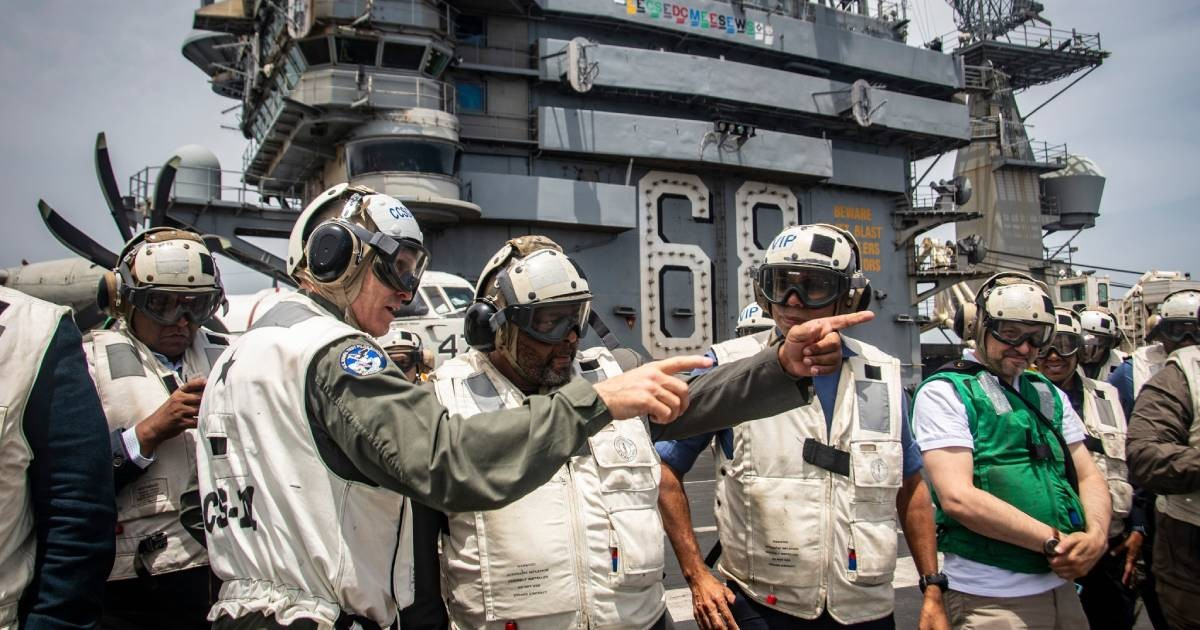
In less than a week, the USS Nimitz (CVN 68) has welcomed aboard delegations from four Caribbean and South American nations, in visits officially presented as opportunities to "strengthen maritime alliances and regional cooperation."
On May 22, the ship hosted distinguished visitors from Suriname for a demonstration of aerial and maritime power. The following day, on May 23, it was Guyana's turn with its president Mohamed Irfaan Ali leading a delegation of government and military leaders. The official post from the ship described the visit as "an opportunity to strengthen the partnership between Guyana and the United States, based on camaraderie, trust, and cooperation at sea."
On Tuesday, May 26, the Nimitz hosted representatives from Trinidad and Tobago while operating in the Caribbean, additionally highlighting the presence of American-Trinidadian sailors on board. This Wednesday, the ship welcomed leaders from Grenada, conveying the message that "opportunities like these foster camaraderie and strengthen the lasting relationships that help promote security and stability in the Caribbean."
All visits are part of Southern Seas 2026, an operation of the U.S. Southern Naval Forces Command and the 4th Fleet aimed at enhancing interoperability and strengthening alliances in the Western Hemisphere.
The deployment does not occur in a vacuum. Trump ruled out on May 21 that the Nimitz would be sent to pressure Cuba: "Not at all. We are going to help them," he stated, describing the island as "a failed country" with no electricity, money, or food.
The arrival of the aircraft carrier in the Caribbean coincided with the federal charges against Raúl Castro for the downing of Brothers to the Rescue planes in 1996. However, the U.S. military outlet Stars and Stripes remarked that "it hardly seemed coincidental that the Pentagon scheduled the arrival of the aircraft carrier in the Caribbean on the same day the Department of Justice announced the charges."
The regional context is highly tense. Since January 2026, the Trump administration has imposed over 240 sanctions against Cuba and intercepted at least seven tankers carrying oil destined for the island, which has reduced Cuba's energy imports by between 80% and 90% and caused blackouts lasting up to 25 hours a day in more than 55% of the territory. On May 17, Axios reported that Cuba may have acquired more than 300 military drones from Russia and Iran, with discussions about potential uses against the Guantanamo Naval Base and Key West.
The Nimitz thus completes the final stage of its circumnavigation of South America—stopping in Ecuador, Chile, Argentina, Brazil, and Panama—before heading to its new home port at Naval Station Norfolk, Virginia.
According to Stars and Stripes, the U.S. Navy has extended the active service of the Nimitz until at least March 2027 to align with the commissioning of the USS John F. Kennedy, the second aircraft carrier of the Gerald R. Ford class.
Filed under: