
Related videos:
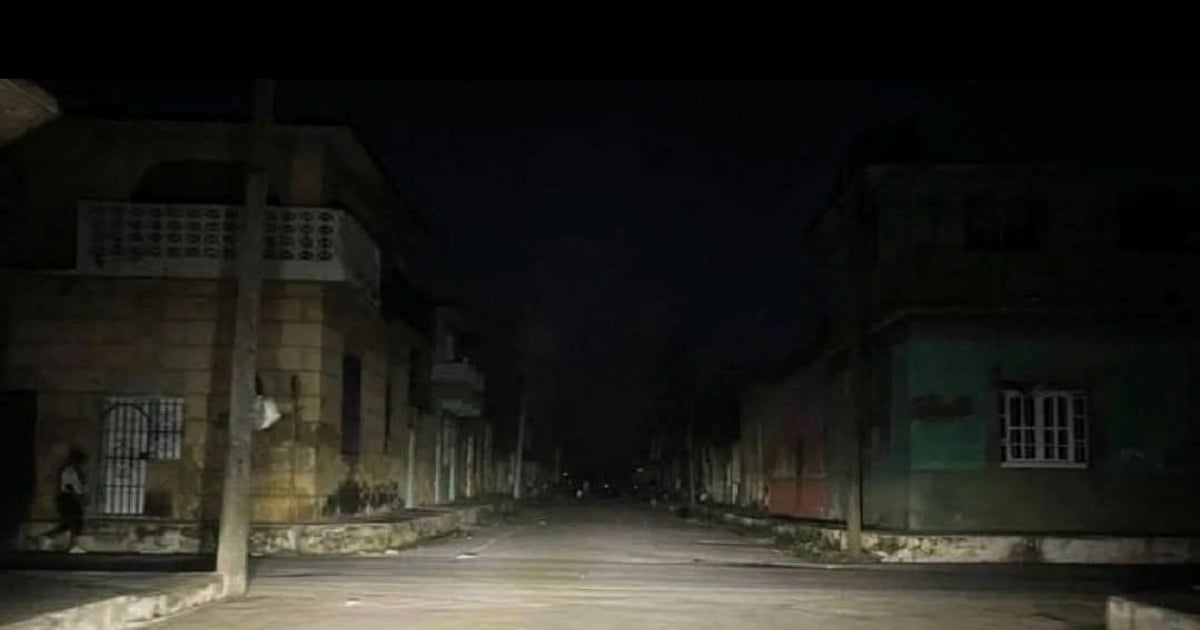
The director of the office at Empresa Eléctrica de Santiago de Cuba, Lester Salvador Cedeño, publicly admitted that power outages in the province exceed 20 hours a day and that in many cases it is not possible to guarantee the two hours of electricity promised to the population, according to statements reported by the state newspaper Sierra Maestra in its PDF edition.
Cedeño appeared on the state broadcaster CMKC to explain the situation of the provincial electric power system, acknowledging a crisis that the regime has tried to downplay for months.
"As has been explained in recent days, the situation of the electricity generation system has been quite complex, as it has been down for all this time due to the breakdown of several units, primarily the unit at the Antonio Guiteras Thermoelectric Plant, which complicates the situation regarding generation; as well as the Renté unit," stated the official.
According to Cedeño, the Antonio Guiteras Thermoelectric Plant —located in Matanzas and one of the most powerful plants in the country— was out of service for several days due to a malfunction, although at the time of his statement it had re-entered the system generating approximately 200 megawatts.
"At this moment, Guiteras is back online and generating, now at approximately 200 megawatts, which improves the situation a bit," he noted.
However, the official was emphatic in describing what residents of Santiago receive: there is no possibility of normal service rotation, and priority is given to circuits with the longest accumulated blackout time.
"The population should be aware that no rotation is possible; what is happening is that approximately two hours of service are being provided, taking into account the duration of the outage. If the circuit has already been affected for 15, 16, or 20 hours, those with the longest outages are given about two to three hours of service," he explained.
The reality, he admitted, is even worse: "Many times we can't even provide two hours of service; what we've been offering is an hour and 30 minutes or an hour and 45 minutes due to the condition of the system."
The breakdowns at Guiteras and the CTE Renté —the main thermoelectric plant in the eastern region— are compounded by the fact that the Moa motors are out of service and that no distributed generation unit is contributing to the national electric grid.
"On the other hand, the Moa Motors are out of service; in the case of distributed generation, there is none contributing to the country's electrical system, which further complicates the situation and leads to prolonged blackouts," Cedeño concluded.
The crisis in Santiago de Cuba is not new. In March, the provincial Electric Company had already acknowledged blackouts lasting 24 hours and a service restoration of just two hours.
On May 16, the municipality of Songo-La Maya experienced over 50 consecutive hours without electricity, and on May 18, protests with pots and pans were reported in Santiago de Cuba and other areas of the country in response to public frustration.
Nationwide, on May 14, a record deficit of 2,174 megawatts was recorded, with only 976 MW available against a demand of 3,150 MW.
The Guiteras Thermoelectric Plant, for its part, went offline again on May 30 —just two days after being reconnected— accumulating at least nine or ten breakdowns so far in 2026, making it the most eloquent symbol of the energy collapse that Cuba suffers after 67 years of dictatorship.
Filed under: