
Related videos:
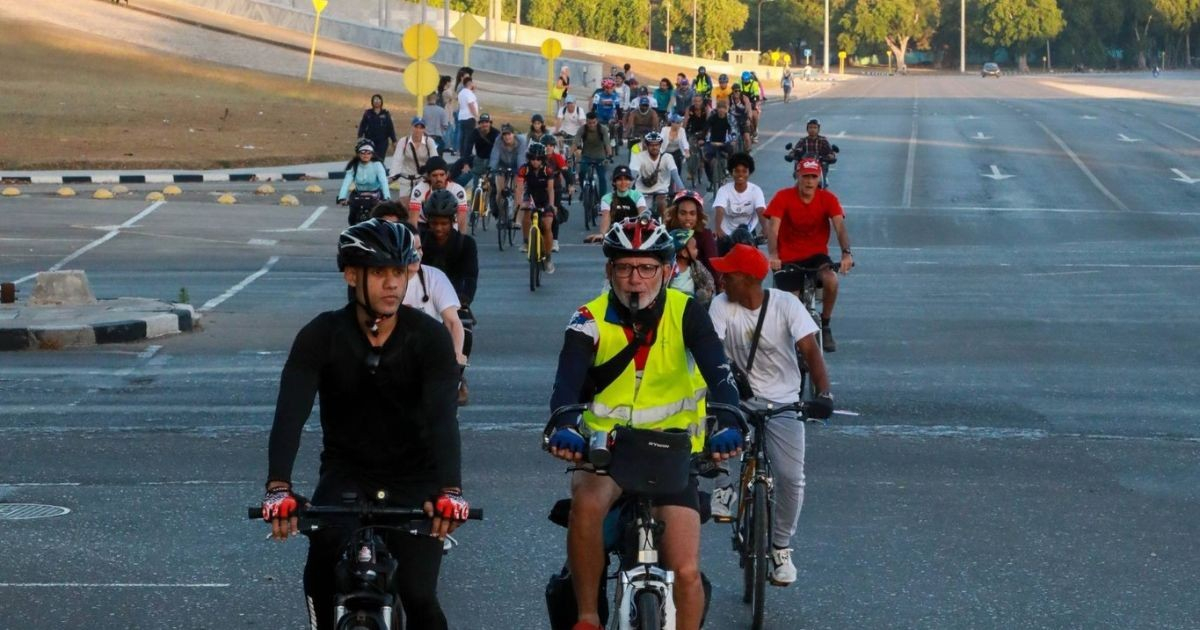
This Sunday, while much of Cuba endures power outages of up to 20 hours a day, 95 students, workers, agents from the Ministry of the Interior, and military personnel from the Revolutionary Armed Forces will be cycling from Parque Martí to Rancho Luna Beach in Cienfuegos, in what the regime solemnly refers to as the Great Bicycle Event 95-Raúl, in honor of the 95th birthday of Army General Raúl Castro.
The number of participants is no coincidence: precisely one for each year of life of the man who ruled Cuba for over a decade, led its army for more than half a century, and whose shadow continues to loom over the Island. This symbolic figure was chosen with the propaganda precision that characterizes these events. In this case, the organization responsible is the Union of Young Communists (UJC) in the province.
Anisley Cordero González, first secretary of the UJC in the territory, described the day as "one of patriotism, joy, and revolutionary reaffirmation." She also clarified that the bicycle ride has an explicit political purpose: to firmly reject "the recent maneuvers and information from the U.S. government against her figure and legacy," reported the newspaper 5 de Septiembre.
The trigger for this official indignation is the federal criminal charge declassified on May 20 by the U.S. Department of Justice against Raúl Castro and five former Cuban military personnel for the shooting down of two planes belonging to Brothers to the Rescue on February 24, 1996, and the deaths of four Cuban Americans: Armando Alejandre Jr., Carlos Costa, Mario de la Peña, and Pablo Morales.
The regime's response was swift. On May 22, President Miguel Díaz-Canel led an event in front of the United States Embassy in Havana in defense of the accused, although Raúl Castro himself was notably absent. Since then, there has been a multiplication of anti-imperialist open forums throughout the country under the redundant slogan "Raúl is Raúl," with events reported in provinces such as: Artemisa, Villa Clara, Pinar del Río, Camagüey, and now Cienfuegos.
Today's bike ride is not the first of the season. In April, the UJC already organized a 230 km journey to Playa Girón to commemorate the 65th anniversary of the Bay of Pigs battle, with nearly 200 young people from Havana, Matanzas, and Cienfuegos. The national first secretary of the UJC, Meyvis Estévez, enthusiastically summarized it back then: "Without oil, we’re going by bike. Fortunately, we are a bit crazy."
The issue of oil is significant. This Sunday, the Electric Union reported a mere 1,113 MW availability against a demand of 2,720 MW, with a projected deficit for the nighttime peak of over 2,042 MW. The company itself acknowledged that the country could experience less than two hours of electrical service in some areas. In Santiago de Cuba, power outages exceed 20 hours a day; in Havana, they have reached 19 hours at some points in May.
Meanwhile, the UJC calls on young people to record videos and write poems under the hashtag #95DeRaúl, in an organization that has lost nearly 200,000 members between 2007 and 2024, decreasing from 609,000 to 415,000 members. The generational disillusionment is inversely proportional to the fervor displayed by its leaders at official events.
The propaganda agenda continues: on Monday, June 1st, at 7:30 in the morning, the "Cienfuegos youth vanguard" will be at the Open Forum "Raúl is Raúl" in front of the 5 de Septiembre Secondary School, near José Martí Park. And on June 3rd, the day the former dictator turns 95, the festival "Cuba is my country" will take place across all eight municipalities of the province, with activities in parks and plazas.
A full display to celebrate the man who, according to the U.S. federal indictment, ordered the downing of civilian aircraft three decades ago and has been, along with his brother Fidel, a key architect of decades of oppression against the Cuban people. The bicycles roll; the light, on the other hand, does not arrive.
Filed under: