
Related videos:
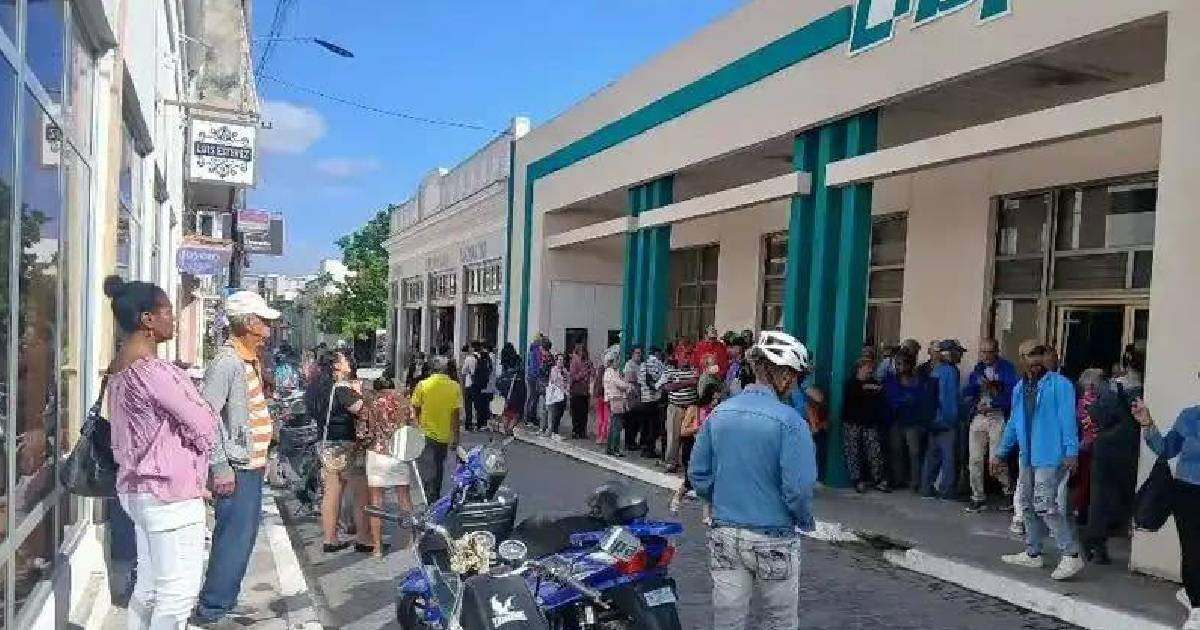
An image posted this Saturday in the Facebook group La Voz de Cueto shows a long line of people in front of what appears to be a bank branch on a cobbled street with a colonial style, encapsulating in a single frame the ordeal that millions of Cubans experience each month just to access their own money.
The reflection accompanying the image, written by the user Luis G Williams in that group, directly points to the regime as responsible for turning a daily and fundamental act into a frustrating obstacle course.
“The lines at the banks don’t exist because the storekeeper, the farmer, or the private vendor refuse to accept a transfer. They exist because thousands of people have money in an account and still face difficulties withdrawing it when they need it,” he wrote.
The text indicates that "if a person sells a product and prefers to be paid in cash, it is generally not to harm anyone. They do it because they need money that can be used immediately to restock merchandise, pay for transportation, cover expenses, or simply to access their own resources without relying on the availability of cash in a bank."
In this regard, he noted that the seller did not create the cash shortage, but rather "is simply trying to protect himself and survive in an environment where, for too many people, withdrawing their own money has become an odyssey."
"If you want to find those responsible, look at those who manage the economy and pay salaries in an electronic currency that often lacks sufficient cash backing to meet the population's demand," pronounced Williams.
Cubans on social media do not hide their frustration. "This happens all over Cuba, and the government is unable to solve it when they themselves created this," wrote a citizen in the comments. "The people are the only victims of their decisions, which only exist on paper," they added.
Citizen feedback is not exaggerated. Less than 10% of private businesses in Sancti Spíritus accept transfers as a regular payment method, according to a recent survey by Radio Sancti Spíritus.
At the La Lisa fair, in El Cotorro, and at the businesses in Mónaco in La Víbora, citizens reported this weekend that no establishment was accepting transfers.
On Saturday, a resident of the Havana municipality of Playa spent the entire morning searching for mipymes that accepted transfers to buy meats, eggs, and sausages, and returned empty-handed.
"Not because there isn't all that and much more, but because I didn't find a micro, small, or medium-sized enterprise that accepted transfers," she reported.
"It is outrageous that you have to eat rice and beans plain because if you don't have cash, you're out of luck, all because of some dehumanized individuals who only care about getting rich at the expense of the people," he added.
The pattern repeats across the country. In Holguín, dozens of retirees line up from five in the morning each month to collect pensions ranging from 3,056 to 4,000 pesos, which is equivalent to less than 10 dollars.
In April, there were pushes and chaos outside a bank branch in the Pan-American Village in Havana, with retirees struggling to get inside.
In Santiago de Cuba, the police detained individuals weeks ago who charged between 35% and 50% in commission for converting transfers into cash.
The banking policy, launched by the Central Bank of Cuba (BCC) in August 2023 through Resolution 111/2023, established a limit of 5,000 pesos per cash transaction and required all economic actors to accept electronic payments.
Three years later, the failure is acknowledged even by officials of the regime itself.
Ian Pedro Carbonell Karel, director of macroeconomic policies at the BCC, publicly admitted in May that "if electronic payment is not easier or faster than paying in cash, of course it will not gain traction."
The official digital portal Cubadebate acknowledged in April that "cash remains the unquestionable king of everyday economics" and that illegal surcharges for electronic payments can reach up to 20% in some provinces.
The vicious cycle is structural, as businesses do not accept transfers because their suppliers do not accept them either; suppliers do not accept them because the system does not guarantee connectivity or immediacy; and the inspectors who should enforce the regulations, according to citizen testimonies, "turn a blind eye to line their pockets."
Meanwhile, over 1.7 million retired Cubans, the majority without smartphones, continue to face the same scenario each month: an endless line, an ATM without cash, and the certainty that the system was not designed to serve them.
Filed under: