
Related videos:
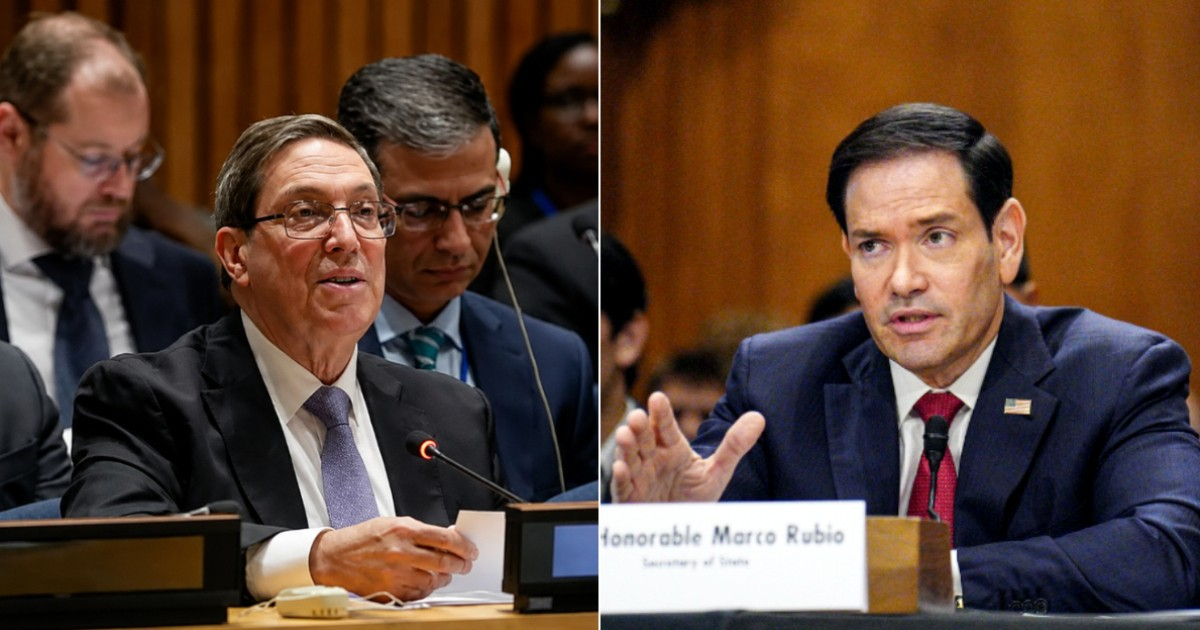
The Cuban Foreign Minister Bruno Rodríguez Parrilla responded this Monday to the U.S. Secretary of State, Marco Rubio, defending Cuba's role in the Colombian peace process and suggesting that he read the book 'La Paz en Colombia' by "Commander in Chief Fidel Castro Ruz."
The response comes days after Rubio described Cuba as “the world capital of radical leftist terrorism” and announced, last Wednesday, sanctions against five Cuban entities: the Ministry of the Revolutionary Armed Forces (MINFAR), the Cuban Institute of Friendship with the Peoples (ICAP), the Committees for the Defense of the Revolution (CDR), Amistur Cuba S.A., and Minera La Victoria S.A.
That same day, Miguel Díaz-Canel, his wife Lis Cuesta Peraza, and Alejandro Castro Espín were added to the Specially Designated Nationals List of the Department of the Treasury.
In his post on X, Rodríguez Parrilla stated that Rubio "should be aware of Cuba's long-standing, ongoing, and acknowledged commitment to the peace process in Colombia" and invoked the "principle of non-interference in the internal affairs of any nation, which is little understood in the U.S. government."
The chancellor cited the formal negotiations held in Havana between 2012 and 2016 between the Colombian government and the FARC-EP, which culminated in the 2016 Peace Agreement, as evidence of Cuba's role as a guarantor and venue for dialogues.
What Rodríguez omits is that the very book he recommends contradicts his central argument.
La Paz in Colombia, published by Fidel Castro in 2008, documents decades of direct relations between Havana and the FARC, including lengthy conversations between Fidel and guerrilla leaders like Manuel Marulanda Vélez and Jacobo Arenas.
Castro himself acknowledged that the book was the result of more than 400 hours of work and that it "reveals for the first time" documents, interviews, and experiences regarding the Colombian conflict, which demonstrates the depth of the connection between the regime and the guerrilla.
History records two distinct stages in Cuba's relationship with Colombian guerrillas.
During the Cold War, Fidel Castro's regime provided political, ideological, logistical, and training support to Latin American insurgent movements, with the ELN being the Colombian guerrilla group that had the closest ties to the island: some of its founders received political and ideological training in Cuba.
In a second phase, starting from the 1990s, Havana began to play a role as a facilitator in negotiation processes. The process has remained turbulent and controversial: in 2022, the ELN delegation withdrew from Cuba, and in 2019, Colombia requested information from Havana about the presence of ELN members on its territory, generating diplomatic tension.
The escalation of U.S. pressure on Cuba began on January 29, 2026, with Trump's Executive Order 14380, which declared a national emergency concerning the island. It was expanded on May 1 with the Executive Order 14404, which extended the sanctions framework to sectors such as energy, defense, metals, mining, and financial services.
Rubio was emphatic in justifying the measures: “The regime in Havana has recruited, trained, and supported violent Marxist and Third World movements throughout the hemisphere and beyond.”
Filed under: