
Related videos:
The head of the Western Army of Cuba, Major General Ernest Feijóo Eiró, assured this Thursday that the troops under his command will remain "firm in our combat positions" in the face of what he described as a "serious threat of aggression to the Homeland," in a speech marked by the rising tensions between Havana and Washington.
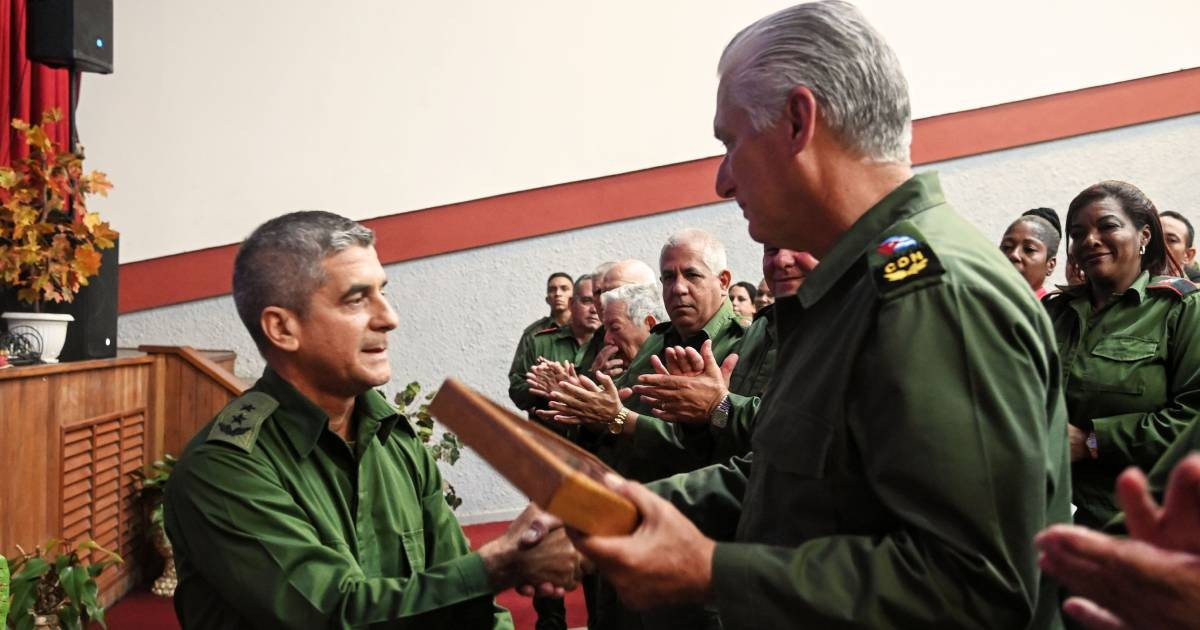
The statements were made during the ceremony for the 65th anniversary of the Western Army, held in the presence of Miguel Díaz-Canel and the Minister of the Revolutionary Armed Forces (FAR), Army Corps General Álvaro López Miera, as reported by the Presidency of Cuba on its social media.
"We will confront any plans that seek to undermine our determination to be free and independent," stated Feijóo Eiró before officials and troops of one of the main military structures of the country.
Although the event was officially dedicated to commemorating the founding of the Western Army, the remarks from the top leadership were marked by the current political and military confrontation between Cuba and the United States.
The ceremony also included a congratulatory message sent by Army General Raúl Castro, as well as tributes to the commander of the Revolution, Guillermo García Frías, who is regarded as the founding leader of that military structure. Medals and honors were also awarded to distinguished officers and fighters, while several military personnel were promoted to higher ranks.
The Western Army was created in June 1961 by Fidel Castro with the mission of defending the western region of the country, where strategic facilities such as the port of Mariel, important military bases, and the Cuban capital are concentrated.
Feijóo Eiró's statements come at a particularly sensitive time for the relations between both countries.
On Wednesday, the U.S. Secretary of War, Pete Hegseth, stated from Tampa that a potential operation to capture or eliminate Miguel Díaz-Canel "remains an option on the table," a statement that further escalated the tone of exchanges between Washington and Havana.
Hegseth had visited the Guantanamo Naval Base, where he presented the so-called "Donroe Doctrine," an update to the historic Monroe Doctrine, and warned that Cuba should not attempt to develop or acquire military capabilities that could threaten U.S. facilities.
During that visit, the U.S. official also recalled the capture of Nicolás Maduro in Venezuela as an example of the operational capability of the United States to act against governments deemed hostile.
The escalation of tensions has intensified in recent months. In May, reports emerged suggesting a supposed acquisition by Cuba of more than 300 military drones from Russia and Iran since 2023, claims that were later denied by Moscow.
In response, the administration of Donald Trump ordered the deployment of the USS Nimitz aircraft carrier in the Caribbean, a decision interpreted by analysts as a show of force in the region.
In parallel, the Cuban government has reinforced its military preparedness rhetoric. Since the beginning of the year, it has declared 2026 as the "Year of Defense Preparation" and has promoted periodic training under the doctrine of the so-called "War of the Entire People".
At the end of May, the Western Army itself released images of military exercises conducted in the Mariel area, including maneuvers by coastal rocket units and specialized combat diving forces.
Díaz-Canel has also intensified the tone of his statements in recent weeks. The leader warned in May that a potential military aggression from the United States would lead to "a bloodbath with incalculable consequences" and subsequently claimed that Washington is considering different scenarios to increase pressure on Cuba.
In that context, the message conveyed during the anniversary of the Western Army reinforces the official narrative of preparedness and resistance promoted by the Cuban authorities in the face of what they perceive as a growing external threat.
The military structure will officially celebrate its 65th anniversary on June 14, a date that the FAR considers a milestone within the country's defense organization.
Filed under: