
Related videos:
"We are not renouncing socialism".
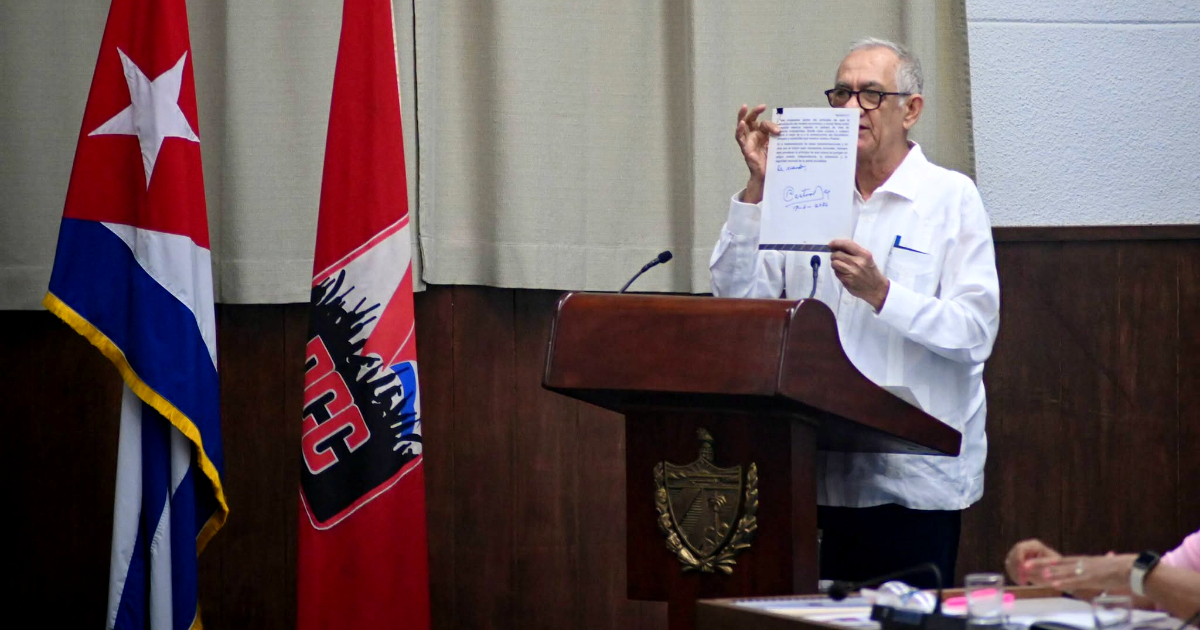
Miguel Díaz-Canel stated it twice before the National Assembly of People's Power, right after the regime approved a package of economic reforms that includes measures difficult to reconcile with the old Cuban socialist imagination.
Private banking, private currency exchange houses, foreign investment in the non-state sector, the flexibilization of small and medium-sized enterprises (Mipymes), the elimination of general price caps, and the conversion of state-owned enterprises into joint-stock companies are some of the 176 measures recently approved by the regime.
The insistence was not casual. Díaz-Canel was not merely explaining an economic reform. He was attempting to protect the political legitimacy of a system that for decades has built its authority on the non-negotiable nature of socialism.
The problem is that the regime itself turned that principle into a straitjacket.
A Constitution for Protection
The Cuban Constitution of 2019 was not drafted as an open letter to political alternation or to the democratic revision of the country's model. It was designed to enshrine "continuity."
The text states that Cuba is a socialist state based on the rule of law and social justice, but it also declares the socialist system to be irrevocable.
It also recognizes the Communist Party of Cuba as the "highest guiding political force of society and the State", a formula that constitutionalizes the political monopoly of the PCC and excludes any real competition for power.
It is not a legal detail. This constitutional architecture serves an obvious political function: to prevent the model from being replaced through conventional democratic dynamics.
The so-called "Cuban revolution" fortified itself.
Socialism has transformed not into a political option subject to public debate, but into a permanent condition of the State. And the Communist Party ceased to be one party among others and instead attained a constitutionally superior position.
In other words, Castroism turned its ideology into the supreme norm.
The permanent revolution
For decades, that shield was presented as a historical guarantee.
The argument was well-known: the Revolution had to be preserved against its internal and external enemies; socialism was an inalienable conquest; the Communist Party represented the continuity of the process initiated in 1959.
The 2019 Constitution carried this logic to its ultimate consequences. It not only protected the regime from political alternation, but it also made any substantial change in the model a constitutional issue.
That was precisely the objective: to prevent a transition. To avoid that a citizen majority, a legitimacy crisis, or a generational change could pave the way for another political and economic system.
The Constitution was conceived as a wall. But now that wall is starting to work against the needs of the regime itself.
The shot in the foot
The paradox is evident. The power that shielded socialism as irreversible now faces an economy that seems to force it to introduce mechanisms associated with the market economy.
The government needs to attract capital, relax regulations, widen the private sector, permit non-state financial institutions, and encourage business models that for decades have been viewed with suspicion by revolutionary orthodoxy.
But it cannot admit that this represents a shift towards capitalism. It cannot say so for ideological reasons. It cannot say so for political reasons. And it also cannot say so for constitutional reasons.
Recognizing a model transition would call into question the very core of the legality that the regime designed to perpetuate itself. That's why Díaz-Canel repeats: "We are not renouncing socialism."
The phrase functions not so much as a description of economic reality but as a political containment operation.
The twists of language
The regime has developed over the years a vocabulary aimed at managing that contradiction.
It does not speak of transition. It speaks of "updating." It does not speak of capitalism. It speaks of "perfecting socialism." It does not speak of the market. It speaks of "Cuban-style socialism." It does not speak of abandoning a model. It speaks of studying "experiences of socialist construction in other countries."
The reference to those experiences is not innocent.
China and Vietnam have served for years as examples of single-party regimes that incorporated extensive market mechanisms without formally relinquishing communist political control.
That seems to be the subterfuge that Havana aspires to: to adopt capitalist economic tools without acknowledging a break from socialism, to maintain the monopoly on power, and to present change as an internal evolution of the same system.
But the more those reforms expand, the more the meaning of the word socialism stretches. And there comes a point where the question becomes unavoidable: how much can a system change before the name it retains no longer describes what it really is?
The legitimacy at stake
Díaz-Canel's insistence reveals a deeper concern. The regime not only needs the reforms to work. It needs them not to undermine the narrative that has justified its hold on power for 67 years.
For decades, Castroism called for sacrifices in the name of socialism. It restricted economic freedoms in the name of socialism. It excluded political competition in the name of socialism. It condemned the market, private enterprise, and the accumulation of wealth in the name of socialism. And in the name of socialism, it repressed, imprisoned, stigmatized, and divided the Cuban people.
Now, in the face of a deep economic crisis, it resorts to practices and language that for years it identified with the ideological adversary. The contradiction is too great to be resolved with a single phrase.
That's why she repeats it: "We are not renouncing socialism."
The repetition seeks to close a gap that the official discourse itself has opened.
The problem is not just economic
The fundamental question is not whether Cuba will continue to be called socialist.
As long as the Constitution maintains the political monopoly of the Communist Party and the irreversible nature of the system, the regime will remain obligated to present itself in that manner.
The real question is a different one.
What legitimacy does a power that for decades declared an irreplaceable model, sacrificed generations in the name of that model, and now needs to incorporate elements that it previously presented as incompatible with its principles, retain?
Castrism built a Constitution to prevent the country from escaping its foundational narrative. However, the economic crisis now forces it to twist that narrative until it becomes almost unrecognizable.
That is the trap. Irreversible socialism was conceived as a guarantee of permanence. Today, it is starting to become a problem for those who need to change without admitting that they are changing.
Filed under: