
Related videos:
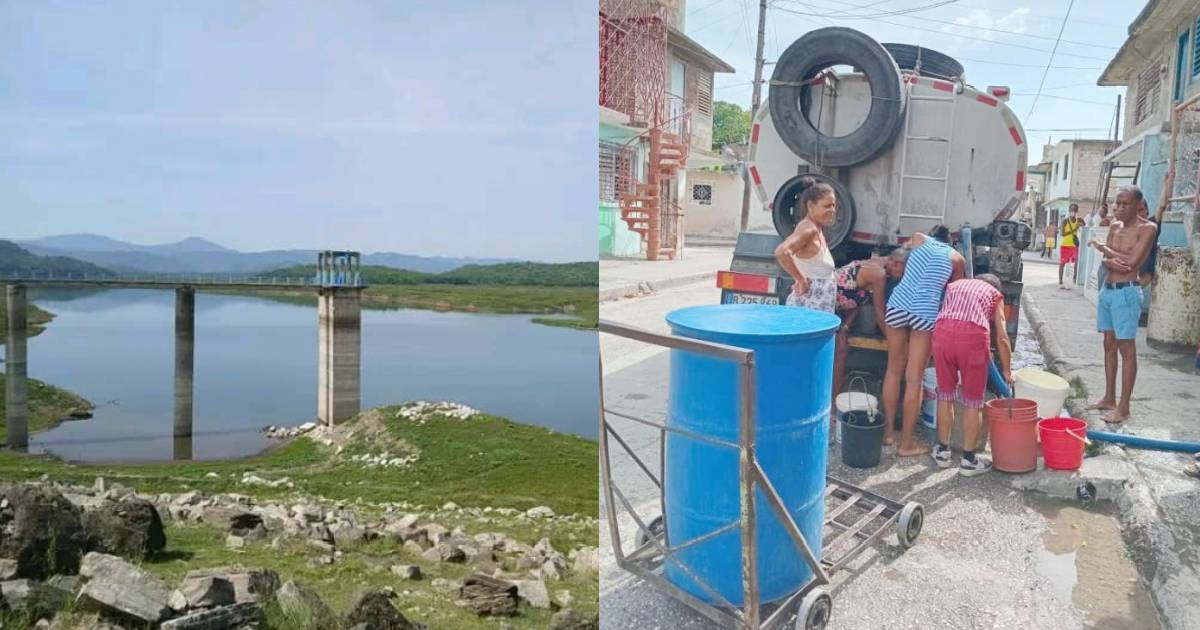
The energy crisis has brought water supply in Santiago de Cuba to critical levels, with some areas of the city going between 39 and 48 days without receiving the service, acknowledged this Saturday Orlando Romero Veranes, director of engineering at the state company Agua Santiago.
In statements to the official newspaper Sierra Maestra, Romero admitted that the direct cause of the collapse is the inability to operate the pumping stations with only two or three hours of electricity available each day, which halts the supply to the neighborhoods that rely on these systems.
"At Altamira, the circuits have been receiving service for over 30 and 40 days; the situation in the El Cristo area is particularly critical, with some circuits having gone 39 and 48 days without service. The electrical outages are related to the pumping station," he confirmed.
The San Juan-Sevilla sector is facing a similarly serious situation: "There are areas or hydrometric circuits that have exceeded 40 days. There have been unstable operations due to obstructions that have been addressed, but the most significant issues have been caused by electrical failures," the official noted.
In that same sector, the theft of oil from transformers forces operations to rely on just one pumping unit, resulting in cycles of over 15 days in the 30 de Noviembre distribution and more than 18 days along the coast.
The areas of La Socapa and Cayo Caracoles receive water through arrangements with Navegación Caribe, which transports fuel in trucks to operate the pumping.
The Quintero system, which supplies most of the city, receives 98% of the planned water from the reservoirs, but can only operate by gravity in two of them, as the others require electric pumping that cannot be reliably guaranteed.
The sectors supplied by gravity have seen their cycles extend from 10-12 days to 10-14 days, he noted.
The Santa María route experiences cycles of 20 to 30 days for buildings reliant on pumping systems. The Republic has been without a functioning pumping unit for over four months and is being supported by external tanker trucks. El Cobre, in the Loma del Burro circuit, has gone 22 days without service.
The Parada system also adds mechanical failures in bearings and equipment, affecting the Mar Verde, Polipalos, La Loma, and La Candela roads, among other circuits.
This situation is neither new nor isolated. In March, Santiago reported 50 non-operational supply systems and fecal contamination in the water, affecting 180,000 people.
In December 2025, municipalities served by Aguas Turquino had accumulated over 100 days without service via the network despite having full reservoirs, highlighting that the issue is not with reserves but with pumping capacity.
The collapse is a result of decades of underinvestment and the structural deterioration of the National Electric System (SEN). At the national level, 87% of aqueducts depend on the SEN, the water system operates with only 37% of the necessary fuel, and nearly 2.7 million Cubans lack regular access to drinking water.
The informal market has established itself as the only option for many, where private water trucks are sold for between 7,000 and 15,000 Cuban pesos in a city where the average salary is not enough to meet that basic need.
The only improvement perspective mentioned by Romero Veranes is the installation of solar pumps for motors up to 20 kW, a project that is still in the land assessment phase alongside the company Inotu, with no confirmed dates or funding.
Filed under: