
Related videos:
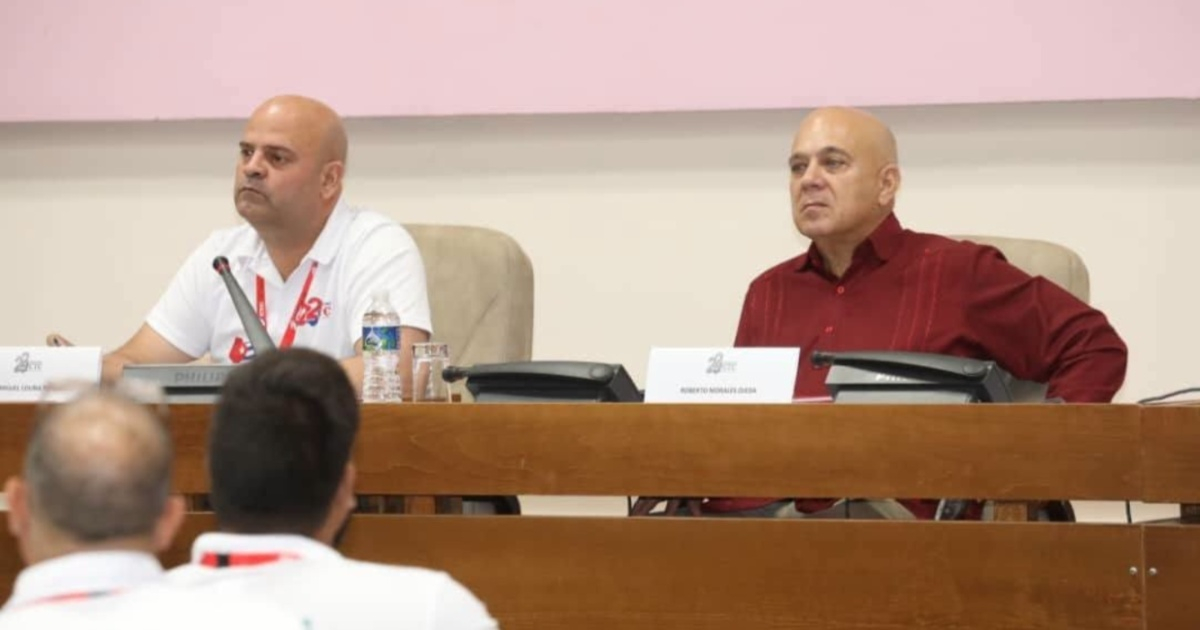
Roberto Morales Ojeda, a member of the Political Bureau of the Communist Party of Cuba, stated this Saturday that the XXII Congress of the Cuban Workers' Central (CTC) was conducted "with transparency and commitment," as published on his personal Facebook account upon concluding the sessions of the workers' conference held in Havana.
The congress, which met on Friday and Saturday under the slogan "For Cuba, Together We Create," gathered 759 delegates: 198 physically present at the Convention Palace in Havana and 561 connected via videoconference from the 15 provinces of the country, in a hybrid format that the regime itself attributed to the "current circumstances" of the country.
Miguel Díaz-Canel presided over the event, which was also attended by Vice President Salvador Valdés Mesa and former second secretary of the PCC José Ramón Machado Ventura.
The sessions were described as "tight, austere, and rational," a characterization that reflects the deep economic crisis currently affecting Cuba, with prolonged blackouts, widespread shortages, and a projected GDP decline of 6.5% for 2026, the worst in Latin America for the second consecutive year, according to ECLAC.
Among the central themes of the debate were the wage deterioration caused by inflation, the situation of workers who had to change careers due to energy difficulties, and the so-called "union democracy."
The non-state management was also critically analyzed, a sector that now encompasses over 50% of workers in areas such as transportation, commerce, construction, industries, and communications.
Morales Ojeda wrote that there was a discussion about "the active role of the labor movement in the approved transformations to strengthen the economy and generate results that allow us to advance and overcome the difficult moment the country is experiencing," although he attributed the crisis to the U.S. embargo, following the regime's usual narrative.
The congress is part of the package of 176 economic transformations that the regime approved on June 18, which includes opening up to foreign investment in private businesses, the establishment of private banking, and the removal of the cap of 100 workers for small and medium-sized enterprises.
Díaz-Canel arrived at the conclave with the message that workers must "create wealth" in what he himself defined as a "war economy."
The CTC is the only labor organization allowed in Cuba, subordinate to the Communist Party.
The new Labor Code, consulted with over two million workers in 2025, does not recognize the right to strike or allow independent unions, making any reference to "trade union democracy" a contradiction with the actual structure of the Cuban labor system.
For this Saturday, the election of the new national secretariat of the CTC was also scheduled, an organization that has been led by Osnay Miguel Colina Rodríguez since July 2025, who was appointed after the dismissal of Ulises Guilarte, who had been at the helm of the labor union for 12 years.
Filed under: