
Related videos:
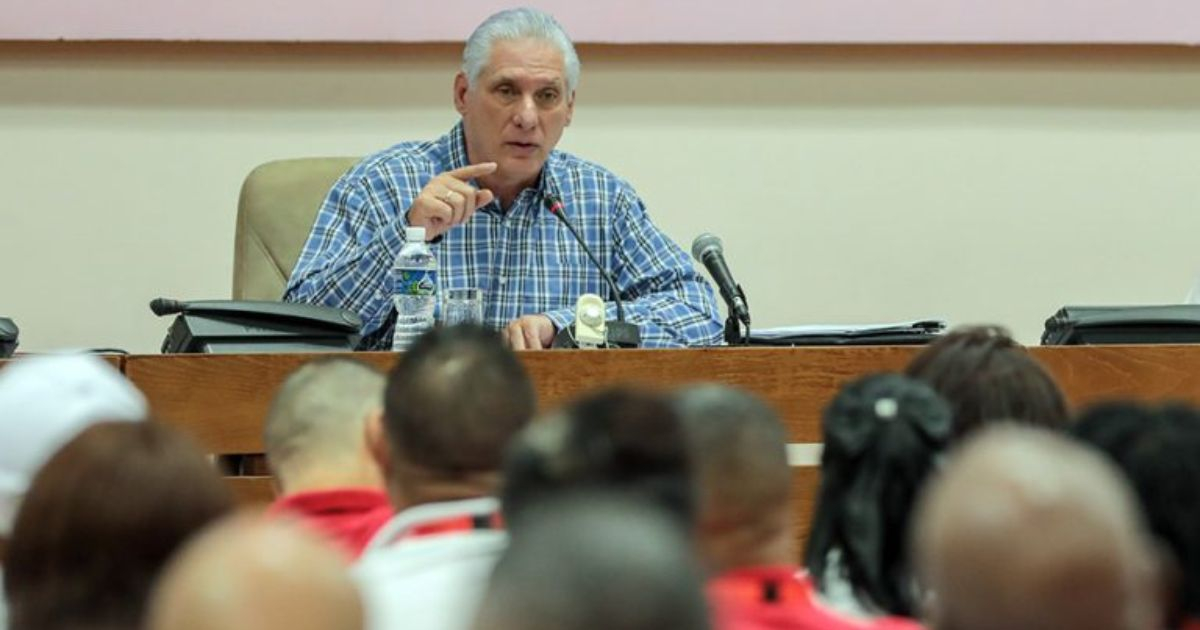
The Cuban president Miguel Díaz-Canel addressed the XXII Congress of the Cuban Workers' Central (CTC) this Friday to advocate for the package of 176 economic transformations approved on June 18. Among his key messages, he asserted that the reforms do not respond to any external pressure and that the most vulnerable sectors will not be neglected by these changes. Reassuring words spoken before union delegates from a country where 89% of the population lives in extreme poverty.
According to the official source Cubadebate, which covered the intervention, the president opened his speech with an extensive denunciation of the U.S. embargo, which he termed "the longest in history," and described the current situation as a "war economy." However, the daily reality of Cubans demands something more urgent than creativity: food.
Regarding the authorship of the reforms, Díaz-Canel was unequivocal: "We are doing this to improve ourselves, to move forward, to overcome this blockade, to shatter the idea that the empire has that they are going to bring us to our knees." He insisted that no one imposed these reforms from the outside. The fact that the Trump administration signed Executive Order 14380 on January 29, 2026—declaring an energy blockade against Cuba and causing power outages of more than twenty hours daily—and Executive Order 14404 on May 1, which internationalized the secondary sanctions, are apparently mere chronological coincidences.
The U.S. State Department had already classified the 176 measures approved by the regime as "superficial smoke signals." Díaz-Canel, on the other hand, presented them as the result of an extended popular debate and a sovereign decision: "It had to be done to save the Revolution, to continue the socialist construction," he stated, without clarifying which revolution he is referring to in a country where domestic food production has declined by 67% in five years.
The leader placed special emphasis on refuting the claim that the poorest would be excluded from the distribution of benefits. "In all transformations, everything that is implemented must have a focus on the most vulnerable sectors, taking into account retirees. What we are seeking is benefit, not to increase inequality, but rather to eliminate it," he stated. This is a reassuring promise for Cuban retirees, whose pensions amount to 3,300 pesos per month—less than seven dollars—while a box of 30 eggs in the private market costs 3,600 pesos: more than what a retiree earns in an entire month.
In light of that reality, Díaz-Canel rhetorically asked, “Isn’t that socialism? To seek human solidarity, to seek community solidarity.” The answer, for millions of Cubans who have gone for years without seeing that solidarity materialized in a plate of food, is likely a different one.
In terms of food, the leader emphasized local self-production and called for abandoning the mindset of waiting for external solutions: "The main food we eat is what we are capable of producing, participating from the municipality and the community. With or without fuel." A statement that, when read in the context of the blackouts that prompted the early closure of the school year due to lack of fuel, takes on an almost epic and surreal tone.
Regarding education, Díaz-Canel presented it as an unblemished achievement: "We have made a tremendous effort not to close the school year amidst our situation. That is social justice." What he omitted is that the 2025-2026 school year started with a shortage of thousands of teachers, that the academic year was moved up due to a lack of fuel, and that the elimination of university entrance exams was not an act of generosity but a response to the logistical collapse of the system.
The leader also urged workers to take an active role in the implementation, warning that "without the active participation of workers, the recently approved economic and social transformations will not achieve the results the country desires." This is an added burden for Cubans who earn average salaries equivalent to about 7,000 pesos per month in a country where the basic cost of living exceeds 96,000 pesos per month.
The CEPAL projects a decline in Cuban GDP of 6.5% in 2026, the worst in Latin America for the second consecutive year, while economist Pedro Monreal warns that the collapse could reach 15%. In light of this situation, Díaz-Canel concluded with the usual promise: "We are not just enduring; we are creatively resisting. The country will advance, and in addition to that, we will prevail."
Filed under: