
Related videos:
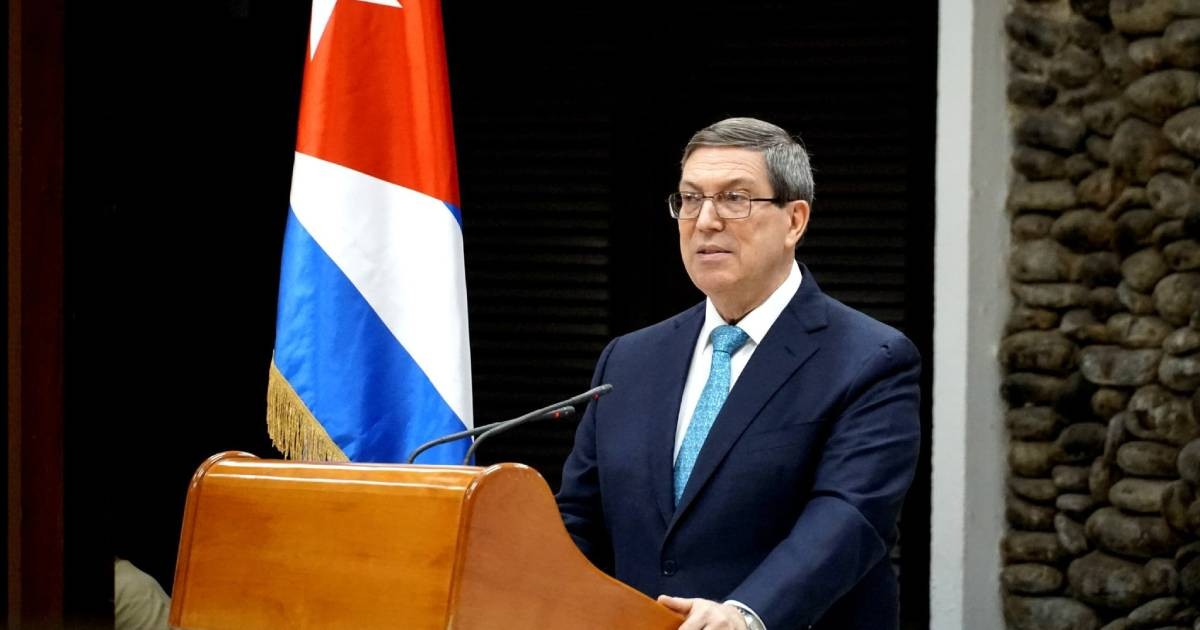
Cuban Foreign Minister Bruno Rodríguez Parrilla announced on Tuesday that Havana has formally requested the convocation of an extraordinary session of the United Nations General Assembly for next July 7, with the aim of denouncing the tightening of sanctions imposed by the United States against the island.
According to information provided by the Minister of Foreign Affairs himself on his X account, the meeting will be held under Agenda Item 38 of the UN, titled "The Need to End the Economic, Commercial, and Financial Blockade Imposed by the United States of America Against Cuba."
Rodríguez stated that the session will allow for denouncing what he termed "the aggressive actions of the United States government," including "the threat and real possibility of military aggression, the energy blockade, and other measures of extreme reinforcement" of the embargo.
The Cuban government claims that the U.S. sanctions constitute "an act of genocide, of collective punishment" and a "flagrant and systematic violation of the human rights of Cubans and of International Humanitarian Law."
Minutes after announcing the call, the chancellor also accused Washington of trying to prevent the session from taking place.
"We denounce the unprecedented pressures and false arguments that the United States government has used to prevent this session, attempting to intimidate Member States, censor their right to speak, and threaten procedural maneuvers to obstruct the session scheduled for July 7," wrote on X.
He also stated that the State Department is making diplomatic efforts to block the meeting and justify, in his opinion, "flagrant violations of the Charter of the United Nations and International Law."
The call comes at a time of increasing economic pressure on the Cuban regime. Since January 2026, the administration of Donald Trump has progressively tightened sanctions against the island. First, it issued Executive Order 14380, which declared Cuba an "unusual and extraordinary threat" and authorized the imposition of tariffs on countries that supply oil to the country. Subsequently, in May, it expanded the scope of secondary sanctions through a new executive order.
These measures were accompanied by the sanctions imposed on May 7 against GAESA, the military conglomerate that controls large sectors of the Cuban economy, as well as those announced on June 11 against the state-owned company CUPET. As a result, fuel imports to the island decreased by 80% to 90%, worsening an energy crisis that is causing power outages of up to 25 hours a day in numerous areas of the country.
The meeting scheduled for July 7 is not the traditional annual vote on the embargo, which the General Assembly holds every October, but rather an extraordinary session requested by Cuba through an unusual mechanism, aimed at bringing international attention to the deterioration of the economic and energy situation.
The diplomatic landscape, however, has also changed in recent years. In the annual vote of October 2025, the resolution presented by Cuba received 165 votes in favor, seven against, and 12 abstentions, the lowest support in over three decades. A year earlier, it had garnered the backing of 187 countries, whereas in 2025 several Latin American governments, including Argentina and Paraguay, voted against the text for the first time.
Rodríguez closed his announcement by reiterating one of the slogans most frequently used by the Cuban government in its international campaign against U.S. sanctions: "Cuba is not a threat. The blockade is."
Filed under: