
Related videos:
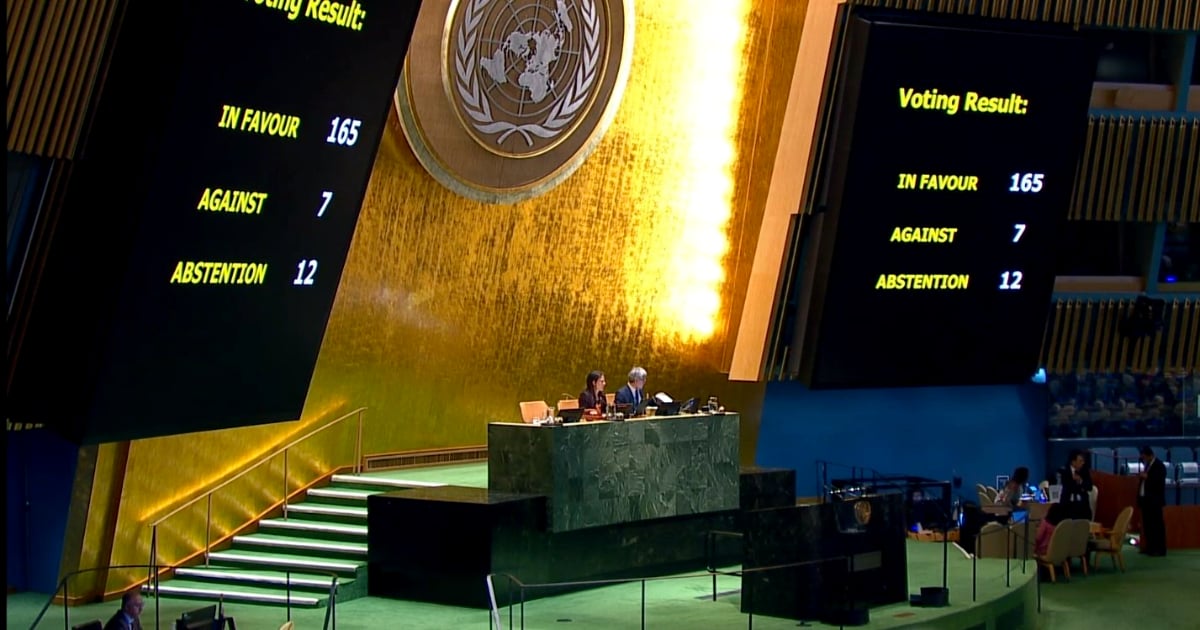
The United Nations General Assembly approved this Tuesday, with 165 votes in favor, 7 against, and 12 abstentions, the resolution calling for an end to the economic, commercial, and financial embargo imposed by the United States against Cuba.
Although Chancellor Bruno Rodríguez Parrilla celebrated the result as a "victory for the peoples," the data reflects a drastic decline in international support for the Cuban regime: it is the lowest backing in over ten years.
The vote—identified as resolution A/80/L.6—showed a significantly different landscape compared to previous years. In 2024, the text was approved with 187 votes in favor, just two against (the United States and Israel), and one abstention.
This year, the number of favorable countries declined by more than twenty, while abstentions and negative votes increased significantly, marking an unprecedented fracture in the traditional automatic majority that Havana used to achieve in such debates.
The votes against and the abstentions
According to official UN data, the seven countries that voted against the resolution were Argentina, Hungary, Israel, the United States, North Macedonia, Paraguay, and Ukraine.
The block of 12 abstentions included several European and Latin American partners, including Poland, Romania, Bosnia and Herzegovina, Costa Rica, Ecuador, Estonia, Morocco, Albania, Lithuania, Moldova, the Czech Republic, Latvia, and Micronesia.
This diplomatic shift reflects the impact of the recent scandals that have embroiled the Cuban regime—from the involvement of Cubans in the war in Ukraine as mercenaries recruited by networks linked to Moscow, to international allegations of structural corruption and the hoarding of foreign currency by the military conglomerate GAESA, which controls over 18 billion dollars in assets.
The discourse of "victory" in Havana
For his part, Chancellor Rodríguez Parrilla described the outcome as a "victory for Cuba, for the peoples, and for the truth against imperialist lies."
On social media, the regime and its embassies launched an intense campaign under the hashtag ‘#TearDownTheBlockade,’ presenting the vote as a new condemnation of Washington's policy.
The Cuban Embassy in Nicaragua, for example, celebrated the resolution stating that "the world demands the lifting of the blockade," despite the fact that the number of supporters fell below 170 votes for the first time since 2011.
Diplomatic sources consulted by international media warned that, far from reinforcing its legitimacy, Cuba is facing a growing moral and political isolation. The change in stance from countries such as Argentina and Paraguay—historically aligned with the Latin American vote in favor of Havana—evidences a fatigue with the narrative of the embargo as the sole cause of the Cuban crisis.
Political context and diplomatic rift
The loss of support occurs amid rising regional tensions. Washington has intensified its military presence in the Caribbean and reinforced sanctions against Cuba's allied governments, such as those of Venezuela and Nicaragua.
In parallel, several Eastern European countries affected by the war in Ukraine have hardened their stance against regimes that collaborate with or sympathize with Moscow.
Analysts indicate that Ukraine's decision to vote against is particularly significant: it comes after the country denounced the involvement of Cuban citizens recruited as fighters by Russian forces. Havana has denied these links, but Kyiv has documented them before international organizations.
Lowest support since 2010
According to historical records from the UN, the resolution on the embargo has never received so few votes in favor since 2010.
In 2016, during the thaw initiated by Barack Obama, the text garnered a record support of 191 votes with no opposition. Since then, the backing has been steadily declining.
In contrast, the U.S. position has not changed. The State Department reiterated that sanctions are “a legitimate pressure tool against an authoritarian regime that deprives its people of basic rights,” and emphasized that the laws allow for humanitarian and food trade.
A new diplomatic landscape
The 2025 voting results redefine the political landscape of support for Cuba.
The traditional narrative of "overwhelming victory" has weakened: more countries are choosing abstention or distancing themselves from a regime that is increasingly questioned due to internal repression, lack of transparency, and its alliances with authoritarian powers.
The triumphalist rhetoric from Havana contrasts with the reality of an island in crisis, isolated even among those who once defended it without reservation.
Filed under: