
Related videos:
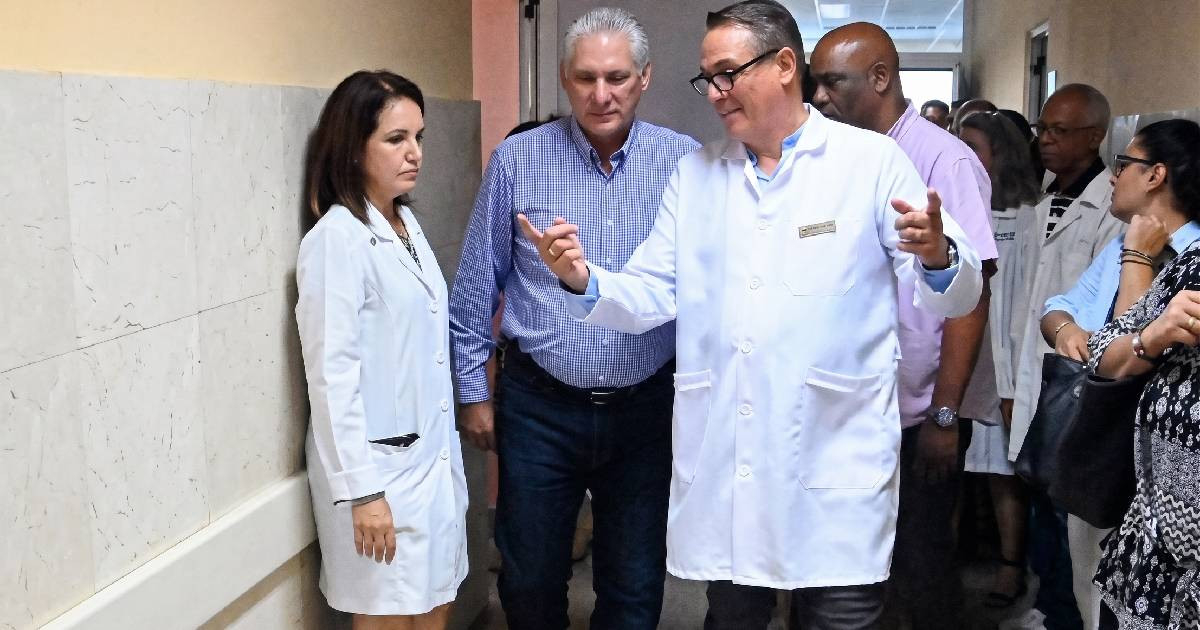
The ruler Miguel Díaz-Canel visited the Ramón González Coro University Gyneco-Obstetric Hospital in Havana this Friday, the main national reference center for gynecology, obstetrics, and neonatology, in a visit that the government presented as part of the periodic evaluation system of the leader at institutions across the country.
He was accompanied by the Deputy Prime Minister Eduardo Martínez Díaz and the Ministers of Public Health, José Ángel Portal Miranda, and Communications, Mayra Arevich Marín, as specified in a report by the Cuban News Agency.
The visit comes at the worst time for the Cuban maternal and child health system in decades. The infant mortality rate closed 2025 at 9.9 per 1,000 live births, the highest figure in over twenty years, compared to 7.1 in 2024 and 4.0 in 2018, representing an accumulated deterioration of 148% over seven years.
Maternal mortality also rose to 44.1 per 100,000 live births in 2025, compared to 40.6 the previous year, according to official figures.
Portal Miranda himself, who accompanied Díaz-Canel on the tour, acknowledged in February that the healthcare system is "on the verge of collapse".
During his tour of hospitalization wards and telemedicine consultations, Díaz-Canel attributed the deficiencies to the U.S. embargo, while stating that it limits care for more than 67,000 newborns, 34,000 pregnant women, and over 100,000 cancer patients, including 1,200 children.
He also acknowledged that the surgical waiting list exceeds 96,500 patients, including 12,000 children, and praised what he called the "creative resilience" of the healthcare staff.
"There is no blackout that can extinguish hope, and no shortage that can break the will," declared the president while referring to the work of doctors and nurses.
The director of the center, Dr. Otto Rafael Recio Rodríguez, reported that efforts are underway to restore the Neonatology units and the Microbiology laboratory with funds from the Plaza de la Revolución municipality.
He also stated that there are plans to install solar panels to ensure Neonatology and Telemedicine services in the first stage, and operating rooms and pre-delivery rooms in a second stage.
The presidential visit contrasts with a wave of complaints that have accumulated in the weeks prior. The 25.2% of registered pregnant women in Ciego de Ávila suffer from nutritional deficits, surpassing the national average of 22.5%, and in that province, 31 expectant mothers lacked a crib and 16 lacked a mattress as of June 6.
In the Camagüey Maternity Hospital, public reports indicated that more than 15 babies died between January and May under deplorable hygienic and sanitary conditions, with sewage leaks in the neonatal ward.
In Las Tunas, the regime prohibited a Christian church from distributing breakfasts to pregnant women in a maternity home, in addition to requiring authorization from the Communist Party for each delivery.
The social crisis in the maternity wards of Las Tunas has also raised alarms, as the teenage pregnancy rate reached 21% in the first quarter of 2026, with 70 new cases reported just in April.
In light of this situation, in May, at which point it identified pregnant women as one of the most vulnerable groups, facing a funding shortfall of over 60 million.
Díaz-Canel concluded his visit with a quote that intertwined the crisis with the regime's legacy: "These are difficult times, but Fidel always told us that in crises we must find the opportunity to grow, develop, and perfect ourselves, and sooner or later we will overcome this situation."
Filed under: