
Related videos:
The Ministry of Transport (MITRANS) announced the schedule for additional national trains during the first half of July, primarily aimed at transporting students and teachers who have been stranded in Havana for months to the eastern provinces, as reported by the official Cubadebate.
The measure, presented by state media in a triumphant tone as "an additional opportunity to the usual scheduling," is actually an emergency response to a transportation system on the brink of total collapse, where the demand between the west and east— as acknowledged by MITRANS itself— "exceeds current capabilities."
The schedule includes departures from Havana to Santiago de Cuba on July 2 and 4, returning on the 6th; to Guantánamo on the 1st, returning on the 11th; and to Bayamo and Manzanillo also on the 1st, returning on the 3rd.
Seats not occupied by teachers and students will be offered to the general public, although the return trips to Havana will be entirely reserved for this priority group.
The MITRANS promised to provide more details on how to purchase tickets in coordination with the Cuban Railway Union, but the confusion is already clear: a user identified as Pedro Pablo left a comment on Cubadebate that summarizes the situation: "There is no way to acquire tickets for the unused capacities."
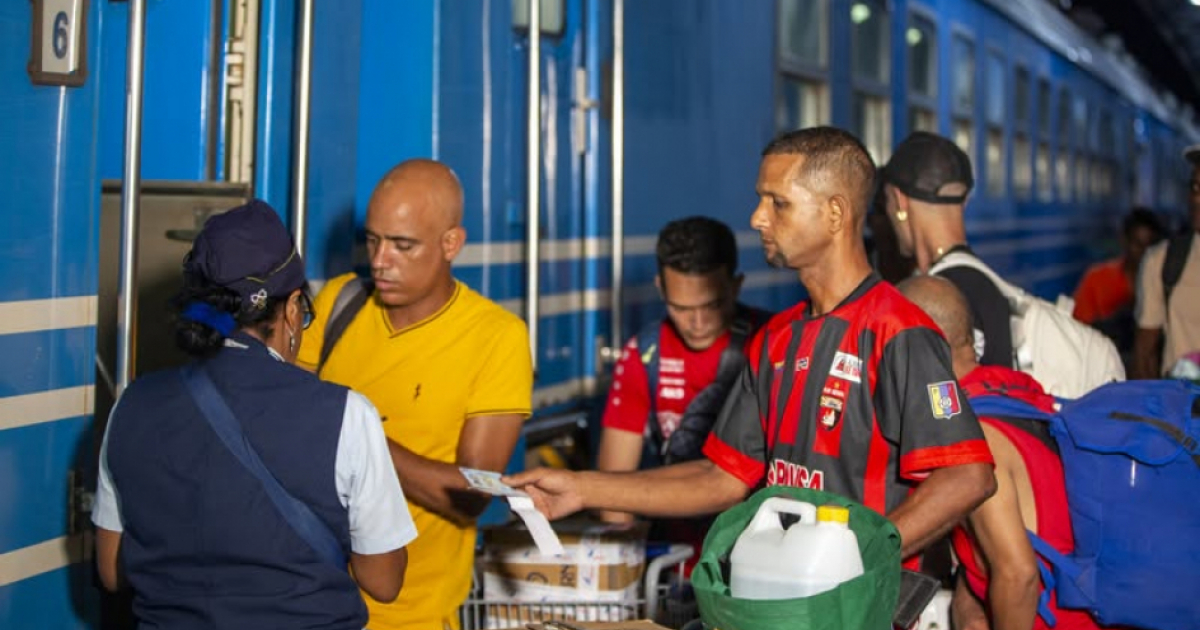
The reality of the first extra train already in motion disproved the official optimism: the departure of train number 9 heading to Guantánamo faced a three-hour delay due to technical issues, including three cars with malfunctions and a broken hose.
The 680 teachers and educators on board had to arrive four hours before departure, with planned pickups starting at 5:30 in the morning from the 11 municipal villages.
The announcement comes after the most severe cut to national transport since June 18, when MITRANS declared a "state of emergency": national buses went from daily service to three departures a week, eastern trains were reduced from every eight days to every 16, and the maritime route from Nueva Gerona to Batabanó was cut down to two services a week.
The APK Viajando application was suspended, and the sale of tickets has been eliminated, replaced by provincial commissions that determine who is allowed to travel based on the reason for the trip.
The structural deterioration of the Cuban railway is alarming: only 12 large locomotives are operational out of the 34 needed, resulting in a deficit of 64.7%, and 67% of the tracks require maintenance.
Passenger train transport fell from 10 million in 2013 to just four million in 2023. Last May, a trip from Holguín to Havana took 27 hours, and on June 3rd, the number 13 train derailed in Omaja, Las Tunas, with 900 people on board.
Filed under: