
Related videos:
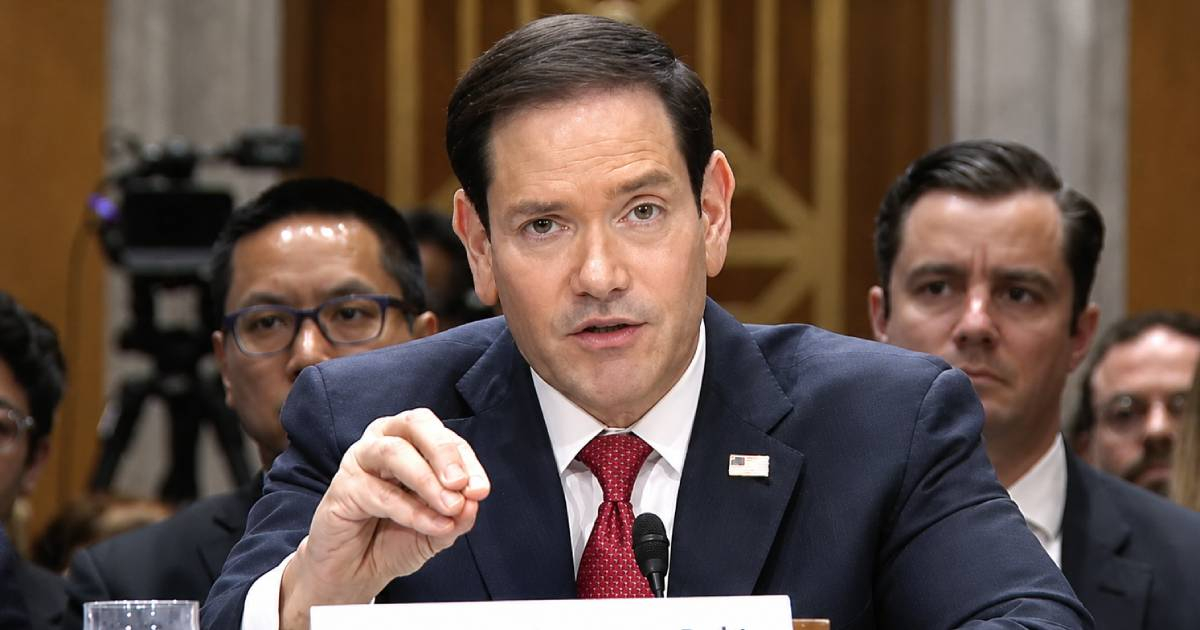
The Secretary of State Marco Rubio invited ministers from over 60 nations to a ministerial meeting scheduled for July 16 at the State Department in Washington, focused on what the Trump administration describes as the “resurgence of extreme left transnational terrorism”, according to documents reviewed by The Washington Post.
The call includes most European nations, the main Latin American countries, and several Asian states such as India, Indonesia, and Singapore.
The invitation was sent out just last week, with confirmation of attendance required by this Friday, which caused discomfort among the recipients due to the short notice.
A "concept note" distributed to the guests describes the event as a ministerial on the "resurgence of political terrorism," with an explicit focus on "extreme left terrorists" who, according to the document, "are increasingly resorting to organized and lethal violence to advance their political goals."
The spokesman for the State Department, Tommy Pigott, justified the call by stating that extreme left-wing terrorism is "an old threat that is resurfacing with strong transnational links and new convergences."
However, the initiative has generated rejection both within the U.S. government itself and among European allies.
Several European diplomats, speaking on condition of anonymity, expressed confusion regarding the invitation. "We don't have Antifa," said one.
"I don't think we can find any reason why we would be interested in attending such an event," noted another. A third was more direct: "Our law enforcement authorities have not focused on left-wing terrorism because it is not considered a high-priority threat in our country."
Some career officials from the Department of Justice and the White House Counsel's Office have also expressed internal concerns, and several chose not to attend the event.
The meeting is part of a series of previous attempts that did not succeed: in May 2026, the State Department held a meeting in The Hague on Antifa that "fell flat," and the Netherlands refused to co-host. In June, a meeting at the U.S. Institute of Peace was described as a "failure."
The background of this policy is the murder of conservative activist Charlie Kirk on September 10, 2025, whose alleged shooter inscribed anti-fascist rhetoric on the bullets used. Following the crime, Trump issued an executive order designating Antifa as a "domestic terrorist organization," a label that experts indicate has no legal weight.
The administration's "anti-terror czar," Sebastian Gorka, has explored the possibility of using foreign terrorism designations for Antifa in order to enable surveillance tools on American citizens linked to the movement, according to three current and former officials.
Experts in security warn that this legal route is unfeasible. "If it has a significant domestic presence, it cannot be designated," explained Jason Blazakis, who led the designation process at the State Department for 10 years.
The administration's anti-terrorism strategy, published in May 2026, calls for the "rapid identification and neutralization" of groups with an "anti-American, radically pro-transgender, and anarchist" ideology, but makes no mention of nationalist neo-Nazi groups, unlike the equivalent strategy from Donald Trump's first term.
The Cuban regime, through the official Carlos R. Fernández de Cossío, described the call for elections as a "smoke screen" and compared the anti-communist rhetoric to "dark episodes of Europe in the 1930s."
"This is the politicization of intelligence, and it's dangerous because what they are essentially doing is playing partisan politics with counterterrorism, only focusing on a fraction of the overall threat," warned Colin P. Clarke, executive director of the Soufan Center. "If I had to rank the priorities, left-wing terrorists would not be in my top three."
Filed under: