
Related videos:
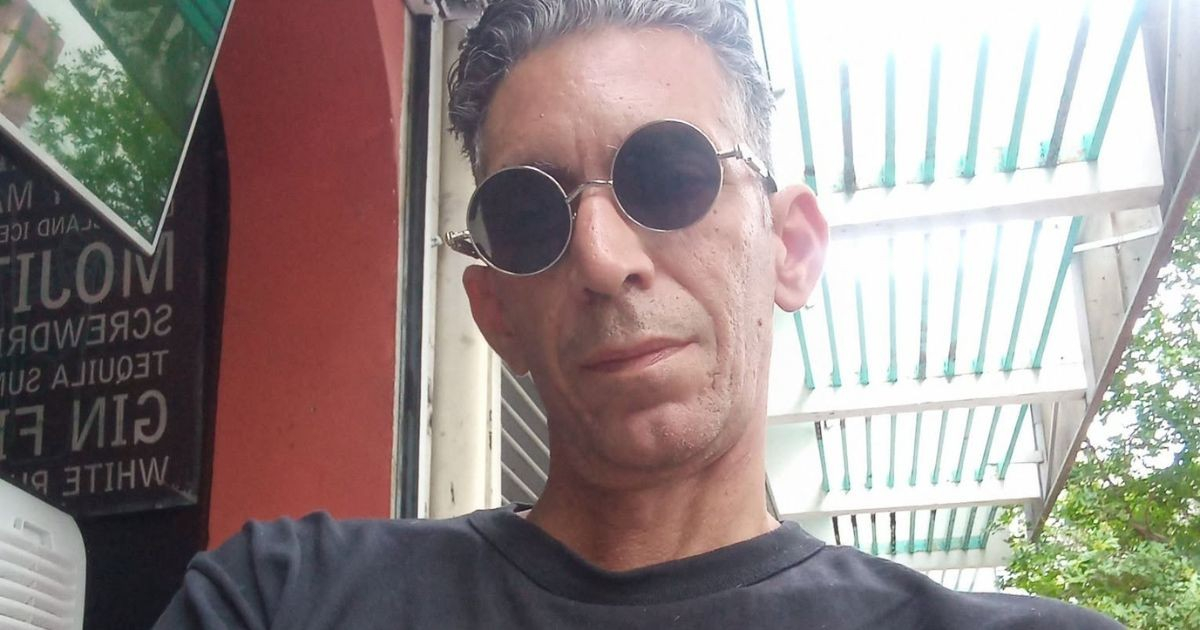
The Cuban poet Poe Cid published this Friday on his Facebook profile a poem of three eleven-syllable verses that vividly depicts the spiritual devastation the totalitarian regime has inflicted upon his generation, concluding with the line: «I was an exemplary pioneer and they returned me / the wound without a country... distant... crazy».
Poe Cid is the stage name of Jorge García Prieto, a poet from Havana born in 1979 and a cultural promoter from the municipality of Arroyo Naranjo. He was awarded the National Décima Prize Francisco Riverón Hernández in 2017, the Ciudad del Che Prize in 2022, and the Décima Cucalambé Prize in 2023. His voice is not that of an outsider to the system; it is that of someone who grew up within it, served it, and was betrayed by it, like so many others.
The poem challenges power—and its visible leadership, personified in a photo of Raúl Castro and his grandson Raúl Guillermo (El Cangrejo)—with a series of unanswered questions. "Is your job to make me endure? / Is my job to make you thrive?" opens the first stanza, before declaring: "There is a blacklist and I am on the list." The reference to the blacklists with which the regime marginalized critical artists and intellectuals is not metaphorical; it is a documented practice that has silenced generations of Cuban creators.
In the center of the poem, a disturbing image emerges: "And the eyes of Abel Santamaría?" The reference points to the young martyr of the attack on the Moncada Barracks in 1953, who was captured, tortured, and killed at the age of 25. The poet accuses the regime of perpetrating the same brutality against its own citizens that it claims to condemn in its foundational martyrs.
The second stage of the descent into existential exhaustion: "They've already burned my time. At my age, / they've already pulled out my claws. I'm already oozing." And then, with a bitter irony that touches on the absurd: "Can there at least be another form of torture / without resorting to such darkness? / For example: the drop on the head. / For example, I don't know: the guillotine / and chasss and that's it. It never ends."
The final verse encapsulates the tragedy of a generation indoctrinated from childhood. The reference to the "exemplary pioneer" points to the José Martí Pioneer Organization (OPJM), founded in 1961, which has historically brought together 98.5% of Cuban children under the motto "Pioneers for Communism... We will be like Che." These children were promised a future of dignity. The poem reflects the cost of that unfulfilled promise: "Do not torture me anymore... turn off the light. / Do not question me anymore... they dismantled me."
The text appears at a time of maximum social tension. Cuba arrives at this Friday with a generation deficit that exceeded 2,341 MW, leaving 73% of the country without electricity, while salaries range from 10 to 15 dollars per month and the economy forecasts a contraction, at the very least, of -6.5% for 2026, although some independent forecasts place it above 10%.
That chasm between the people and the elite takes on a specific face in the public debate of these weeks: that of Raúl Guillermo Rodríguez Castro, who granted an interview to USA Today wearing Hermès sneakers, a Hugo Boss t-shirt, and a Rolex watch, and stated: "It pains me greatly that people cannot live like I do." The indignation sparked by those words resonates in every line of the poem like an involuntary counterpoint.
The professor Julio César González Pagés noted this week that "the misery and desolation endured by the average Cuban is the backdrop for many creative discourses" that speak of homeland and nation, and he added that "time keeps passing and the reconcentrated continue to die in silence in hospitals and dark homes without medication, food, water, and electricity." Poe Cid's poem is, precisely, that voice that refuses to die in silence: "From there certainty came to suicide. / Little foam in the sea and in the beer. / Little spore in the good. Everything very little."
Filed under: