Related videos:
Raúl Guillermo Rodríguez Castro did not explicitly say that there are political prisoners in Cuba.
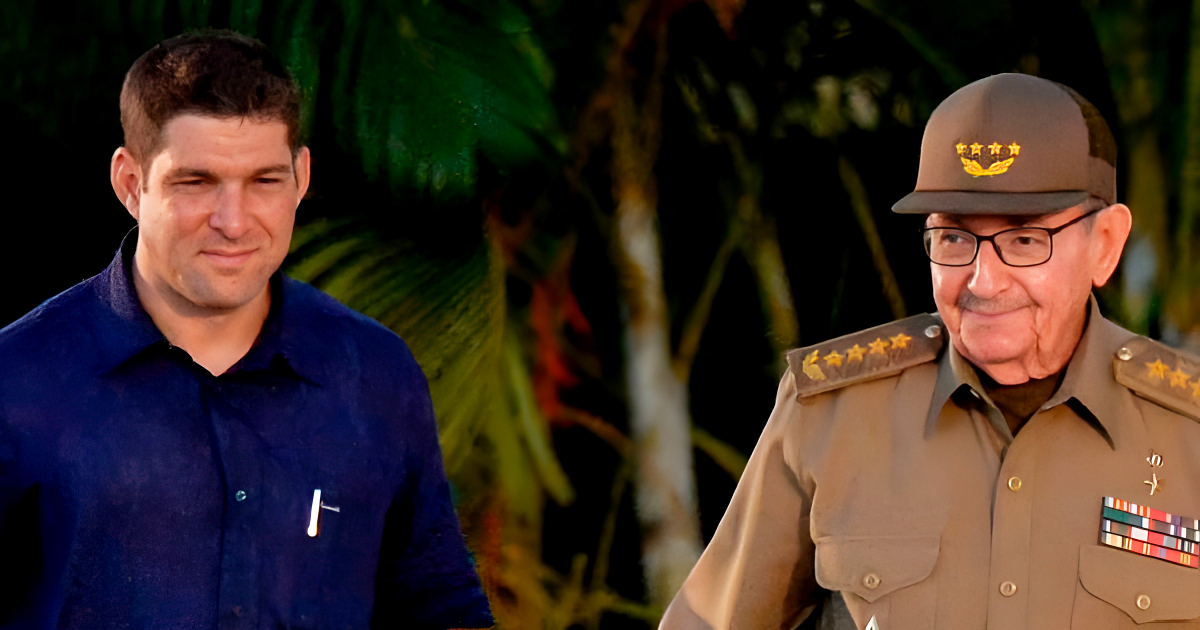
Raúl Castro's grandson, known as 'El Cangrejo', opted for a more cautious yet revealing approach: the regime would be willing, “under the right conditions,” to release individuals “considered political prisoners”.
The rodeo aims to maintain a minimum distance from reality. Prisoners are political only for those who “consider” them that way, not for the totalitarian state that condemned them.
But the second part of the sentence undermines that caution: if the government can release them as a result of a political negotiation, it becomes very difficult to continue asserting that their imprisonment lacks a political nature.
The statement from 'El Cangrejo' does not signify a democratic conversion nor an acknowledgment of the injustices committed. It is something different: a crack in one of the most persistent denials of the official Cuban discourse.
Just three months earlier, Miguel Díaz-Canel had stated on U.S. television that there were no political prisoners in Cuba. According to the regime's usual narrative, those imprisoned were individuals convicted of vandalism, violence, or common crimes.
Now a colonel from the Ministry of the Interior appears, caretaker of his nonagenarian grandfather, without any profession or benefit, and without any representative position, ready to discuss the terms for releasing those who officially do not exist.
Deny, reclassify, negotiate
The manipulation of the political prisoner category is almost as old as the regime itself.
The dictator Fidel Castro built much of his rhetoric on a deliberate substitution: the imprisoned opponents were not political prisoners, but rather "counter-revolutionaries," "mercenaries," enemy agents, or individuals sanctioned for crimes against state security.
By changing their names, the authorities aimed to erase the motivation behind their convictions as well.
However, Castro was inconsistent even with that denial. In November 1978, during a process of releases and dialogue with the administration of Jimmy Carter, he declared that the 3,600 prisoners who would be released represented about 80% of the political prisoners then in Cuba. Most, he added, were classified by the regime as "counter-revolutionaries."
The contradiction shows that Castroism has never had a real problem identifying its political prisoners. Its issue has been publicly admitting that it incarcerates them for political reasons.
When the category involves responsibility, it disappears. When prisoners can be released to gain a diplomatic advantage, enhance international image, or facilitate negotiations, it reappears.
Human rights organizations such as Human Rights Watch (HRW) were already denouncing in the late 1990s that Cuban authorities used wordplay to claim that the country had no political prisoners, despite laws punishing open opposition and prisons housing dissidents convicted for exercising fundamental rights.
"Give me the list."
Raúl Castro brought that stage presence to one of his most memorable moments during Barack Obama's visit to Havana in March 2016.
The journalist Jim Acosta asked during a joint press conference why Cuba was not releasing its political prisoners. Raúl responded defiantly: “Give me the list of political prisoners right now, and I will release them immediately.”
Then he insisted: to provide him with the names and, if they were imprisoned, they would be released before the night was over.
The bluster aimed to create the impression that there was no one to liberate. It turned the journalist into the one responsible for proving what the State itself knew all too well: the names of the individuals it had detained, prosecuted, condemned, and imprisoned.
Raúl was not seeking information. He was expressing ignorance and perplexity at the bold audacity of asking about political prisoners.
The lists existed. They had been published by Cuban and international organizations, family members, and human rights groups. But the general demanded a list as if he were asking for an impossible proof, shielded by a system that monopolizes the courts, prisons, and information about the inmates.
Ten years later, his grandson changes the family rhetoric. He no longer sarcastically asks where those prisoners are. He speaks about the conditions for their release.
A truth pursued from below
What’s striking is not that 'El Cangrejo' has revealed something unknown.
Generations of Cubans have denounced the existence of political prisoners. Family members have done so at the prison gates, as well as opposition members, independent journalists, human rights organizations, former prisoners, artists, religious figures, and citizens without any political affiliation. Thousands have called for the review of cases, the annulment of convictions, or an amnesty.
Madelyn Sardiñas Padrón was detained in Camagüey in 2023 for stating on Facebook that there were political prisoners in Cuba. Her case summarizes an essential paradox: the same truth that drives a citizen's complaint in front of a police station now allows a Castro to present himself as an international negotiator.
For powerless Cubans, naming political prisoners has meant surveillance, interrogations, job loss, acts of repudiation, imprisonment, or exile. For a member of the ruling family, indirectly acknowledging them can become a demonstration of pragmatism.
In Cuba, the truth does not solely depend on the facts. It also depends on the surname of the person who speaks it.
What are the "adequate conditions"?
The most serious part of 'El Cangrejo's' words is not in “people considered political prisoners.” It's in the “adequate conditions.”
Adequate for whom? For the prisoners and their families? To annul arbitrary convictions? To end surveillance, harassment, and threats of re-incarceration? For those who were exiled to be able to return?
Or suitable for the regime to obtain fuel, relief from sanctions, investments, international recognition, or guarantees of survival?
'El Cangrejo' did not mention reviewing judicial processes, investigating torture, compensating victims, or restoring rights. He spoke about releasing individuals if certain conditions are met.
He did not acknowledge that freedom belongs to them. He hinted that power may return it if he receives something in exchange.
This formulation turns prisoners into negotiable capital. They cease to be officially nonexistent and become potential pieces of a transaction.
A narrative that begins to decompose
The statement from 'El Cangrejo' should be read within the broader crisis of the official discourse.
For decades, the regime was able to simultaneously assert that there was no hunger, unemployment, racism, political emigration, or political prisoners in Cuba. The propaganda did not need to seem true; it was enough that no voice could publicly contradict it without paying a price.
That monopoly has weakened.
The economic crisis, power outages, mass emigration, access to social networks, and growing citizen distrust have widened the gap between reality and the narrative. The government continues to suppress, but it no longer manages to control the meaning of what is happening with the same effectiveness.
From this decomposition, strange outcroppings emerge. The leader appointed by Raúl Castro denies the political prisoners in April, and his favored grandson speaks in July about the conditions for their release.
The discourse is not opening up because the regime has embraced the truth, but because its various needs are starting to produce contradictions that are impossible to conceal.
'El Cangrejo' needs to show flexibility toward Washington without questioning the artifact it intends to inherit, called "revolution." To do so, it partially acknowledges a reality that the regime continues to deny. Its statement does not represent a break with the system, but rather an effort to save it through less rigid and more negotiable language.
But once admitted, it cannot be entirely withdrawn.
Fidel referred to the prisoners as counter-revolutionaries when he needed to criminalize them and as political prisoners when he needed to release them. Raúl demanded a list to pretend they didn't exist. 'El Cangrejo' no longer dares to repeat that denial with the same certainty: he offers to release them when the “appropriate conditions” arise.
The taboo has been broken, albeit in an oblique manner.
And behind the spectacle lies the truth that so many Cubans have paid for with surveillance, imprisonment, and exile: there are political prisoners in Cuba.
They do not require suitable conditions to be freed. They need the injustice that led them to prison to come to an end.
Filed under: