Related videos:
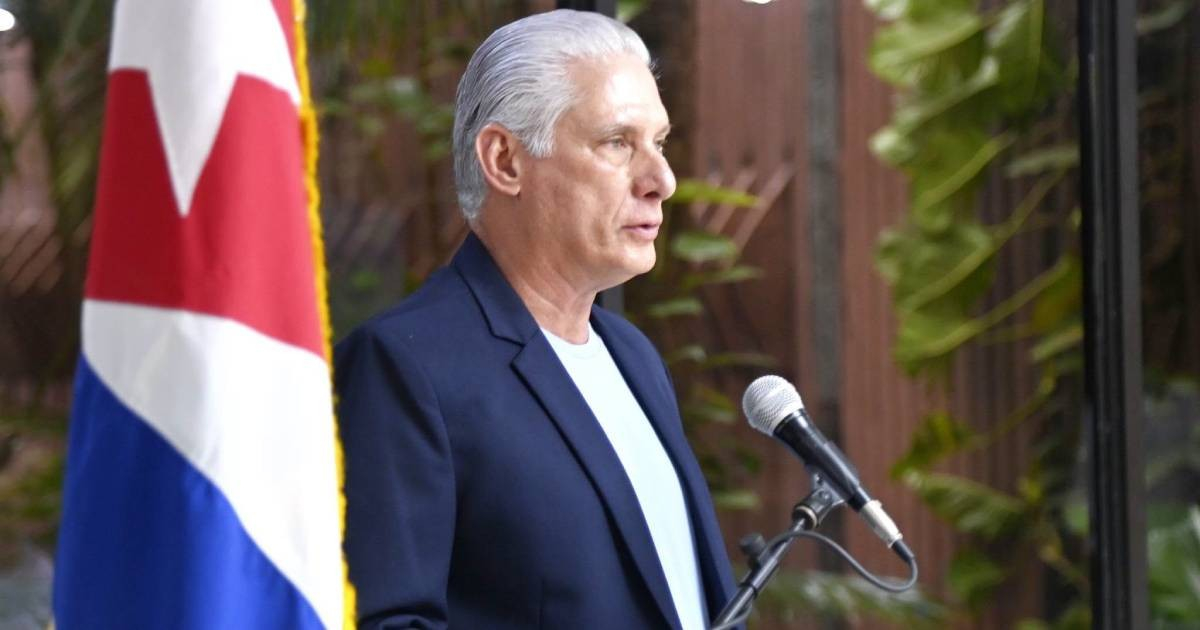
The Cuban leader Miguel Díaz-Canel reacted this Monday to the new sanctions announced by the United States against state entities on the island and accused the administration of President Donald Trump of intensifying a strategy to strangle the Cuban economy.
Through a message posted on his account on social network X, Díaz-Canel described the measures as a deliberate aggression against the population.
"Another week, another list of 'sanctions' against Cuba. It is the war of the U.S. and its desire to strangle our economy. They are intensifying their aggression in search of greater harm to the people. We are facing a genocidal plan denounced at the UN less than a week ago," wrote the leader.
His reaction came hours after the Department of the Treasury, through the Office of Foreign Assets Control (OFAC), added 10 new Cuban entities to the Specially Designated Nationals (SDN) List.
Among the sanctioned organizations is the Ministry of Tourism of Cuba (MINTUR). The measure also affected GEMAR, GECOMEX, COREYDAN S.A., ENETEC S.A., ANTEX S.A., OSDE Caudal S.A., the Territorial Troops Militias (MTT), the Association of Combatants of the Cuban Revolution (ACRC), and the Rapid Response Brigades.
The new designations were adopted under Executive Order 14404, signed by Trump on May 1, 2026, which expanded sanctions against entities linked to the Cuban government and includes measures for those who engage in certain operations with them.
The reference to the UN
In his message, Díaz-Canel referred to the extraordinary session of the UN General Assembly held on July 7, which was convened by Cuba to denounce the tightening of American sanctions.
During that debate, the Minister of Foreign Affairs, Bruno Rodríguez Parrilla, described Washington's measures as an "act of genocide" and a "collective punishment" against the Cuban people.
The resolution was approved by the General Assembly with 136 votes in favor, nine against —including the United States, Argentina, and Israel— and 40 abstentions.
On behalf of Washington, Jeffrey Bartos rejected the accusations from the Cuban government and stated that "there is no U.S. blockade; the only embargo is the guillotine that the regime hangs over its people," in addition to denouncing the situation of political prisoners on the island.
The pressure from Washington continues
The sanctions announced this Monday are part of the pressure strategy promoted by the Trump administration since early 2026.
In the last two months, the United States has sanctioned GAESA, MININT, MINFAR, CUPET, the Committees for the Defense of the Revolution (CDR), ICAP, as well as Díaz-Canel himself, Alejandro Castro Espín, and other figures in the leadership, along with additional entities deemed by Washington as sources of funding or instruments of repression for the regime.
The new measures come in the context of a deep economic crisis in Cuba, marked by prolonged blackouts, fuel shortages, a collapse of tourism, and a sustained contraction of economic activity, while Havana attributes the decline mainly to the tightening of U.S. sanctions and Washington blames the economic and political model of the regime.
Filed under: