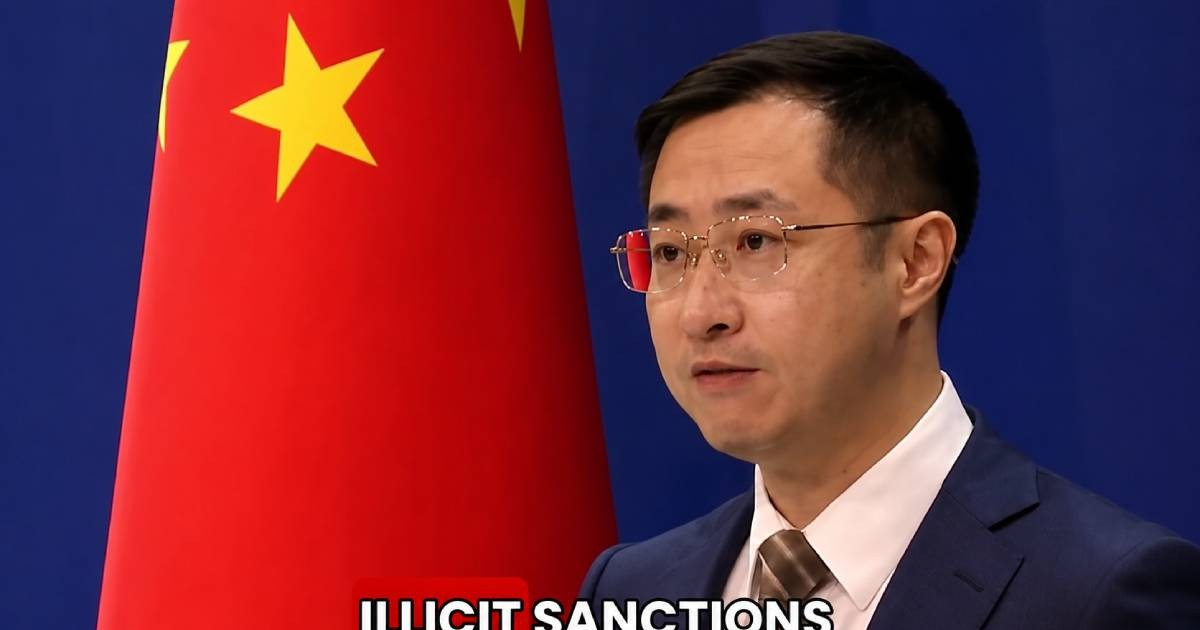
The Chinese government came to the defense of the Cuban regime on Wednesday following the latest round of sanctions imposed by the United States. In Beijing, the spokesperson for the Ministry of Foreign Affairs, Lin Jian, reaffirmed his country's support for Havana, rejected any "external interference," and demanded that Washington put an end to the embargo and coercive measures against the island, reports Xinhua News.
The statements were made just two days after the Donald Trump administration announced a new set of sanctions against 10 entities linked to the Cuban state apparatus, including the Ministry of Tourism (MINTUR), the Maritime Port Transport Business Group (GEMAR), the Foreign Trade Business Group (GECOMEX), as well as the Territorial Troops Militias and the Rapid Response Brigades.
This is the eighth round of sanctions imposed by the White House against Cuba in 2026. In total, the Trump administration has implemented over 240 measures since January under Executive Order 14404, signed on May 1.
During a press conference, Lin Jian described the U.S. embargo as "illegal" and stated that its effects directly impact the Cuban population.
"The United States has imposed a comprehensive blockade and illegal sanctions against Cuba for over 60 years, causing deep suffering for the Cuban people. More recently, it has intensified its blockade and sanctions, severely impacting the basic livelihood ofCubans and generating widespread concern in the international community," he stated.
The spokesperson also urged Washington to modify its policy towards the island.
"The United States should listen to the rightful voices of the international community, immediately end its blockade and coercive pressure against Cuba, and stop undermining the Cuban people's right to subsistence and development," he stated.
A constant support from Beijing
The reaction from the Chinese government is part of a consistent line of support for the Cuban regime. In May, Lin Jian himself publicly defended Raúl Castro after the United States filed criminal charges against him. A few days later, on July 9, the Chinese ambassador in Havana reiterated Beijing's confidence that Cuba "will achieve its development."
That support has also translated into financial aid. In January 2026, President Xi Jinping approved an emergency assistance package valued at 80 million dollars, in addition to the shipment of between 60,000 and 90,000 tons of rice to alleviate the food crisis affecting the island.
China has also solidified its position as Cuba's main trading partner since 2017. In recent years, the regime has intensified its focus on Chinese investments as an alternative in response to the tightening of U.S. sanctions, including negotiations for tourism projects such as the operation of the Copacabana Hotel in Havana.
The response from Havana
After the announcement of new sanctions, Foreign Minister Bruno Rodríguez described the measures as "criminal and genocidal" and accused Washington of continuing to "intensify the war against the people of Cuba, their living conditions, and their sources of livelihood."
China's position is also systematically reflected in international forums. Since 1992, Beijing has voted in favor of all UN General Assembly resolutions calling for an end to the U.S. embargo. In the most recent vote held in 2024, the resolution received 187 votes in favor and only two against: the United States and Israel.
Related videos:
Filed under: