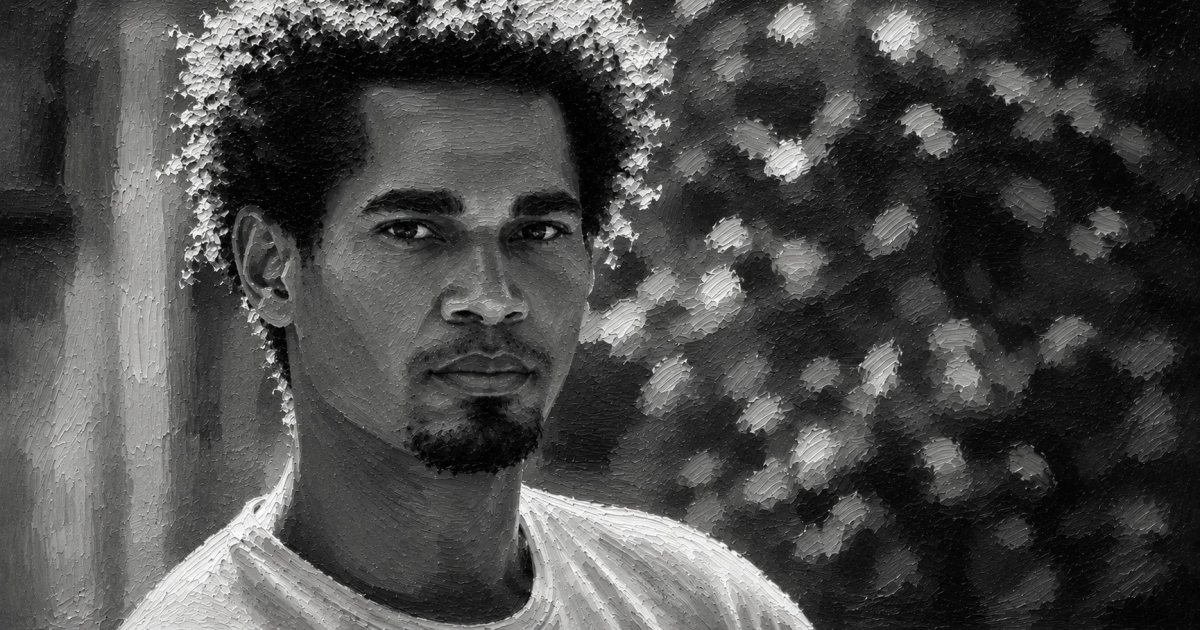
When I think back to the nights when I didn't know if I would come out alive from a cell, I clearly understand what Luis Manuel Otero Alcántara has endured for more than five years. The neurons of a political prisoner never get a break. Every step of the jailer and the common criminals surrounding you may conceal a provocation, an assault, an attack. Every kind gesture is a trap; every transfer, a beating or a maneuver aimed at destroying health, will, honor, and public image. It’s a constant battle against professionals of evil.
On November 18, 2024, at around seven-thirty in the morning, six members of the “Conduce” squad arrived at my cell and ordered me to get dressed. They said they would transfer me to the so-called hospital of the Boniato prison. I refused. For almost three years, I had been hearing reports about that place: prisoners with tuberculosis, malnutrition, scabies, and other infectious diseases; men who entered sick and came out dead. I suspected they might try to infect me.
My refusal unleashed violence. They beat me, twisted my arms behind my back, and subjected me to a form of torture known as "the bicycle," forcing me to move on tiptoes. They threw me into a transport cage vehicle. Once at Boniato, when I refused to get out, they threw me onto a floor covered in stones and dragged me, hitting me, to the hospital. My right arm was injured, and my shorts and part of my body were covered in blood.
Then a major from the political police, who calls himself Julio Fonseca, appeared. He arrived in a conciliatory manner, pretending to be surprised by the condition I had been left in. His message was simple: the only solution for me and my family was to leave Cuba. This is how tyranny operates: first, it strikes, tortures, isolates, and buries you alive; then it sends the "friendly" officer to offer exile as salvation. I rejected the offer.
On January 16, 2025, I was released from prison along with Félix Navarro and other detainees, in the context of the Vatican's efforts and measures announced by the Joe Biden administration regarding Cuba. Havana presented the releases as a gesture, although it never ceased to demand silence and political inactivity. When we refused, we were re-imprisoned. We returned to prison on April 29.
This time I had made a decision: if the regime imprisoned me again, I would leave the country to prevent the Unión Patriótica de Cuba from remaining trapped in that cycle: when we left, we rebuilt activism; when we returned to prison, repression paralyzed almost everything. The political police, led against me by a colonel who calls himself Ramsés, wanted to impose their conditions: to send me to Guyana or Nicaragua without my family, to extract favorable statements for a dialogue with the U.S. designed by the dictatorship, and to obtain manipulable images or audios. I refused. I would only leave with my dignity intact.
Therefore, upon learning that Luis Manuel had been taken from Guanajay and moved to an unknown location, I thought of that method. After serving his sentence on July 9, he was left under the regime's captivity; Anamely Ramos received a brief call during which he could not disclose his whereabouts. It has now been reported that the United States has approved his humanitarian parole and preparations for his journey are underway, although he remains under the control of Cuban authorities while awaiting his departure.
I can imagine the psychological pressures, the hidden cameras, the false politeness, the improved food, and the efforts to make things look as good as possible. The dictatorship needs to create a façade. It wants to expel you while at the same time producing materials that it can manipulate to undermine your resolve and credibility.
If Luis Manuel Otero had given in, he would have been expelled years ago to any destination convenient for the regime. He has endured five years under hellish conditions because he defended his right to choose where to rebuild his life and continue his fight. He does not leave Cuba out of a lack of love for his homeland. He is exiled because the dictatorship cannot tolerate his art, his rebellion, or his ability to inspire young people.
The same is being attempted with other political prisoners. We have received reports that if someone pays for the ticket and another country accepts them, they can leave directly from prison to the airport. Among the cases mentioned is Daniel Moreno de la Peña, incarcerated in Santiago de Cuba.
The purpose is not humanitarian. It seeks to eliminate the most steadfast, reduce international pressure, and stage a tragicomedy of supposed openness, all while maintaining intact the subordinate courts, the shadowy prisons, and the criminal political police that uphold the despotic regime.
Luis Manuel will arrive in exile to begin another chapter. The regime fears that he will continue to inspire artists, youth, and neighborhoods within Cuba that are protesting against blackouts, hunger, misery, and oppression. It worries that his example will help to foster a free, democratic, just, and prosperous Cuba; a nation with rights, decent wages, food, medicine, and opportunities; a Cuba for all and for the good of all, as Martí dreamed.
Let us welcome Luis Manuel Otero Alcántara. Let us rejoice that another good Cuban has emerged alive from the hellish prisons of Castro-communism. Let us stand with him so that his voice continues to reach those who remain on the front lines, where the fight is most perilous.
As the poet Henry Longfellow wrote, "great lives remind us that we can ennoble our own and leave, upon departing, footprints in the sands of time."
Luis Manuel has already left his mark and will continue to do so, just as Félix Navarro, his daughter Saily , and many other political prisoners will continue to demonstrate in the prisons of the tyranny, people we must not forget for a single moment.
Related videos:
Filed under:
Opinion article: Las declaraciones y opiniones expresadas en este artículo son de exclusiva responsabilidad de su autor y no representan necesariamente el punto de vista de CiberCuba.