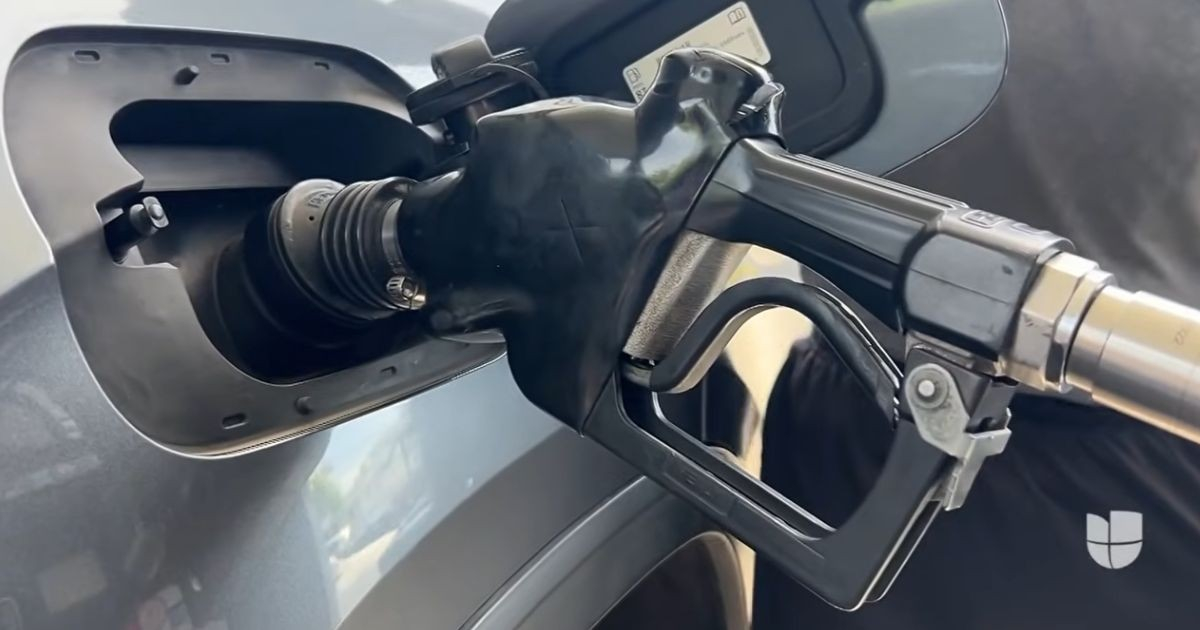
The average price of gasoline in the United States returned this Monday to $4 per gallon, driven by the resumption of military attacks between Washington and Tehran.
Thus confirmed the federation of automobile clubs AAA, according to Associated Press. The increase comes a month after prices had fallen below that threshold thanks to a provisional agreement between the U.S. and Iran.
However, the truce was broken when the Tehran regime attacked commercial vessels in the Strait of Hormuz on July 6 and 7, prompting President Donald Trump to order new massive bombings.
Since then, the United States has completed at least seven consecutive nights of attacks against Iran, hitting over 300 military targets.
On July 18, Iran announced the suspension of the agreement with Washington. Since July 11, the new supreme leader, Mojtaba Jamenei, had ordered the continuation of attacks and dismissed any return to the negotiating table in the short term.
The current price of $4 per gallon represents an increase of nearly 90 cents compared to the average of $3.14 recorded a year ago.
The figure is a national average, so the variation between states is substantial. Some drivers have been paying significantly more than $4 for some time, while others are still below that level, depending on local supply and the rates and taxes of each state.
In Florida, the state average hovers around $3.91 per gallon, slightly below the national average, although in Miami the price has already exceeded $3.97. The year's peak was reached on May 2nd, when the national average hit $4.48, with spikes of up to $5.39 in Miami Beach.
In international markets, crude Brent —the global benchmark— rose by 3.2% to $90.95 per barrel on Monday, while the U.S. benchmark crude (WTI) increased by 2.8% to $84.04 per barrel.
The conflict between the two powers began on February 28, 2026, with Operation Epic Fury, a joint attack by the United States and Israel on Iranian nuclear and military facilities.
Since then, the price of gasoline in the country has risen by about 50%, largely driven by disruptions in the Strait of Hormuz, through which between 20% and 25% of the world's oil passes.
Related videos:
Filed under: