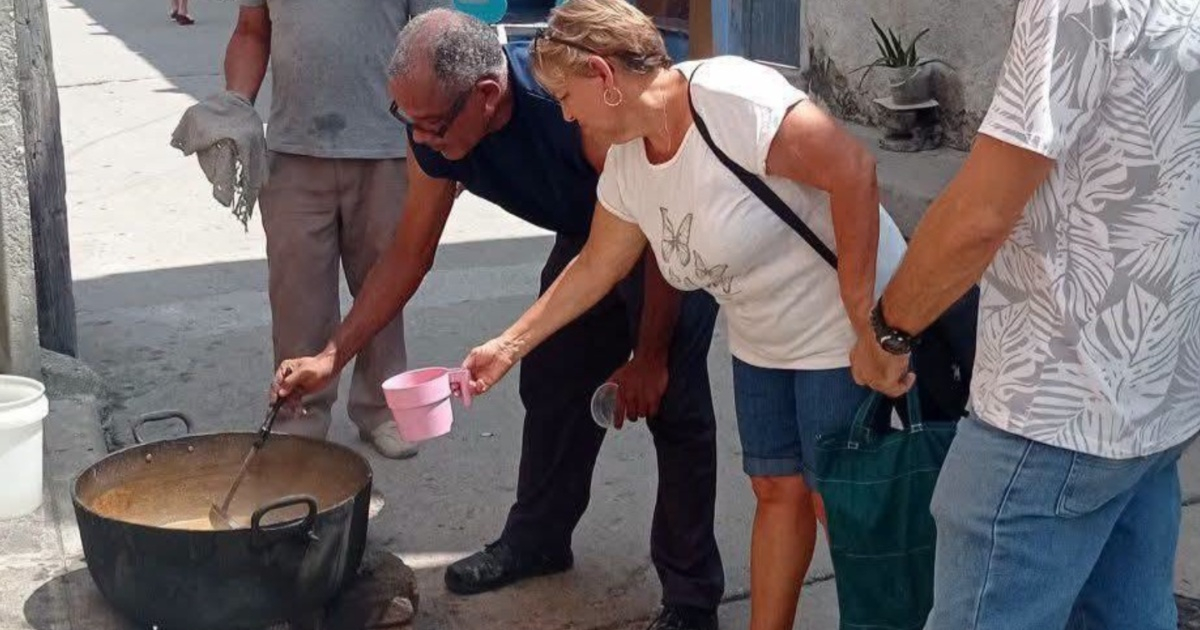
This Saturday, on the eve of the 73rd anniversary of the assault on Moncada, the Provincial Company of Technical Services of Villa Clara (EPSTAC) organized a community stew in the middle of the street in the Popular Council Center of Santa Clara, presented by the authorities as an act of solidarity framed within the government program "My Neighborhood for the Homeland".
The images shared by the official page "Soy Villa Clara" on Facebook show workers cooking with firewood and black cauldrons on the pavement, surrounded by buildings with deteriorated facades.
The official publication described the event as an activity "in solidarity" in commemoration of July 26th.
The scene, however, generated a predominantly critical reaction on social media. "As always, romanticizing misery," wrote one user.
Another remarked sarcastically, "Is that really the solution? How depressing Cuba is! We're still heading towards the horizon." A third person summed up the mood of many: "God, what era are they in? How sad."
Not all comments were negative. One user defended the initiative: "It's very good, this way they help those in need. Good initiative."
But most pointed out the contradiction between the official discourse and everyday reality. "The people suffering without water, and when the electricity comes, the voltage is terrible," wrote another individual.
"If I didn't take it when there was enough to give, just imagine that soup," wrote a Cuban in the comments, bitterly summarizing what many think about a celebration that, for a large part of the population, reflects how far the standard of living on the island has fallen.
The street caldosa is not a new phenomenon in Villa Clara. Bodegas in the municipality of Manicaragua were already selling caldosa in June as a "nutritious and traditional option" in response to the shortage of basic food items, and in July other bodegas in the province began selling rice, elbow macaroni, and caldosa at prices of 45 pesos for a serving of rice and 60 pesos for a serving of spaghetti or elbow macaroni.
The context in which this celebration takes place is one of deep crisis. The Food Monitor Program reported in 2026 that 96.91% of the Cuban population lacks adequate access to food, and that 33.9% of households had a member who went to bed hungry in the 30 days prior to the study.
The Minister of Food Industry acknowledged in June that the regulated basket had not distributed oil, chicken, or yogurt so far this year.
In addition to the food crisis, there is the energy collapse: power outages have exceeded 20 hours a day in many areas of the country, which explains why cooking with firewood in the street has become a common practice rather than a festive tradition.
Despite everything, the regime highlighted Villa Clara as the winning province of the Moncadista emulation, with Caibarién serving as the venue for the provincial event.
The national central event of July 26 was held this Saturday in Pinar del Río, on a day that the regime presented with special symbolic significance as it coincided with the centenary of Fidel Castro's birth.
Related videos:
Filed under: