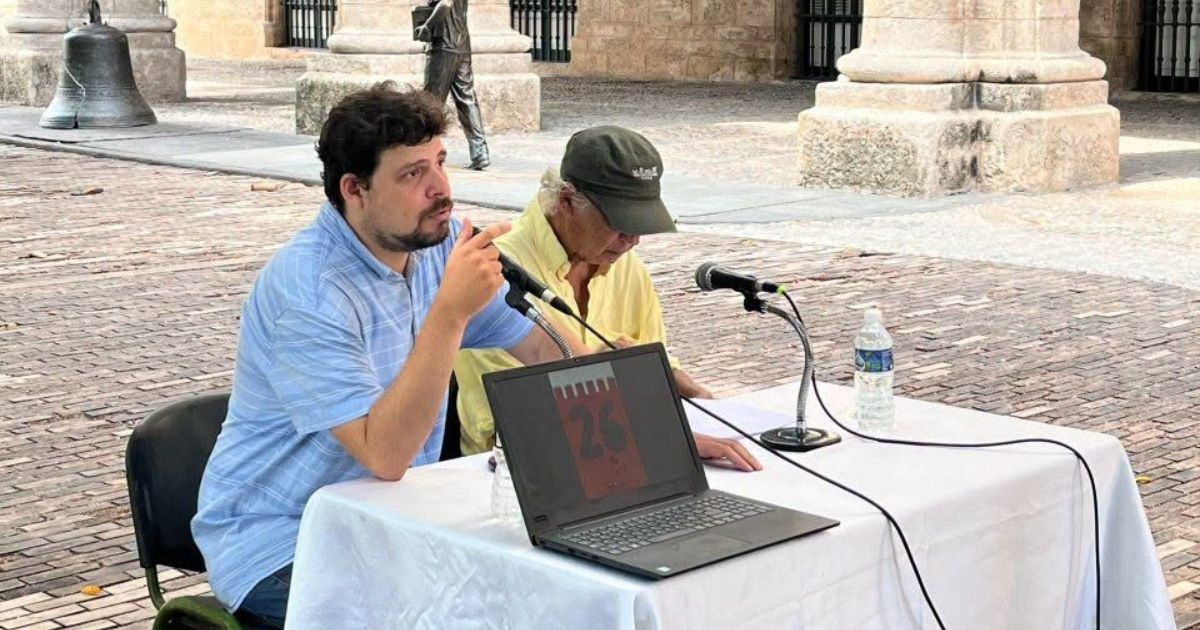
While Cuba is drowning in blackouts lasting between 20 and 40 hours, chronic hunger, and shortages of all kinds, the regime's propaganda machinery does not rest: this Saturday, the Cuban Institute of Books presented the book "26" during the "Saturday of Books" event in Old Havana, in commemoration of the 73rd anniversary of the assault on the Moncada Barracks.
The work, published by Editorial Ciencias Sociales, brings together accounts from the key figures of what the regime refers to as the "Moncada feat": Fidel Castro, Raúl Castro, Haydeé Santamaría, Jesús Montané Oropesa, Melba Hernández, Pedro Miret, and Marta Rojas, among others.
The most striking aspect of the launch is that the publication is not exactly new: its last printed edition dates back to the 1970s. What the regime is now presenting as a major novelty is a book from half a century ago repurposed into electronic format. The official spokesperson Michel Torres Corona, director of the Nuevo Milenio Publishing House, described it unabashedly as an “editorial novelty.”
Ricardo Hernández Otero, researcher and university professor, noted that the work "represents a tribute to the men and women who, over seventy years ago, dedicated their lives to this cause." The event was presided over by Juan Rodríguez Cabrera, president of the ICL.
The contrast with the Cuban reality could not be more stark. According to the Food Monitor Program, 96.91% of the population does not have adequate access to food, and 33.9% of households had at least one person who went to bed hungry in 2025. The cultural machinery of the regime, however, finds resources to reissue the narratives of the armed struggle of 1953.
The irony reaches difficult heights when recalling that Granma and Juventud Rebelde are now printed only once a week with just eight pages since March 2, and provincial newspapers have ceased to circulate on paper due to a lack of supplies. There isn't enough paper to inform Cubans, but there is enough —or its digital equivalent— to publish books of revolutionary exaltation.
In October 2025, the regime launched the collection "Raúl Castro Ruz, Selected Works," consisting of nine volumes and over 5,000 pages, partially funded by 3,000 collections donated by the Party and Government of China. On May 30, 2026, it presented the book "Revolution, the Most Beautiful Work" to celebrate Raúl Castro's 95th birthday. The paper that is lacking for newspapers is abundant for laudatory books.
The national central event of July 26 was assigned to Pinar del Río, a province that the official discourse presents as an example of achievements. The reality is different: more than 40,000 families in Pinar del Río remain without housing, the damage from Hurricane Ian has been resolved by only 63% four years later, there are neighborhoods without regular water supply for more than two years, and power outages exceed 30 consecutive hours.
The assault on the Moncada Barracks took place on July 26, 1953, when young people led by Fidel Castro attacked the armed facility in Santiago de Cuba in a failed attempt to overthrow the dictatorship of Fulgencio Batista. It was a military failure that the regime turned into a foundational myth. Seventy-three years later, the propaganda machinery continues to operate, books keep being published, and the Cuban people remain without food, without electricity, and without a future.
Related videos:
Filed under: