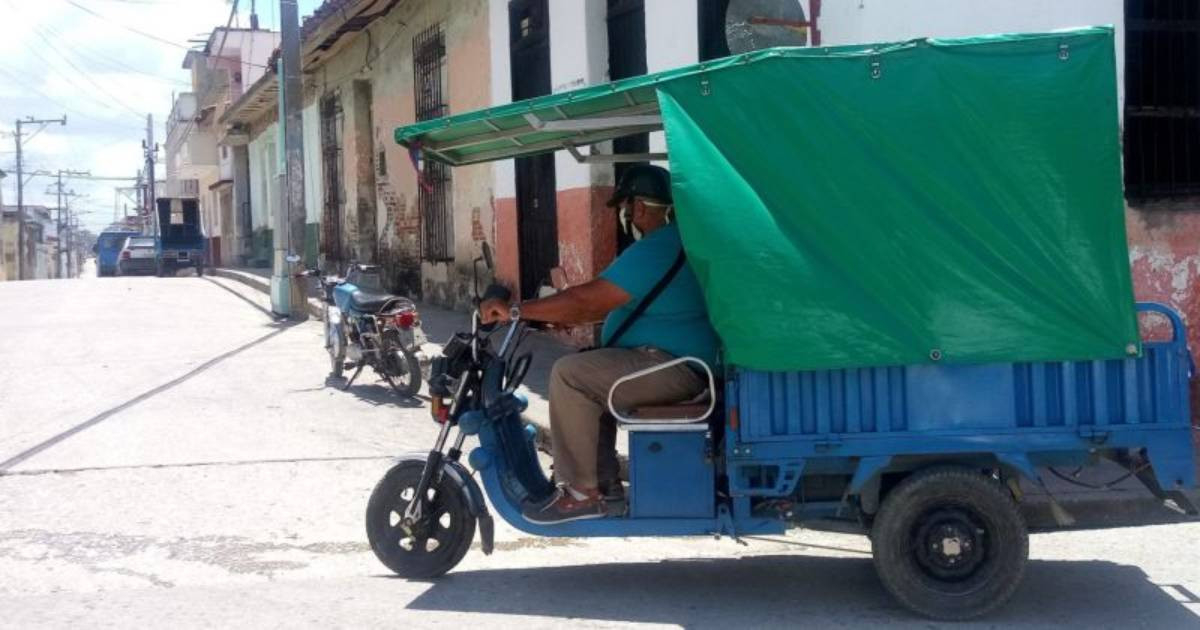
The authorities in Sancti Spíritus announced this Saturday that starting August 1, they will begin to "crack down" on electric tricycles operating without legalization, in a move that highlights the contradiction of the Cuban regime, which tolerated a completely informal sector for years and is now threatening to sanction it.
This was confirmed by José Lorenzo García, the delegate of the Ministry of Transport (Mitrans) in the central province, in statements to the official newspaper Escambray.
"Today, the vast majority are illegal. Starting August first, we plan to begin controlling them on the routes, organizing the tricycles by routes because many pick-up points are also illegal," he said.
The official was explicit about the consequences for those who do not regularize their status. "Starting August first, anyone on the road without proper legalization, without the special permit sticker, will be penalized," he emphasized.
The legalization process is conducted municipality by municipality and includes certain flexibilities: drivers who do not have three years of driving experience will receive a special provisional permit until that requirement is met.
Membership in the Transportation system is voluntary, although the authorities aim to persuade operators to join stands with rates set by municipal governments. Door-to-door service will also be allowed with differentiated pricing.
García acknowledged that many tricycles are operated by individuals who are not even their owners and that numerous drivers work without a license.
"In no country in the world can you be violating tax laws without contributing anything to the state budget," he pointed out.
The paradox is hard to ignore. The Cuban government promoted electric tricycles as an alternative due to the collapse of public transportation and the critical fuel shortage, yet allowed them to operate without any effective regulatory framework for years.
In Sancti Spíritus, the collapse was particularly severe: in May 2026, almost all intermunicipal and urban routes were suspended due to a lack of diesel, with only one daily departure to Havana remaining. In light of this gap, private tricycles became the only real alternative for mobility, charging fares that the very delegate describes as "astronomical."
The pattern had already repeated itself in Matanzas, where in June fares doubled overnight, reaching 300 pesos per trip. The local government only intervened to set regulated prices, following the massive outrage from users.
The legal framework supporting the current regulation is Instruction No. 1 of 2026 from Mitrans, which allows for the exceptional and temporary granting of Transport Operation Licenses – valid for one year and until December 31, 2026 – to owners of electric tricycles, using the chassis number as a reference when the vehicle lacks a license plate.
Related videos:
Filed under: