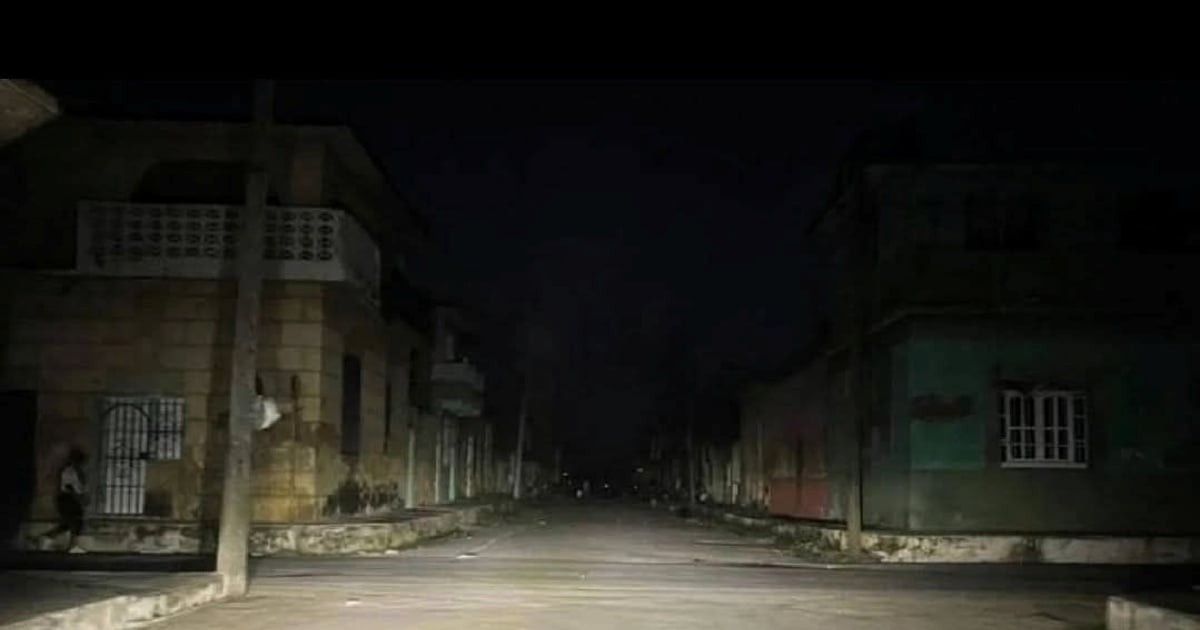
Cuba arrives at this Saturday, the eve of the 73rd anniversary of the assault on the Moncada Barracks, plunged into an unprecedented electrical crisis.
While the regime prepares to celebrate on Sunday with a central event in Pinar del Río, millions of Cubans face darkness with no end in sight.
According to the informative note from Unión Eléctrica, on Friday the service was interrupted for 24 hours across all provinces, with a maximum impact of 2,315 MW at 9:10 PM.
For this Saturday, an impact of 2,160 MW is expected during peak hours. The gap between what the system can generate and what it needs is enormous: with a demand of 3,200 MW, the availability will be 1,070 MW.
Five thermal generation units are out of service at the power plants Máximo Gómez, Ernesto Guevara, Diez de Octubre, Lidio Ramón Pérez, and Antonio Maceo, while four others are undergoing maintenance.
Additionally, 106 distributed generation plants were out of service due to lack of fuel.
In that context of widespread darkness, something happened on Friday that many residents of Havana had not seen in weeks: precisely at 9:00 PM, the exact time called for by the Assembly of the Cuban Resistance for a national pot-banging event, entire neighborhoods in Havana received electricity simultaneously.
The images were captured by activist Leonardo Romero Negrín and shared by journalist and activist Mag Jorge Castro, who did not hesitate to label the episode as a deliberate maneuver by the regime to demobilize the population ahead of the protests.
"Entire neighborhoods electrified at the same time, after weeks without light during the night. The regime responded this way to the large national call… the electricity lasted little and protests began," Castro wrote in his post.
The maneuver, if it was one, was ineffective.
The clanging of pots could be heard in Lawton, San Agustín, La Coronela, and La Lisa, in Havana, as well as in Santiago de Cuba and Cienfuegos. In the Lawton neighborhood, residents of Parque Dolores used pots and fire extinguishers to amplify the sound of their protest.
July 2026 has been the most critical month of the Cuban electricity crisis in recent years. The National Electroenergetic System (SEN) has experienced three total collapses—on the 6th, the 10th, and the 14th—leaving approximately 9.6 million people without power each time.
The accumulated indignation has been building for weeks. Lawton already featured protests on July 18 and 19 with slogans of "Freedom" and "We want the light," and a casserole strike in El Vedado after 30 hours without electricity showed that the protests are spreading throughout the capital.
Mag Jorge Castro concluded his publication with a call that encapsulates the mood of the protesters: "Let every day at 9 PM all of Cuba be heard and let the sound of the pots and pans be heard. Let us extend the national cacerolazo for every day that a Cuban family suffers injustice, for every prisoner, for every hungry child. Now is the time."
Related videos:
Filed under: