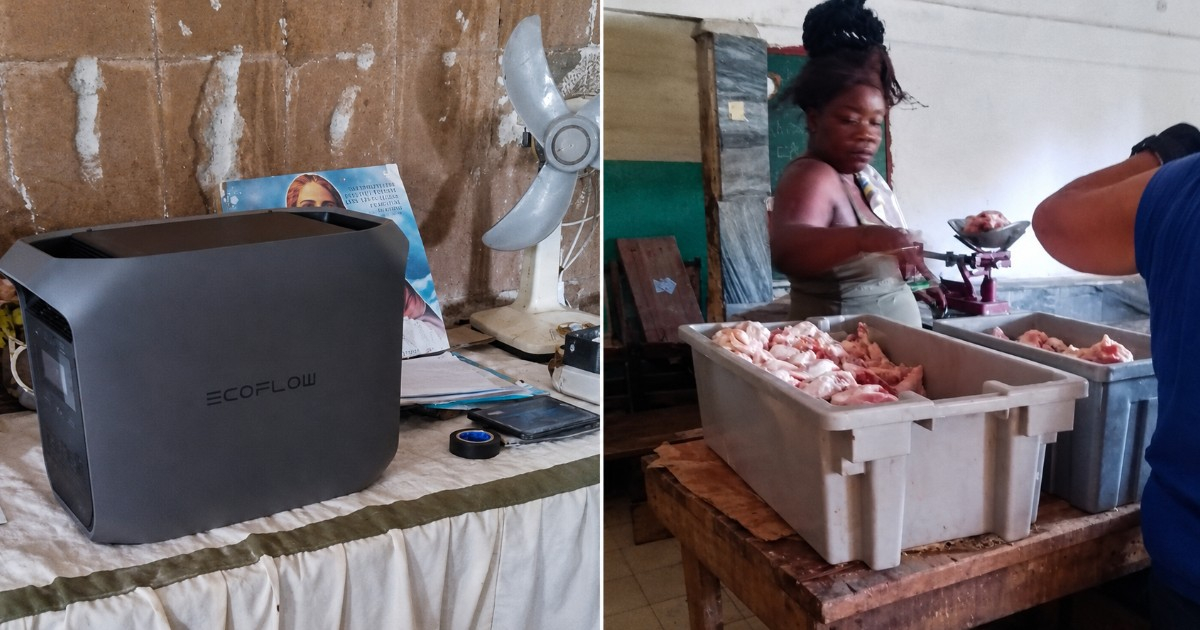
The administrator of a market in the Micro 70 neighborhood of Nueva Gerona, Isla de la Juventud, brought his own portable power station EcoFlow to the chicken sales stand to ensure the scales operated and to provide lighting in case the distribution extended into the evening, according to a post by Bárbara Pérez on Facebook that circulated this Sunday.
The author celebrated the initiative with a "Bravo" and presented it as an example to follow: "These are the best practices we should adopt daily."
His statements celebrate a personal initiative, undoubtedly commendable, yet one that relies solely on the will and resources of the administrator. In reality, it is the regime that should ensure the necessary means for workers to perform their duties.
Furthermore, the fact that the manager has chosen to bring his own equipment to avoid interrupting distribution illustrates how deeply the energy crisis has penetrated the daily operations of state-run retail.
What might seem like a curious anecdote in another context is, in the Isle of Youth in 2026, a logical response to an unprecedented electricity crisis.
The territory has only two hours of electricity per day, a dramatic decrease from the six hours that the general director of the National Electric Union, Rubén Campos Olmo, acknowledged in May during a Mesa Redonda.
The local electricity generation operates at only 18 MW compared to the 48 MW of installed capacity, a direct result of the lack of fuel and the deterioration of the generation fleet.
In February, the Electric Company of the Island had already announced four-hour cyclic outages due to a lack of fuel, a situation that has only worsened.
On the other hand, the episode adds to a series of makeshift solutions that Cubans have developed to cope with power outages.
In the Isle of Youth, the regime even went so far as to enable power outlets in solar parks so that the population could charge electronic devices, a measure that reflects the extent of the collapse.
Related videos:
Filed under: