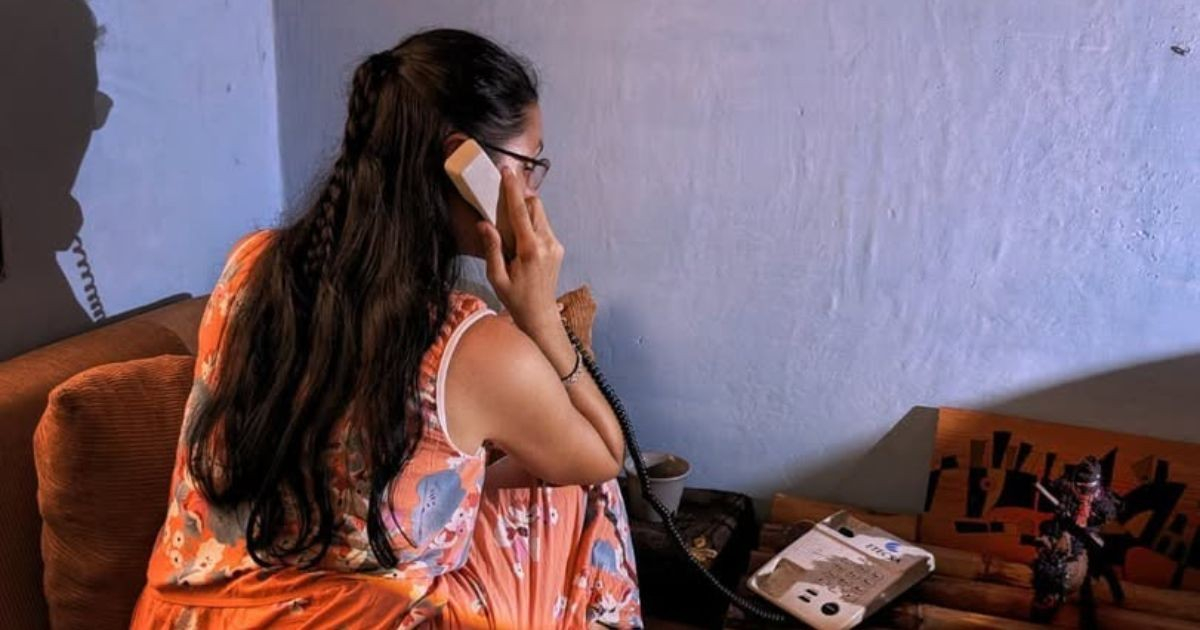
The Cuban intellectual Isabel Cristina López Hamze, a theater scholar and professor at the University of the Arts (ISA) in Havana, imagined her own departure from Cuba in a piece of poetic prose published this Sunday that uses the recurring idea "The house is left alone," reflecting the collective pain left by the massive exodus from the island's homes.
The author clarified that she has no intention of emigrating, but that the departure of several close people in the same month prompted her to put herself in the shoes of those who do: "This month several people close to me have left, and it's inevitable that a feeling of abandonment shadows my joy for them. I don’t want to leave, but I’m interested in putting myself in the others' shoes because my dream is to write novels. Imagining my departure, I wrote this text."
The result is a poetic inventory of the objects that would be left behind: the grandmother's scale swaying in the wind "as if a ghost were sitting on it every afternoon," the sofa where the cat and visitors from around the world would sleep, the frying pan for making chicharrones, and the swing on the little porch "where we dreamed that the children who were never born would swing."
Every detail holds a precise domestic story: the bike tire that got flat on a trip to Gran Piedra and was never thrown away “because it was nice to keep that memory,” the bathroom tiles installed with “a makeshift cement,” the empty clotheslines, and the rusty water tank that they continued to use “because we didn’t have another one.”
The text reaches its highest intensity when López Hamze suggests that the house would remain alone even if other identical occupants were to inhabit it: "And if we decided to stay in the house, if we closed the doors and windows and filled every little gap with paper scraps, so that we couldn't get out anywhere… the house would still be alone."
The closing takes the metaphor to its limits: "One would have to burn the house with all its smells inside to save it from solitude. But even in ashes and scattered through the air, our lonely house would fall upon the city. It would fall upon the heads of the people, upon other houses, upon the memory of itself, abandoned."
The mini-chronicle resonates with an unprecedented demographic reality. According to data from the National Office of Statistics and Information released in July 2026, Cuba recorded a negative migration balance of 245,264 people in 2025, with 317,320 external emigrants compared to only 72,056 immigrants.
This negative balance is further compounded by a natural decline: only 68,051 births compared to 134,354 deaths in 2025, which means that Cuba is losing population due to both emigration and aging simultaneously. The island's population ended that year at 9,434,593 inhabitants, well below the approximately 11.3 million before the accelerated exodus that began after the protests on July 11, 2021. Independent specialists estimate the current population of the country to be even below 8.1 million people.
Eighty percent of those who emigrate are between 15 and 59 years old, exacerbating aging demographics and putting pressure on the pension system. The largest negative balances in 2025 were concentrated in Havana, with 57,433 people, followed by Santiago de Cuba, Holguín, and Matanzas.
The exodus does not distinguish profiles. Artists and intellectuals have left the island, driven away by agonizing daily blackouts, chronic shortages of food and medicine, and sustained inflation. Musician William Vivanco emigrated to Spain in January 2025, stating that there is "no future" for artistic work in Cuba. In July 2026, visual artist Luis Manuel Otero Alcántara left for Miami after five years in prison, describing his departure as a forced expulsion.
Approximately 38% of Cuban families have at least one member living abroad. López Hamze's piece circulated on social media and received comments from Cubans both inside and outside the island, who recognized their own stories of departure or waiting in those everyday objects—the balance, the pot, the rusted tank. They pointed out that the text accurately described what no statistic can capture: the silent emptying of homes left behind by the exodus.
Related videos:
Filed under: