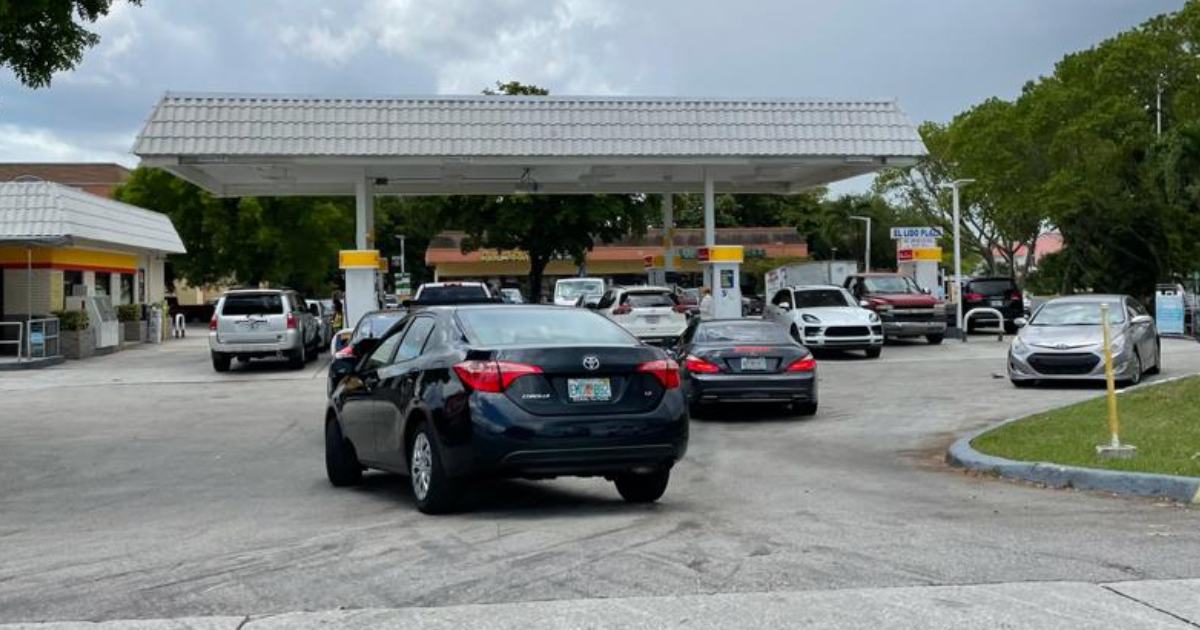
The gas prices rose again in South Florida, with several counties exceeding or nearing $4 per gallon on Monday, according to data from AAA and GasBuddy published on July 27.
Miami-Dade recorded an average of $3.96 per gallon, three cents more than the previous week; Fort Lauderdale (Broward) reached $4.01, with an increase of two cents; West Palm Beach and Boca Raton hit $4.12, also two cents above last week, while Monroe County —the Keys— was the most expensive in the region at $4.19, although it dropped one cent compared to the previous week.
The increase is not only local. Nationally, the average rose 11 cents compared to the same day of the previous week, according to GasBuddy, which surveyed nearly 1,700 stations in South Florida. The average price in the Miami area is now 15 cents higher than a month ago and 91 cents higher than a year ago.
The main driver of the increase is the geopolitical tension surrounding the Strait of Hormuz, a strategic passage through which a significant portion of the world's oil flows. The instability in that region pushed crude oil prices into the $90 per barrel range, which quickly translated to the pumps.
"Currently, drivers must expect fuel prices to remain high, but the intensity of any new increases will largely depend on how the geopolitical situation unfolds over the next week," warned Patrick De Haan, head of petroleum analysis at GasBuddy.
Within Florida, the gap between the northern and southern parts of the state is notable. The cheapest markets are Panama City ($3.70), Pensacola ($3.74), and Crestview-Fort Walton Beach ($3.76), while the most expensive are West Palm Beach-Boca Raton ($4.10), Fort Lauderdale ($4.00), and Naples ($4.00), according to AAA.
This increase comes after a period of temporary relief. In June, gasoline prices fell in Florida after signs of de-escalation between the United States and Iran brought Brent down to around $83 per barrel. However, uncertainty regarding the durability of the ceasefire pushed crude prices back up in July.
The recent historical context is even more dramatic: in May, gasoline in Florida rose by 40 cents in one week, reaching a peak of $4.34 per gallon, while in April Miami Beach surpassed the $5 per gallon mark, with recorded prices as high as $5.39 in that area.
To reduce fuel expenses, experts recommend combining errands, paying in cash—some establishments charge a surcharge per gallon for those using credit cards—avoiding excess weight in the vehicle, and using apps like GasBuddy to locate the most economical stations in each area.
The behavior of prices in the coming days will depend, according to analysts, on the evolution of the situation in the Middle East and whether the oil market perceives a lasting stabilization in the region.
Related videos:
Filed under: