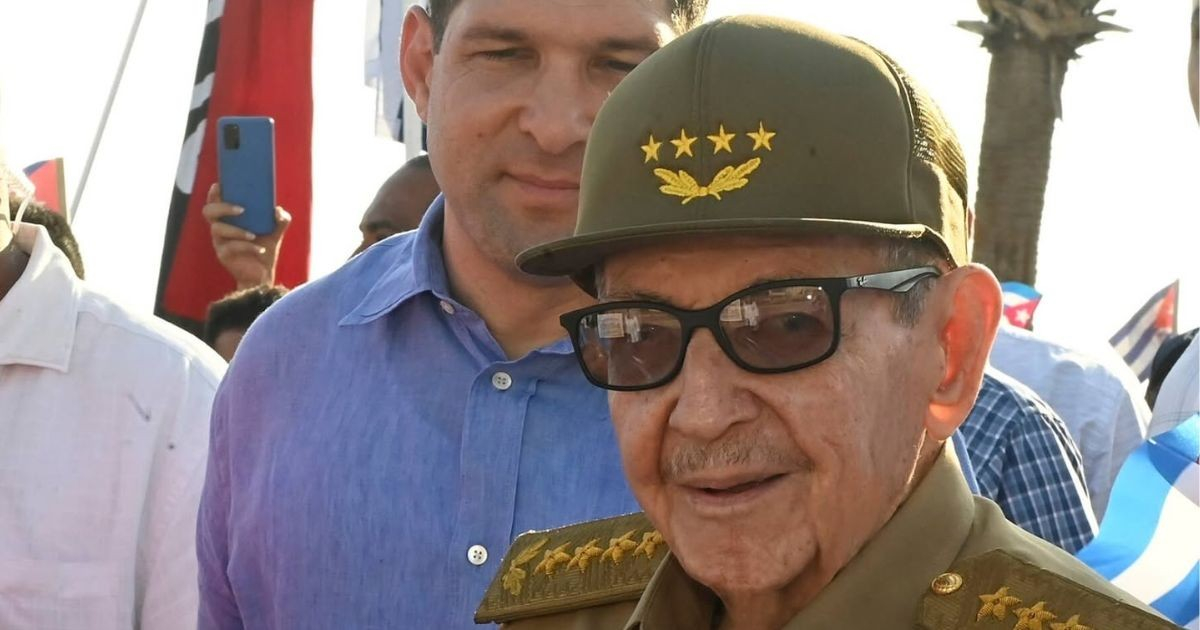
A message with a handwritten signature from Raúl Castro to the inhabitants of Pinar del Río, circulated this Sunday on the Facebook page of the Presidency of Cuba to mark the 73rd anniversary of the assault on the Moncada and Carlos Manuel de Céspedes barracks, sparked mockery and irony on social media, highlighting the gulf between the official discourse and the reality experienced by the people of Pinar del Río and all Cubans.
The text, published by the official account of the Cuban Presidency and read at the event by Miguel Díaz-Canel, stated: «Dear people of Pinar del Río: Receive, this July 26, my affection and recognition for having earned, through your effort, dedication to the revolutionary cause, and creative work, the great honor of being the host of the central event for the 73rd anniversary of the assault on the Moncada and Carlos Manuel de Céspedes barracks, National Rebellion Day. A warm embrace to all, Raúl Castro Ruz, 26-7-2026».
The detail that did not go unnoticed: the 95-year-old former president did not bother to appear physically in Pinar del Río, as reported by the AP agency, in what may be his first absence in at least three decades at a central event on July 26, with no explanation provided by the regime.
The response from Cubans on social media was immediate and straightforward.
An internet user captured the collective sentiment with a phrase that went viral: “And as a gift, here are 48 hours without electricity. Thank you, revolutionary people.” Another one wryly recalled a historical promise from Castro: “Soon you’ll get your little glass of milk... promised since 2007. Signed: Raúl Castro.” A third was even more direct: “Keep resisting, people from Pinar, while we’ll continue getting richer; this is the real message.”
The demands surfaced bluntly: "Turn on the electricity and water," wrote another user, while someone else simply wrote two words that said it all: "More grinding."
Sarcasm had a solid basis in reality. Pinar del Río faced a historically significant electrical crisis this Sunday: in March 2026, it was left completely in the dark after a malfunction in the Mariel-Pinar del Río transmission line, and in July, the National Electric System experienced three total collapses — on the 6th, the 10th, and the 14th of July — leaving millions of people without electricity each time.
In the days leading up to the event on the 26th, Cuba was experiencing massive blackouts with a peak impact of 2,315 MW, including outages lasting up to 24 hours across all provinces.
This Sunday, the National Electroenergetic System recorded a mere availability of 1150 MW against a demand of 3,200 MW, while the Antonio Guiteras thermoelectric plant went offline due to a new technical failure—the 17th of the year—in the early hours of the morning.
The fact that the regime could indeed find fuel and resources to stage the political spectacle in Pinar del Río was precisely the target of the sharpest criticisms. Since the announcement of the event's location and all its preparations, Cubans had responded with phrases like "We're suffocating, stop the talk," "Cuba is not celebrating, you're killing the country," and "There's fuel for that."
It was the fourth time that Pinar del Río hosted the central event of July 26, following the editions of 1976, 2000, and 2017, and the first time that Raúl Castro himself—who governed Cuba from 2008 to 2018 and seemingly retains symbolic leadership and control over the military elite—merely sent a signed document while the province that was supposedly being honored, and the entire nation, has been crumbling for months amid power outages, shortages of water, food, and medicine.
Related videos:
Filed under: