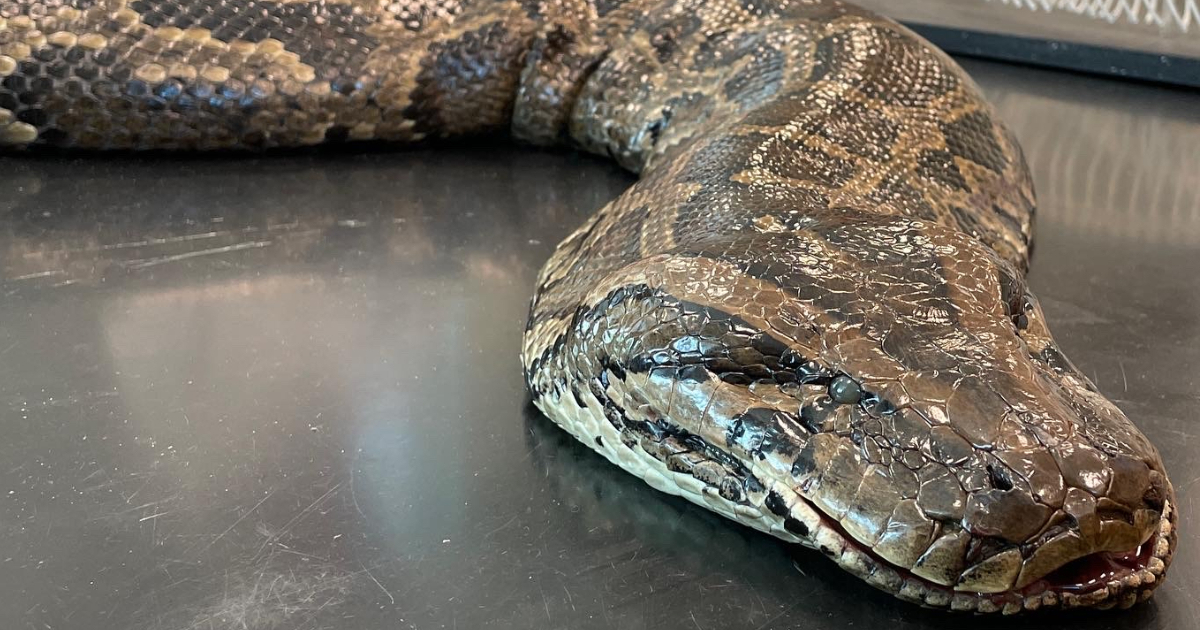
Burmese pythons have established a breeding colony in Charlotte County, Southwest Florida, marking the first confirmed expansion of the species outside its historical range in the southern part of the state, as ABC News.
The Florida Fish and Wildlife Conservation Commission (FWC) confirmed that Burmese pythons are now considered "established" in a part of western Charlotte County, north of Naples and Fort Myers, on the Gulf Coast.
Until this confirmation, the established range was considered to extend from the south of Lake Okeechobee to Key Largo, and from the west of Broward County to Collier County.
The first reports of sightings in the area began to multiply starting in 2020, concentrating in the towns of Rotonda West, Placida, Englewood East, and South Gulf Cove.
Biologists have identified an active breeding colony near the Charlotte Harbor Preserve State Park.
Authorities rule out that this new colony is the result of natural migration from the Everglades.
The FWC believes that the animals were pets that escaped or were deliberately released by their owners.
Ian Bartoszek, biologist and scientific coordinator of the Conservancy of Southwest Florida, endorsed that conclusion: "The evidence of the new colony is consistent with what biologists would expect from a satellite population established through intentional introductions, not from natural expansion."
The FWC and its partner agencies continue to monitor Charlotte and Lee counties, although experts acknowledge that, at this time, there is no effective large-scale solution to reverse the ecological damage caused by this invasive species.
The problem has its roots in the exotic pet trade: the U.S. Fish and Wildlife Service estimates that about 180,000 Burmese pythons were imported into the country between 1975 and 2018, many of which ended up in the ecosystem due to escape or release.
Since the year 2000, the species has already had a self-sustaining population in southern Florida.
The ecological impact of these snakes is devastating. As generalist apex predators, they feed on raccoons, opossums, lynxes, caimans, birds, and deer, including prey larger than themselves.
In invaded areas of the Everglades, studies document declines of up to 99.3% in raccoon populations, 98.9% in opossums, and 87.5% in lynxes.
Bartoszek summarized it clearly: "It is a generalist apex predator, and that’s why we are so interested in removing it from the ecosystem."
Robert McCleery, an ecologist at the University of Florida, warned that once pythons establish themselves in an area, most mammal populations are decimated, leaving a "simplified ecosystem" dominated by rodents and other invasive species.
"This is a pattern that we have not yet found a way to stop or reverse on the scale necessary to address the issue," he noted.
One of the biggest obstacles to control is the difficulty in detecting these reptiles. The estimated success rate in search operations is only 1% to 3%, and in Everglades National Park, approximately one python is located for every eight hours of tracking.
Florida maintains active control programs. In June 2026, the state set a record by removing 177 Burmese pythons with a combined weight of 8,080 pounds during the mating season, surpassing the previous record of 6,300 pounds.
Additionally, the Florida Python Challenge 2026 offered $10,000 in prizes to the participant who eliminated the most snakes during the 10-day event, held from July 10 to July 19.
Related videos:
Filed under: