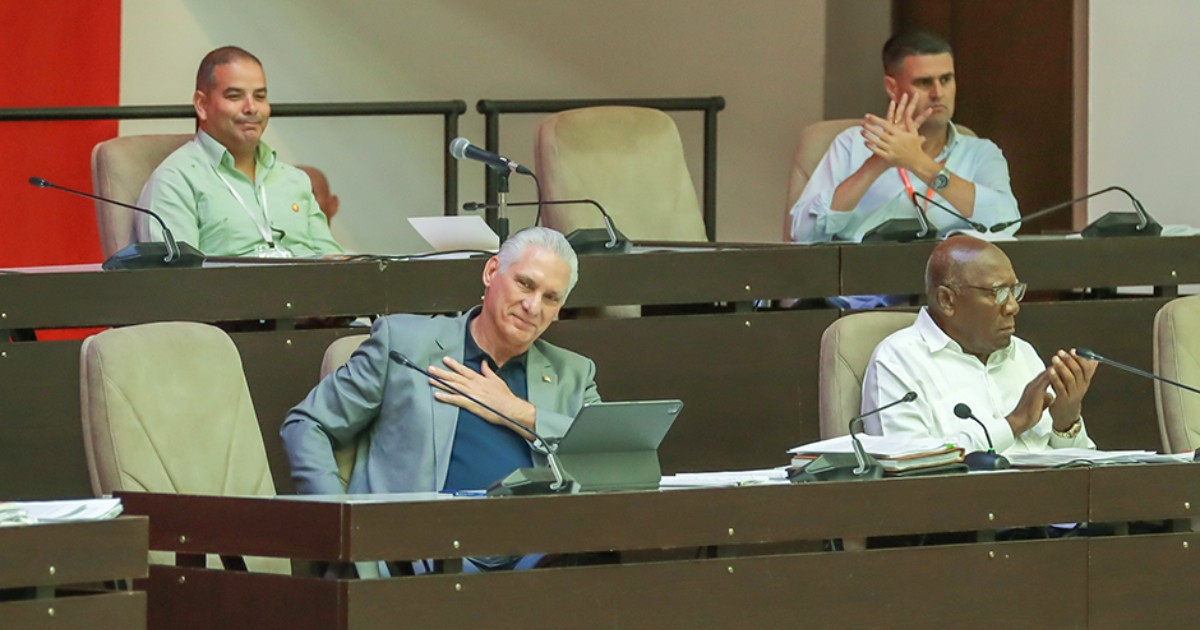
The National Assembly of People's Power inaugurated its VII Ordinary Session of the X Legislature on Wednesday at the Palace of Conventions in Havana, with the addition of ten new deputies and an extensive legislative agenda that, seemingly, does not include concrete responses to the crisis afflicting Cubans.
Raúl Castro connected via videoconference, while Miguel Díaz-Canel attended in person the opening of the session, which physically brings together only the representatives from Havana; the rest of the country participates remotely, according to the state media Cubadebate.
The first act of the period was to validate the election of ten parliamentarians—among them the official spokesperson Jorge Legañoa—to fill vacancies in an equal number of municipalities, in accordance with the provisions of Cuban Electoral Law, which mandates that municipal assemblies elect a substitute when a seat becomes permanently vacant.
The official agenda includes the evaluation of the so-called "economic and social transformations" implemented in 2026, the review of the State budget execution in the first half of the year, and the settlement of the 2025 budget, which is expected to have a deficit of 74.5 billion pesos.
Among the bills that the deputies must approve are the Agricultural and Forestry Land Law, the Law on the Organization of the Central State Administration —which would reduce the central agencies from 27 to 21—, the Housing Law, the Labor Code, and the Law on the Personal Identity and Address System.
The Chancellor Bruno Rodríguez Parrilla will additionally present a report on the international situation regarding Cuba, at a time when the pressure from Washington on the regime remains at its highest point.
The session began with a minute of silence in posthumous tribute to Ramiro Valdés Menéndez, who passed away on June 21, 2026, at the age of 94, one of the last survivors of the founding generation of the Revolution.
The context in which this parliament is convening —widely criticized as a ratification body without real debate— could not be more bleak. According to data from Infobae, Cuba's GDP has experienced a decline of over 15% since 2020, with an estimated contraction of 5% in 2025 and projections of up to 7.2% for 2026.
While the deputies debate laws, the population endures power outages of up to 30 hours a day, shortages of food, medicine, and fuel, as well as persistent inflation that erodes the purchasing power of salaries that, since July 1, have a minimum of 3,210 pesos, although the actual payment will be made in August.
In June, the regime announced a package of 176 economic transformation measures that includes opening up to private banking and private exchange houses, presented as the largest reform in decades, but whose real impact on the daily lives of Cubans remains to be seen.
The new Housing Law that will be debated in this session has raised concerns among analysts, who warn that it reinforces state control over the sector rather than expanding citizens' rights.
With 470 deputies in its X Legislature —now ten more than at the beginning of the term— the National Assembly meets only twice a year to approve, in a matter of hours, an agenda that the Communist Party and the Council of State have already predetermined.
Related videos:
Filed under: