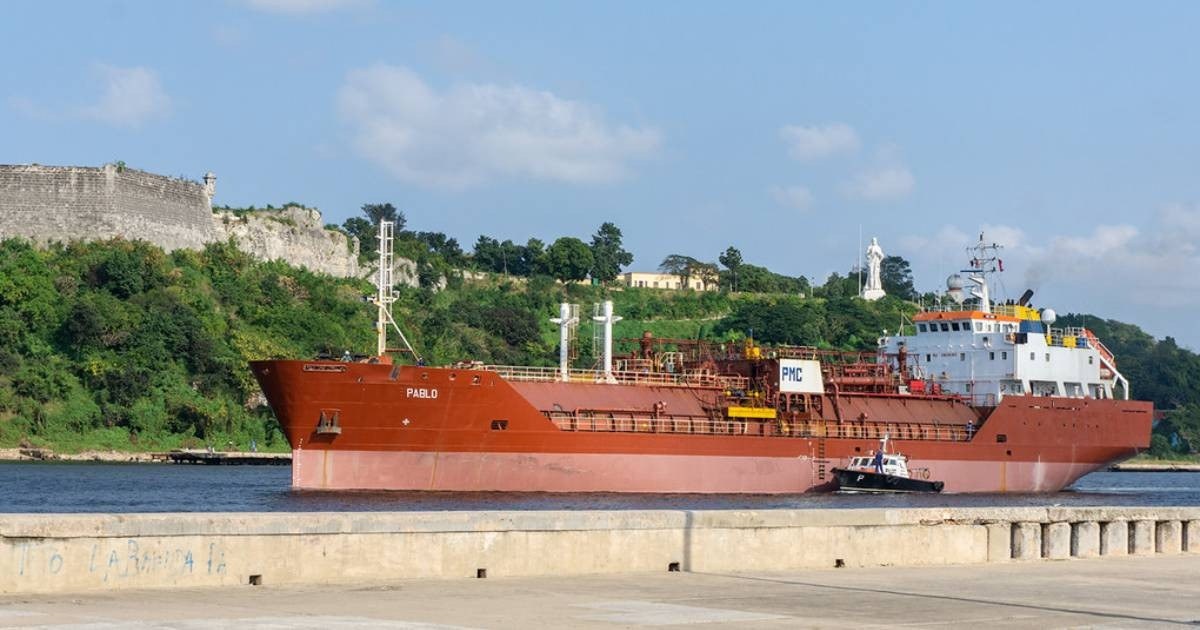
An international journalistic investigation revealed that at least nine shipments of Venezuelan oil valued at around 429 million dollars were sent to Cuba between May and September 2025, but left no trace in maritime monitoring systems or in the entry records of the island's ports.
The report, published this Tuesday by La Prensa of Panama, the Latin American Center for Investigative Journalism (CLIP), Armando.Info, Transparency Venezuela, and Diario de Cuba, is based on internal documents from the state-owned Petróleos de Venezuela (Pdvsa) and reveals an alleged scheme for the triangulation of shipments through shell companies.
According to the research, three companies registered in China, Singapore, and Hong Kong —Hangzhou Energy, Shineful Energy, and Forever Energy Trading— shipped 47 million barrels of Venezuelan crude during that period, with an estimated value of 2.6 billion dollars.
According to three sources from Pdvsa cited by the investigators, those companies were controlled through frontmen and were linked to the Panamanian businessman Ramón Carretero Napolitano and Carlos Malpica Flores, nephew of Nicolás Maduro and former vice president of Finance at Pdvsa.
The shipments destined for Cuba were consigned in the name of Cubametales, the state-owned company responsible for importing fuels and linked to the military conglomerate GAESA.
One of the most striking cases occurred on August 2, 2025, when the vessel Halima loaded 1.1 million barrels of Merey 16 crude oil with a declared destination of Cubametales. Two days later, the same tanker received another million barrels, this time consigned to Forever Energy Trading, one of the companies identified in the investigation.
According to a source from Pdvsa, the plan was to initially unload the crude oil in Matanzas and then continue to Malaysia, where it would be sold using cryptocurrencies to complicate the tracking of the operations.
However, the internal records of the Venezuelan oil company do not confirm that these shipments to Cuba were actually carried out.
Ships that never arrived... at least officially
One of the main findings of the report is that none of the identified ships appear to be arriving at Cuban ports.
The maritime tracking platforms MarineTraffic, VesselFinder, and Global Fishing Watch do not register arrivals in Matanzas, Havana, or Cienfuegos of the ships indicated by Pdvsa.
The research adds that the Energy Institute of the University of Texas detected six Venezuelan shipments sent to Cuba between June and September 2025, but none match the ten operations that, according to internal Pdvsa documents, were destined for the port of Matanzas.
The case of the Skipper
One of the episodes that best illustrates the complexity of the scheme is that of the tanker Skipper.
The ship was intercepted by U.S. forces on December 10, 2025, while transporting crude oil contracted jointly by Cubametales and Shineful Energy.
It had set sail from Venezuela six days earlier with a declared destination of Matanzas. However, during the journey, it transferred part of its cargo to the ship Neptune 6 at sea and subsequently continued its voyage towards Asia, according to data from the specialized firm Kpler, cited by The New York Times.
After the capture, the Cuban regime denounced the operation as an act of "piracy and maritime terrorism" and claimed that it worsened the already critical energy situation in the country.
In the midst of an electrical crisis
The alleged oil shipments occurred while Cuba was facing one of the worst energy crises in its recent history.
On July 21, 2025, the Electric Union reported a deficit of 2,045 MW, a record figure at that time, which led to power outages exceeding 12 hours daily in numerous provinces.
Despite the seriousness of the situation, a significant portion of the fuel that, according to Pdvsa's documents, was supposed to arrive on the island cannot be traced in public records.
The sanctions and the official silence
The investigation also reveals that the relationship between Ramón Carretero, a Panamanian businessman with a history of dealings with authoritarian governments, and the Cuban regime extended beyond the oil business.
His closeness to Raúl Rodríguez Castro, the grandson of Raúl Castro known as "El Cangrejo," was revealed after an air accident that occurred on September 24, 2025 at the Venezuelan airport of Maiquetía, where the flight log confirmed that both were traveling together.
Months later, on December 11, 2025, the U.S. Department of the Treasury sanctioned Carretero and Carlos Malpica Flores, extending the measures to the relatives of both and to companies linked to the investigated network.
In April 2026, Miguel Díaz-Canel publicly acknowledged that the Cuban economy had suffered a significant impact following the capture of Nicolás Maduro, but he refrained from disclosing information about oil imports.
"I’m not going to give you figures because these are things that are very closely monitored by American intelligence services to see how they can affect us," he declared at the time.
The journalists from the international alliance requested explanations from Cupet and the Ministry of Energy and Mines, but did not receive a response.
Thus, the main question raised by the investigation remains open: if the shipments left Venezuela bound for Cuba and never appeared in the island's port records, what happened to that oil valued at nearly 429 million dollars?
Related videos:
Filed under: