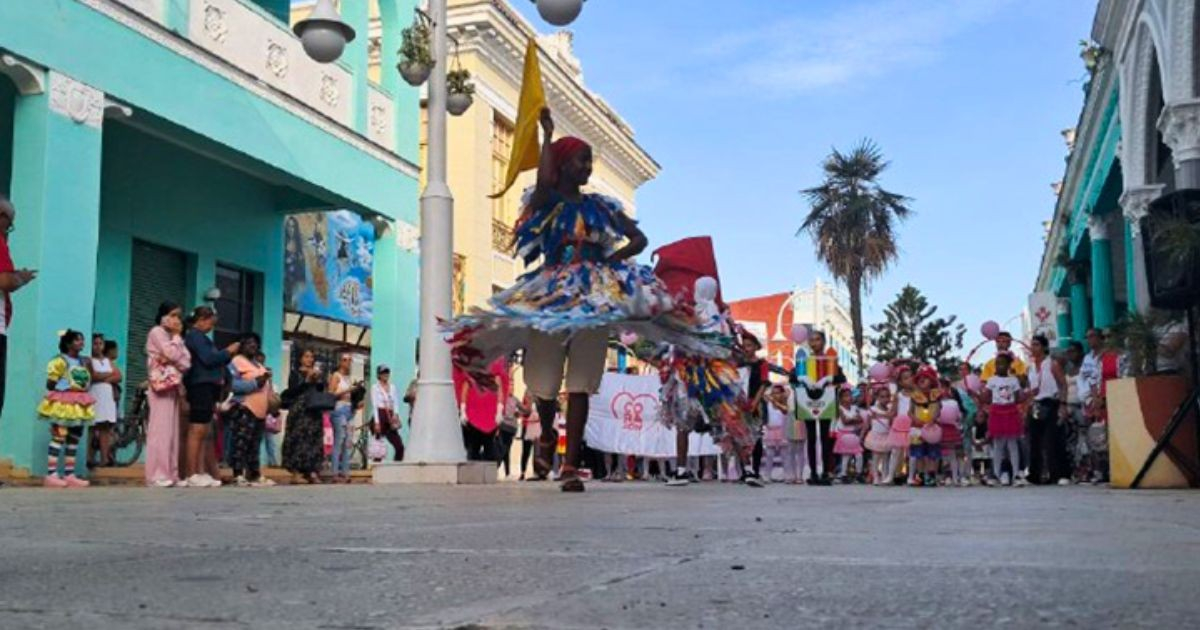
Neither the acrobats, nor the jugglers, nor the Caribbean Gagá are exempt from the mandatory ideological stamp in Cuba. The X Circus Art Festival, Circávila 2026, kicked off on Friday in Ciego de Ávila with a parade along the city boulevard, and the state agency ACN made it clear, without shame, that the festival "is part of the centenary of the birth of Commander-in-Chief Fidel Castro Ruz (1926-2016)."
The circus, ultimately, also belongs to Fidel.
The opening parade stretched from the Hotel Rueda to the Principal Theater, making three stops: acrobatics by the Haliom company at the Casa del Joven Creador, a performance of Gagá— a Caribbean popular expression with Haitian and Dominican roots— at the Casa de Cultura José Inda Hernández, and a show by the Guiñol Polichinela at the Sala Abdala, according to the source.
The tenth edition of the festival brings together Haliom, the National Circus School, the Movement of Amateur Artists, the Corazón project, and Polichinela itself, with the declared ambition of surpassing the reach of previous editions. Eight students from the National Circus School trained in the 2025-2026 program are also participating, and for the first time in the history of the event, the Ballet Folklórico Osokpuan Irawo has joined with choreography featuring "come candelas" and skillful machete demonstrations, the note adds.
The programming —the media details— includes the shows "People with Swing" and "Circus Varieties" at the Principal Theatre this Saturday, with the closing taking place on Sunday, August 2, featuring a Varieties show at 10:00 a.m. Admission costs 200 pesos, an amount that is not exactly symbolic in a Cuba facing power outages and shortages.
But the truly circusy aspect isn't on the floor: it's in the propaganda machinery that surrounds the event. The National Assembly approved on December 20, 2025 to name this year "Year of the Centenary of the Commander in Chief", and since then, practically no event on the island escapes the mandatory "framing."
The list of what already bears Fidel's mark in 2026 is as extensive as it is surreal: the 34th International Book Fair, the I International Colloquium "Fidel: Legacy and Future," the Havana Poetry Festival, the #ArteFiel campaign by UNEAC, blood donations as a "revolutionary commitment" in Holguín, tourist trips from Chile at $2,000 per person to attend the official events, and military personnel mobilized to plant a hundred cedars forming the name "Fidel" in military units across various provinces.
Now it's the circus's turn. The official slogan of the year is "Fidel is a country," and the regime seems determined to prove it function by function.
The reaction of many Cubans on social media to all this "framing" has been one of irony and weariness. Some refer to the year as "the centenary of Cuba's misfortune"; others simply call it "the year of the eternal blackout," in reference to the blackouts that continue to paralyze the island, which is also suffering from a chronic shortage of medicines and food, while the regime invests resources in glorifying its founder.
The Camagüey priest Alberto Reyes accurately described the model that produced this cult: “a State and a Party that only had one point of reference, one leader, one owner, one unquestionable voice: his”. The analyst Jorge L. León summarized it from another angle: “Democracies are sustained by institutions; dictatorships, by men”.
The central event of the centenary is scheduled for August 13 in Birán, Holguín, the birthplace of Fidel Castro. Until then, the regime will continue to look for events to "frame." The circus has already done its part.
Related videos:
Filed under: