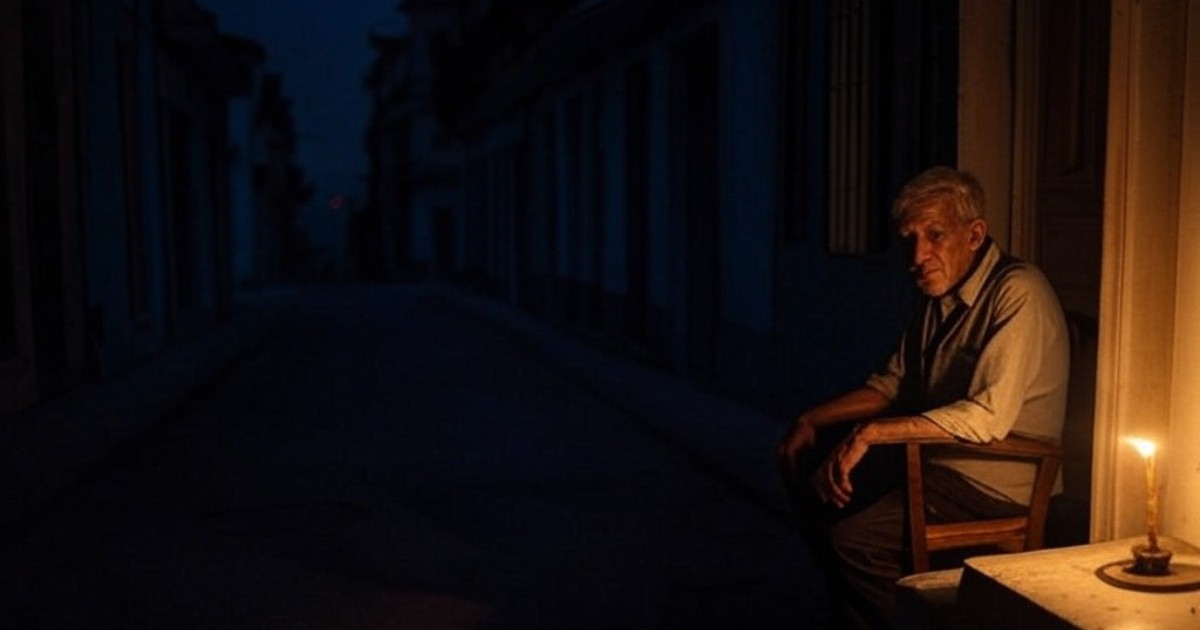
The writer and journalist from Camagüey, María Antonia Borroto Trujillo, published this Friday on her Facebook profile a spiritual survival manual for calling the Electric Union without experiencing a cardiac episode in the process.
The text is not exactly a technical manual: it is a guide to meditation, yoga, tai chi, prayer, and aromatherapy designed for the citizen to reach a state of Buddhist serenity before inevitably hearing the busy signal.
Borroto Trujillo, a doctor in Communication Sciences and a member of the Cuban Union of Writers and Artists (UNEAC), begins the protocol with seemingly reasonable instructions: "Breathe slowly and deeply for about three minutes. Recall pleasant scenes or moments of complete relaxation. Proceed to enter the corresponding digits."
So far, so good. The problem arises in the next step, which the author candidly anticipates: "If it rings busy, which is the most likely scenario."
And then the true manual begins. When faced with a busy signal, the citizen should light a stick of incense or a candle dedicated to their favorite saint, take eight breaths, and repeat a mantra— "it could be Om, the universal mantra"—before dialing again. If the line remains busy, the protocol escalates: more incense, alternate breathing, an Hail Mary, two or three laps around the room barefoot, a Our Father, and, if possible, "some simple yoga asana."
The story doesn't end there. Borroto Trujillo recommends going for a complete walk around the block, returning without shoes, and approaching the attempt with renewed calm. For those who are more advanced, he offers personalized options: "If you practice yoga, do the sun salutation. If tai chi is your thing, perform the 8-form. And try once more."
The punchline is a gem of Cuban irony: "This sequence does not guarantee good communication, but at least it will prevent a heart attack or a stroke."
Humor does not arise from pure imagination: it reflects the desperation of millions of Cubans trying to report power outages to the UNE through the official number 18888, which is supposedly available 24 hours a day, only to find the line busy or unanswered. July 2026 became the most critical month in Cuban electrical history, with three total collapses of the National Electric System in ten days. On the 6th, the 10th, and the 14th of July, millions of people were left without service; and on July 29, the available generation was merely 850 MW compared to a demand of 3,200 MW, with 74% of the country without power at the same time. The Electric Company of Santiago de Cuba admitted that it could not guarantee even two hours of electricity a day in some areas.
The post is part of a trend of dark humor that in 2026 has almost become a genre of its own on Cuban social media. Ulises Toirac made a joke about the blackout on July 26; Otto Ortiz mocked after receiving just 45 minutes of electricity; and Mario Sardiñas, with his character Chequera, reduced the blocks of the electrical system to just two categories: “with power” and “without power.”
Borroto Trujillo, recipient of the Calendario, Dador, and Eliseo Diego awards, demonstrated that in Cuba, self-help literature has an urgent and very specific niche: emotionally surviving customer service at the Electric Union.
Related videos:
Filed under: