
Related videos:
The Electric Company of Santiago de Cuba acknowledged this Thursday that it cannot adhere to the blackout schedule it announced just two days earlier, and that it will only restore service to the circuits with the longest outage times "with up to two hours of service," without even guaranteeing that minimum.
The official statement indicates that "due to the reduced demand to be served in the province authorized by the National Cargo Office, it is not possible to meet the planned schedule," and it attributes the noncompliance to "the decrease in available generation in the National Electric Power System."
The announcement suggests that the energy crisis in the country has intensified and that the National Electroenergetic System is once again at risk of a new collapse.
What makes the announcement more serious is its immediate context: on Tuesday, June 16, the same company had reorganized the power outages into nine blocks —eight for residential circuits and one for vital centers such as hospitals and water pumping stations— with a schedule of only one or two hours of electricity per day per area, applicable for June 16, 17, and 18.
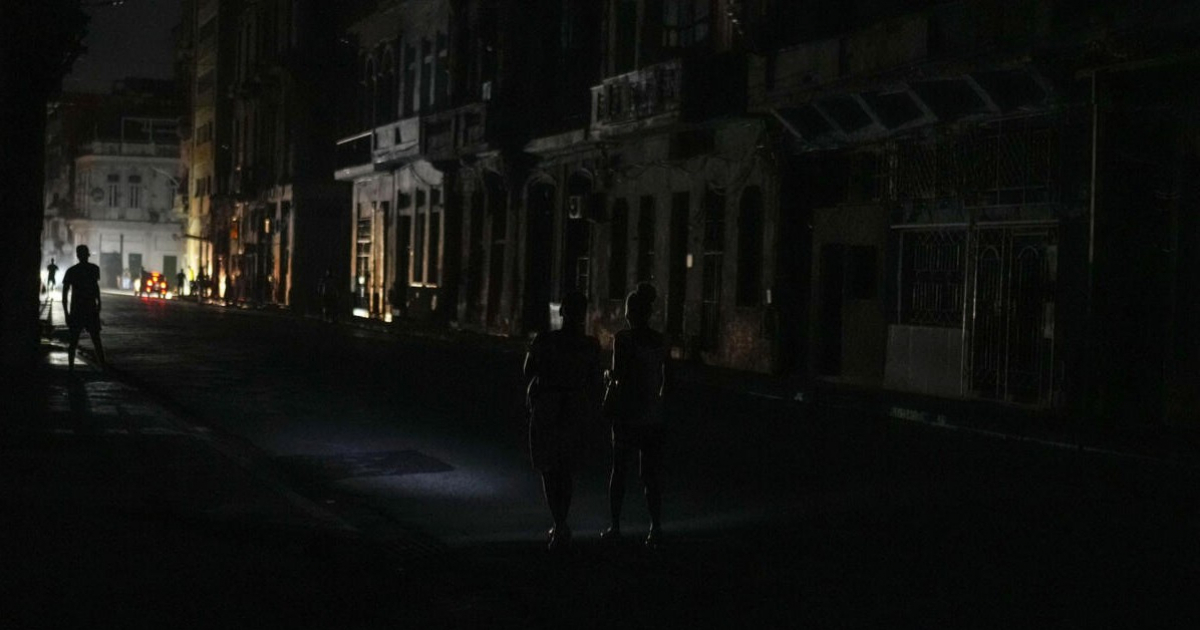
That scheme already left the people of Santiago without electricity for 22 hours or more each day. Now, not even that is guaranteed, which opens the door to outages lasting more than 24 consecutive hours.
The figures from the national electric system confirm the collapse. This Thursday at 6:00 a.m., the National Electroenergetic System had only 970 MW available against a demand of 2,650 MW, with 1,650 MW already affected. For the nighttime peak, the Electric Union projected a availability of 1,015 MW against a demand of 3,050 MW, with a deficit of 2,035 MW and a projected impact of 2,075 MW.
The deterioration is not sudden. On May 31, Lester Salvador Cedeño, head of the provincial Electric Company, had already publicly warned that "we can reach less than two hours of service," acknowledging actual deliveries of only one hour and 30 minutes or one hour and 45 minutes per block.
The situation has exceeded the patience of the residents. In the early morning from Wednesday to Thursday, there were reports of protests with pots and pans in various neighborhoods of Santiago de Cuba due to power outages, and throughout the day on Thursday, there have been reports of new protests in the streets of the city.
On Sunday, June 15, residents of San Ricardo had already protested after several days without electricity, and on Thursday, June 12, the José Martí Urban Center experienced a demonstration with demands for electricity, food, and freedom.
The crisis has structural roots that date back at least to 2024. In October of that year, the company reported only three hours of electricity and 21 hours of blackout; in November, it promised to guarantee at least five hours a day, a commitment it also failed to uphold.
In April 2026, the UN the Cuban energy crisis as having a systemic humanitarian impact, affecting health, water, sanitation, food, education, transportation, and telecommunications.
The statement from Tuesday, the 16th, warned that "the adherence to this schedule will depend on the daily performance of the SEN, so adjustments may be made to the proposed times and blocks." Two days later, that warning became a reality: not even the announced minimum can be met.
Filed under: