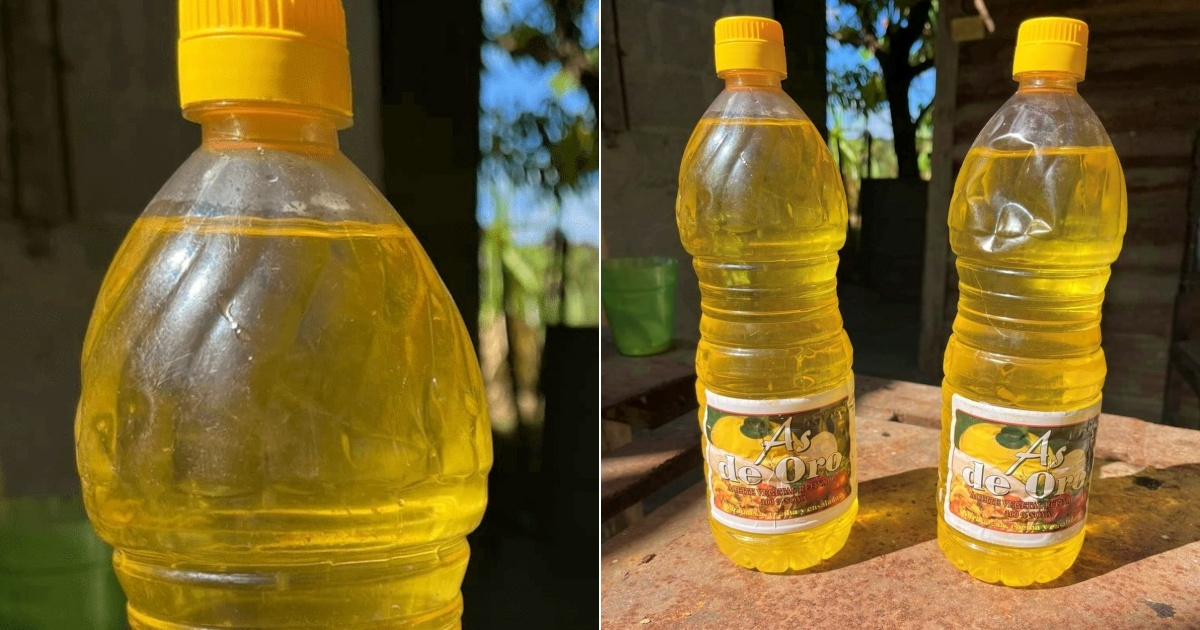
The Holguin writer José Poveda Cruz published this Sunday on his Facebook profile a text titled "The Bottle of Oil and the Invisible Laws of the Market", in which he ironically depicts the skyrocketing increase in vegetable oil prices in Cuba and dubs it "the true Olympic champion of prices."
Poveda Cruz, a member of the Cuban Union of Writers and Artists (UNEAC), compares inflation to a fever that on the island "learns to live with the patients and ends up becoming part of the routine," and points to oil as its most faithful thermometer: "That golden liquid, essential for frying an egg, cooking beans, or giving dignity to rice, has transformed into a more precise economic indicator than many speeches."
The fact that underpins their complaint is specific: “On the street, far from the vilified magnetic card and any attempt at regulation, a bottle is already hovering around three thousand pesos. [...] That would be almost six dollars for a bottle of oil, a price that is hard to find even in countries where salaries multiply several times ours.”
That figure is not a literary exaggeration. The price of a liter of sunflower oil in the informal market increased from approximately 1,500 pesos several months ago to between 2,000 and 3,000 pesos in July, with variations by province. A notable case was that of Sancti Spíritus, where the price astonishingly multiplied in less than 24 hours.
Behind this escalation lies a decision made by the regime itself: the Resolution 150/2026 from the Ministry of Finance and Prices removed the price ceiling for imported cooking oils, abolishing the previous limit of 990 pesos per liter. On July 16, the ceiling on rice was also eliminated, and the government did not distribute oil through the rationing card at any point in 2026.
Poveda Cruz notes that the explanation goes beyond logistical factors: "There may be delayed containers, logistical difficulties, or issues with imports. But it's also impossible to ignore another old custom: hiding the product until it reaches the desired price, turning scarcity into profit and someone else's need into a private opportunity."
The writer also dismantles the official narrative regarding salary increases: "While salary increases are announced for certain sectors, the price of oil embarks on an upward trajectory that threatens to consume them before they reach people's pockets. Inflation has that talent: it gives with one hand what it takes away with the other two."
The numbers support that reading. The new minimum wage of 3,210 pesos, effective from July 1, 2026, is equivalent to less than five dollars a month at the informal exchange rate, a sum barely sufficient to buy a single bottle of oil on the market without spending anything else on various household needs.
Economists estimate that a person in Cuba would need around 96,060 pesos monthly to cover their basic needs, with the largest portion allocated solely for food. The official inflation rate for June 2026 was 18.27% year-over-year, but independent estimates place the real inflation significantly above that figure.
The writer does not speak from a distance: "I do not speak from a comfortable academic distance. I too belong to the vast majority who feel this direct blow to our diminished wallets. I also do impossible math, I also watch as the expense notebook turns into a science fiction novel where the numbers defy all logic."
Poveda Cruz concludes his text with a sentence that blends analysis and resignation: "Because this no longer responds solely to supply and demand. Other, less visible and much more effective actors are involved here. [...] No; this is not simply supply and demand. This is pure, hard pressure."
Related videos:
Filed under: