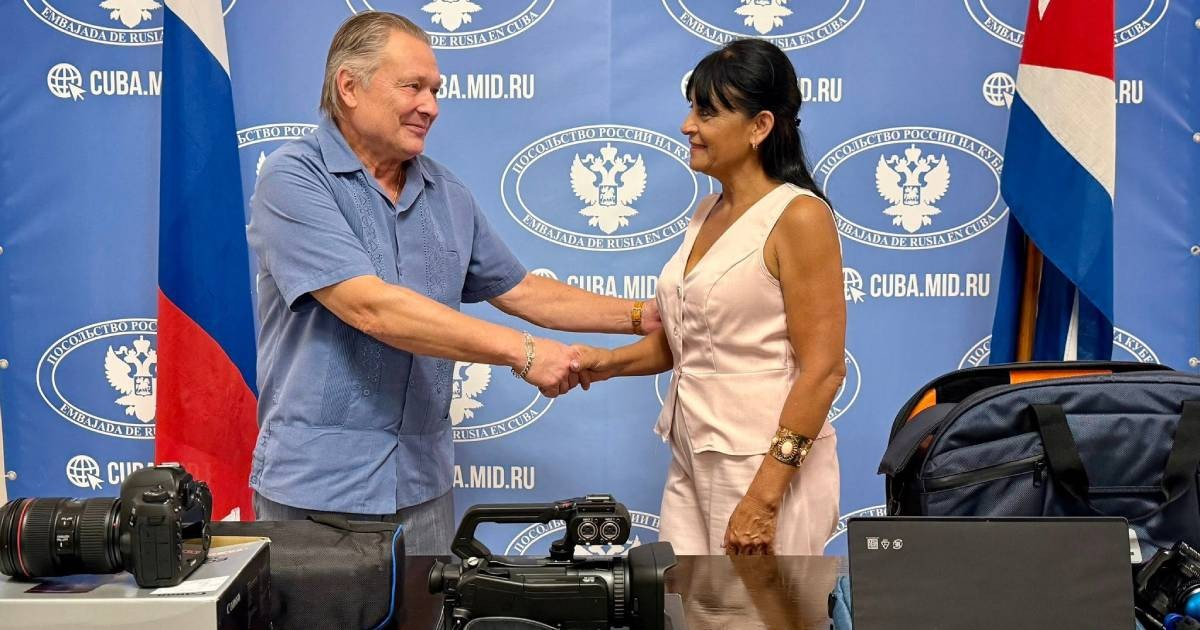
The Central Election Commission of Russia delivered a batch of technological and audiovisual equipment to the National Electoral Council (CEN) of Cuba this Tuesday in a ceremony held at the Russian Embassy in Havana.
The equipment includes a Canon EOS 5D Mark IV DSLR camera, a professional Canon camcorder, a laptop, and various accessories for photography and videography.
The event was chaired by the Russian ambassador to Cuba, Víctor Koronelli, and the secretary of the CEN, Eraida Espinosa Aguilar, who expressed, according to the official publication from the embassy, "the mutual willingness to deepen Russian-Cuban collaboration in electoral matters."
The delivery is not an isolated gesture: just four days later, on August 8, the chairwoman of the Russian Central Electoral Commission, Ella Pamfilova, and the chairwoman of the Cuban CEN, Alina Balseiro Gutiérrez, will sign a memorandum of electoral cooperation in Moscow aimed at refining Cuban electoral legislation, raising the so-called "legal culture," and promoting the use of modern technologies in the electoral processes of the Island.
The Cuban delegation made a two-day visit to the Russian Central Electoral Commission to learn about its regulations and technologies prior to signing the agreement.
The CEN is the state body responsible for organizing and overseeing elections, referendums, and public consultations in Cuba. It was established in July 2019 and consists of 21 members who report to the National Assembly of People's Power.
Electoral cooperation is part of a broader pattern of the Cuban regime's increasing dependence on Moscow, which over the past two years has included donations of medicines, ambulances, and vehicles, as well as commitments in the energy, military, and financial sectors.
In February of this year, Koronelli himself made Moscow's position clear: “Russia will continue to provide both political and material support to Cuba”.
The deepening of electoral cooperation between both governments is significant given that Russia is systematically highlighted by international human rights organizations as a model of non-competitive elections, while Cuba is a one-party state where the electoral system excludes real political pluralism.
The memorandum to be signed in Moscow on August 8 will formally consolidate that connection, turning the Cuban regime into an official student of the Russian electoral model.
Related videos:
Filed under: