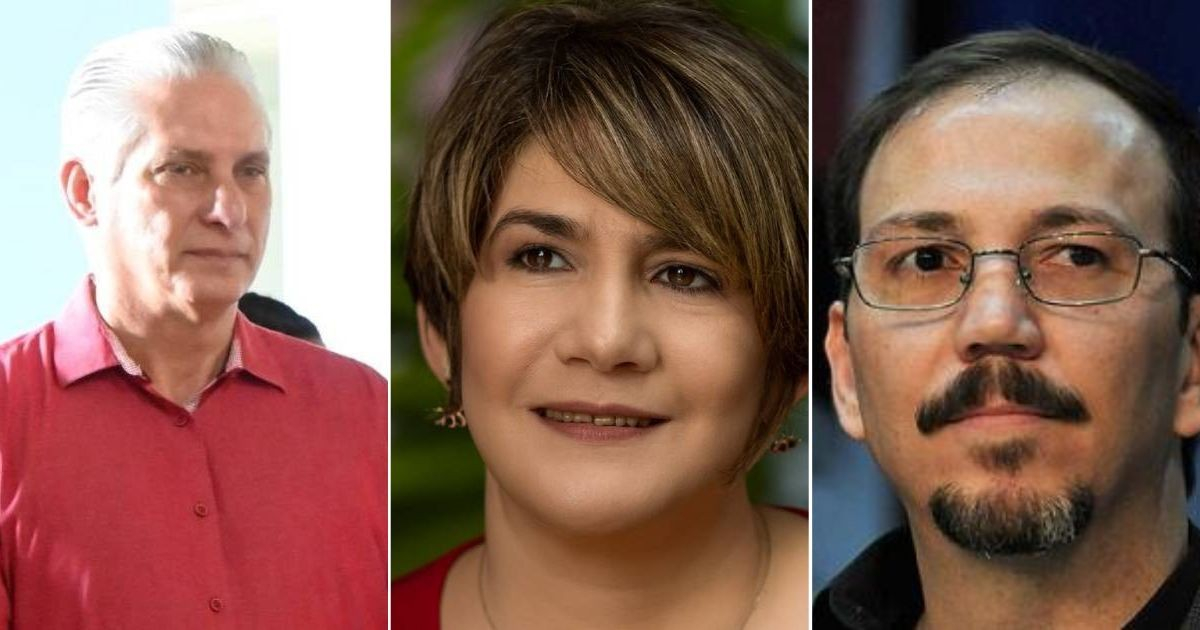
The United States government officially published sanctions this Wednesday in the Federal Register against five individuals and six entities linked to the Cuban regime, including leader Miguel Díaz-Canel, his wife Lis Cuesta Peraza, and several members of the Castro family.
According to Martí Noticias, the publication of the document 2026-15827 does not entail new sanctions, but rather permanently incorporates the measures adopted on June 4 by the Office of Foreign Assets Control (OFAC) of the Department of the Treasury, in accordance with Executive Order 14404, signed by President Donald Trump on May 1 of this year.
With this formalization, all assets and interests that the sanctioned parties may have under U.S. jurisdiction remain blocked, and it continues to be prohibited for U.S. citizens, companies, or institutions to engage in transactions with them.
In addition to Díaz-Canel and Lis Cuesta, the list includes the stepson of the leader, Manuel Anido Cuesta; the son of Raúl Castro, Alejandro Castro Espín; and the grandson of the former Cuban president, Raúl Alejandro Castro Calis.
The sanctions also target the Ministry of Revolutionary Armed Forces (MINFAR), the Committees for the Defense of the Revolution (CDR), the Cuban Institute of Friendship with the Peoples (ICAP), the travel agency Amistur Cuba S.A., linked to ICAP, and the mining company La Victoria S.A.
The inclusion of MINFAR has a special significance due to the influence that the military establishment maintains over broad sectors of the Cuban economy through the business conglomerate GAESA. Meanwhile, the appointment of La Victoria S.A., a joint venture between the Australian Antilles Gold Ltd and the state-owned Geominera S.A., led in June to the suspension of the stock quotation of the Australian company.
Also noteworthy is the inclusion of Alejandro Castro Espín, a figure regarded as one of the most influential individuals within the Cuban security apparatus, who led the secret negotiations with the Barack Obama administration that culminated in the restoration of diplomatic relations between the two countries in 2015.
When announcing the sanctions in June, Secretary of State Marco Rubio stated that the measures aim to target "the network that enables and finances subversive and radical operations in Cuba" and warned that anyone or any entity providing support to those sanctioned could be subject to new designations.
The measures now published in the Federal Register corresponded to the third round of sanctions imposed under Executive Order 14404. Previously, Washington had sanctioned GAESA, Moa Nickel S.A., several high-ranking officials of the security apparatus, and entities linked to intelligence and the National Revolutionary Police. In the following months, the Trump Administration expanded the restrictions on companies related to the tourism, energy, and Cuban medical mission sectors.
Following the announcement of the sanctions in June, Miguel Díaz-Canel described the measures as "illegitimate" and assured that Cuba would withstand what he termed an "imperial assault." Meanwhile, the Cuban Deputy Foreign Minister stated that Washington has imposed around 250 sanctions against the island since the beginning of 2026.
Related videos:
Filed under: