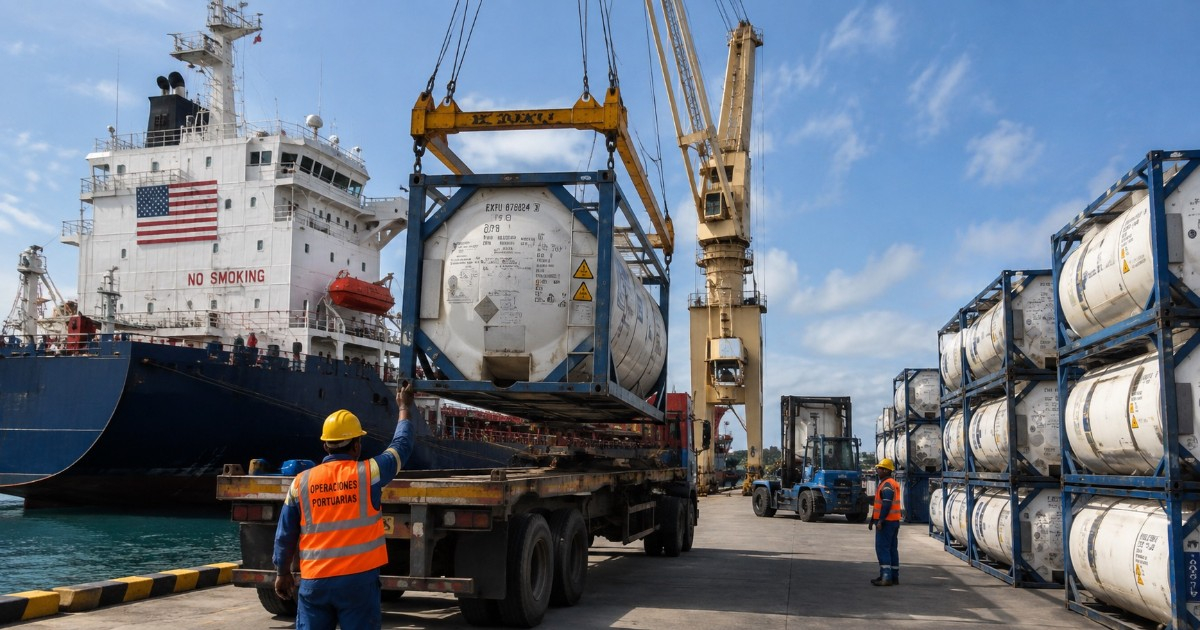
Cuban buyers purchased $95,744,767 in fuel from the United States between January and June 2026, according to data published by the U.S.-Cuba Trade and Economic Council (UCTEC).
The figure reveals an unprecedented escalation in U.S. energy exports to the island, driven by a deliberate policy from Washington to supply the Cuban private sector while intensifying sanctions against the state apparatus.
The month of June accounted for nearly half of the total for the semester. During that period, $47,842,674 worth of petroleum products was dispatched.
The contrast with the first two months of the year is striking. In January and February, exports barely totaled $2,548,110, a figure that multiplied by more than 18 times by the end of the period.
The heaviest product in the breakdown was light fuel oil with low sulfur content, which accumulated over $39 million between the ports of Houston-Galveston and Miami.
The shipments departed from four customs districts: Miami and Tampa in Florida, Houston-Galveston in Texas, and New Orleans in Louisiana. Miami was the most active in terms of product variety, while Houston-Galveston led in value with $25,194,850 in that category alone.
Among the products shipped are leaded and unleaded gasoline, jet fuel, aviation and automotive lubricating oils, medicinal-grade mineral oils, liquid propane, and various hydrocarbon mixtures.
The legal framework that enabled these operations took shape on February 25, 2026, when the Department of Commerce published the "Support for the Cuban People" (SCP) license exception, allowing the export of petroleum products to private Cuban entities without the need for specific authorization from the Office of Foreign Assets Control (OFAC).
On the same day, OFAC announced a policy favorable for the resale of Venezuelan-origin oil intended for the private sector on the island, explicitly excluding the government, the armed forces, and sanctioned entities.
The Secretary of State Marco Rubio described the strategy as "entirely designed to put the private sector and private Cubans —not affiliated with the government, not affiliated with the military— in a privileged position."
The fuel primarily arrives in isotank containers transported by container ships, unloaded at the port of Mariel, with identified beneficiaries including private bakeries, wholesalers, and small distributors.
This commercial dynamic unfolds alongside a tightening of sanctions against the state energy sector. In June, Washington imposed sanctions on CUPET and, at the end of July, on CEINPET, ENERSA, and EINARBO, further constricting the entire chain of exploration, importation, and distribution of fuels by the regime.
Following the capture of Nicolás Maduro on January 3, 2026, Venezuela halted its oil shipments to Cuba, and subsequently, Mexico also suspended its collaboration with the island.
In May, the Minister of Energy and Mines, Vicente de la O Levy, publicly acknowledged that Cuba had "absolutely no fuel, no diesel, only associated gas."
Despite the increasing volume of American fuel, it flows exclusively to the private sector. It does not address the collapse of the national electrical system.
Related videos:
Filed under: