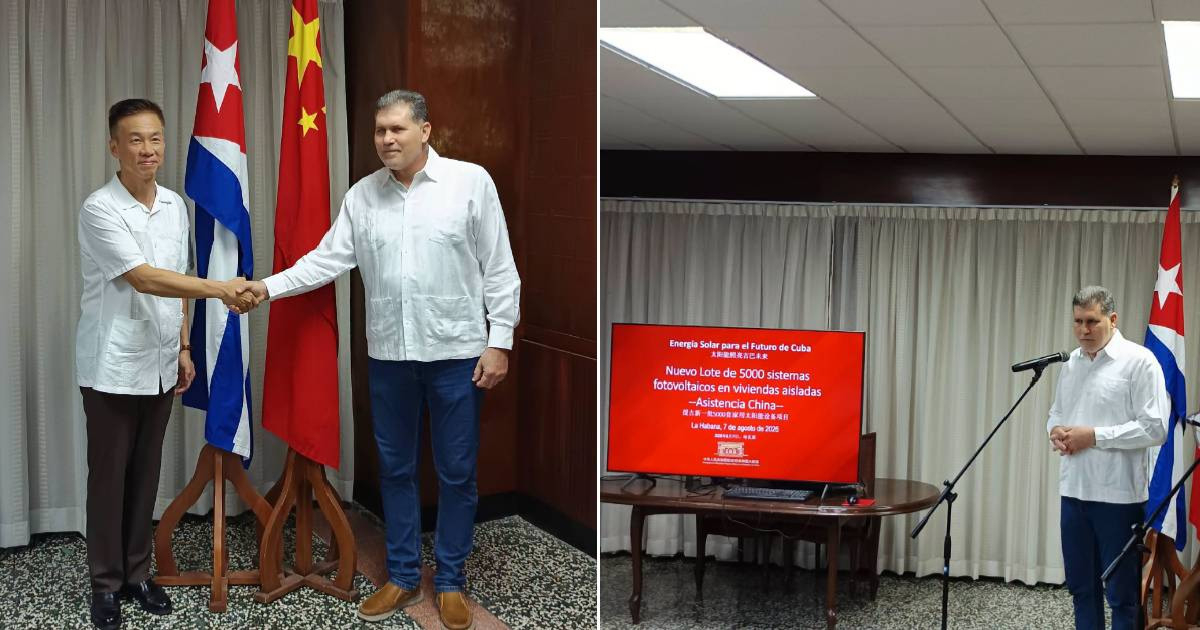
The Chinese government delivered a second batch of 5,000 photovoltaic systems to Cuba on Friday, aimed at electrifying isolated rural homes and ensuring solar energy for health centers, childcare facilities, and bank branches in the country's 169 municipalities.
The ceremony took place at the headquarters of the Ministry of Foreign Trade and Foreign Investment (Mincex) in Havana, with the participation of executives from that organization, the Electric Union of Cuba, and the Chinese Embassy, the ministerial structure specified on Facebook.
The equipment, managed by the China International Development Cooperation Agency, represents a significant technical improvement over the first donation received in November 2025: they achieve a power output of 3.6 KWh and double the storage capacity to 14.3 KWh.
The Vice Prime Minister Óscar Pérez-Oliva Fraga thanked Beijing for its support and emphasized "its special significance in the very complex situation the country is facing."
The Chinese ambassador Hua Xin framed the delivery on the eve of the centenary of the birth of the dictator Fidel Castro (1926-2016), which is commemorated on August 13, and presented it as "a gift from the Chinese people to practically help improve the well-being of the Cuban population."
The donation comes just days after Cuba experienced two total collapses of the national electrical system in less than 48 hours, on Sunday, August 2, and Monday, August 3, marking the sixth and seventh national blackout of the year.
The first batch of 5,000 systems, delivered in November 2025 and valued at over 114 million dollars, was not without controversy, as some of this equipment was reassigned to the state telecommunications monopoly, Etecsa, to support fixed-line telephone services and Nauta Hogar in Matanzas, instead of directly alleviating blackouts in Cuban households.
Energy cooperation between both countries has steadily accelerated. Cuba's imports of Chinese solar panels increased from 16.6 million dollars in 2019 to 48 million in 2024 and 117 million in 2025.
In the commercial sector, the mixed company SUMAI S.A., comprised of Cuban capital and the Chinese firm Hangzhou Iunke Industrial Development Co., is preparing to open a store in El Vedado to sell solar panels and other products exclusively in dollars, illustrating the dual approach - donations and trade - with which China is advancing in the Cuban energy sector.
Cuba currently has more than 30 solar parks in operation and an installed capacity of nearly 1.2 GW, a 350% increase compared to 2024, although renewable energy only accounts for around 9% of total generation, far below the 15% target set by the regime for this year.
Related videos:
Filed under: