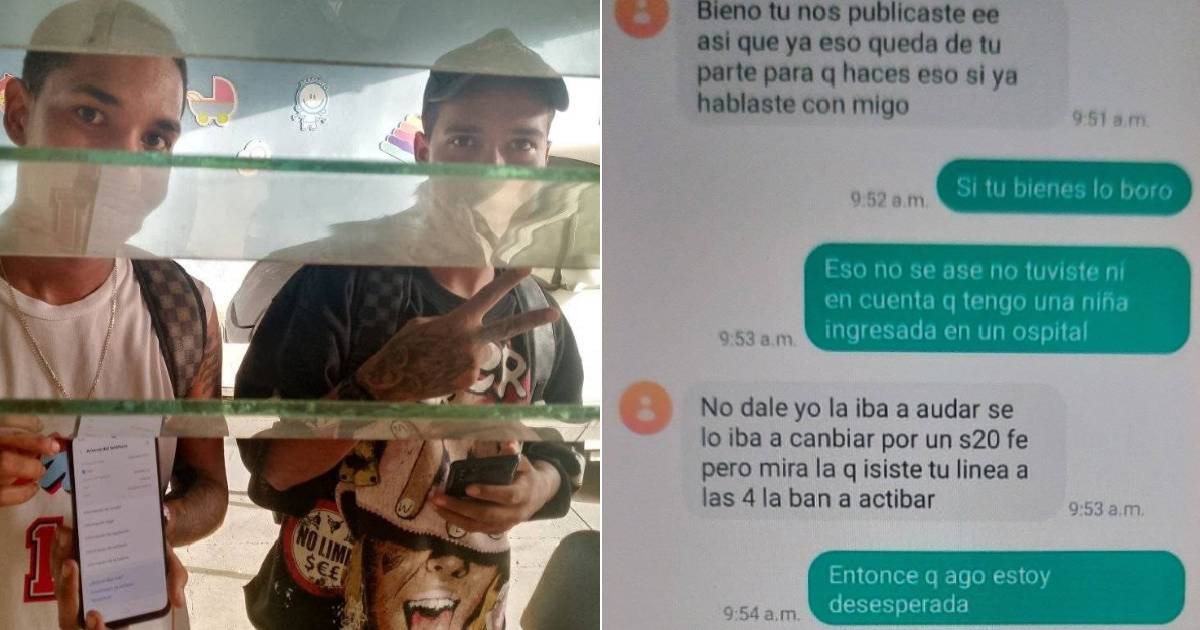
A Cuban woman reported this Friday in a Facebook group dedicated to the sale of used phones in Havana that she was a victim of an alleged scam after purchasing a Samsung A17, which later turned out to be blocked by the state-owned and sole telecommunications company in Cuba (Etecsa).
According to the account of Marimar Rial Molina, she has been in a hospital in Havana for months with her baby, and since she has no family or acquaintances in the capital, she decided to buy a phone because she needed to stay connected and her old device, a Samsung J2, kept shutting off.
The woman stated that the sellers came to the hospital to deliver the device and that they were aware of her situation. The day after the purchase, the line was blocked and a worker from Etecsa informed her that the phone had been reported as stolen.
In light of that situation, Rial explained that she went to the police to report what had happened, but she could not file the complaint because, as they told her, "there was no connection or system" to process the procedure. Desperate, she returned to the hospital and tried to get in touch with the vendors.
According to her post, one of them initially responded and hung up after learning the reason for the call. The woman claims that afterwards the phone used by the sellers was turned off, and she decided to make her complaint public on social media.
Rial also stated that, after presenting the case, a publication emerged in which another woman accused her of buying phones and then claiming that they were stolen.
The complainant stated that she had reviewed profiles related to the sellers and claimed that they were involved in selling stolen phones, although these accusations are not accompanied by independent confirmation in the publication.
Several users commented on the complaint and questioned the actions of the police. One participant believed that a lack of connection or system should not hinder the acceptance of a report, while another suggested that the affected individual should go back to the authorities with photographs and documents related to the purchase.
Other comments included similar accusations against the alleged sellers and references to an address in Lawton where they supposedly tend to meet.
One person even claimed to have unknowingly purchased a stolen phone and ended up being detained for a day in a cell, although this is also a testimony published by a user and not an independently verified fact.
The complaint also prompted calls from some participants to locate and confront the alleged scammers with force, a reaction that highlights the tension caused by the perception of being unprotected in the face of such conflicts.
Rial assured that he retains messages and photographs related to the operation and warned that he will continue to spread the case on social media.
This case is part of a historic escalation of crime in Cuba, where the Cuban Citizen Audit Observatory (OCAC) documented 2,833 verified crimes in 2025, an increase of 115% compared to 2024 and 337% compared to 2023.
Thefts topped that list with 1,536 cases, an increase of 479% since 2023, and in 2026, the trend continues to rise.
The theft of cell phones has a particularly severe impact on the island, as for thousands of families, the mobile phone is the only means of communication with emigrated relatives and the only way to receive remittances.
The energy crisis exacerbates the problem. Power outages lasting over 20 hours a day force Cubans to huddle near windows and doorways in search of a signal or a breeze, putting them at risk of assaults.
In Vedado, cell phone thefts have increased to the point that residents have self-organized into night patrols due to police inaction.
There is a legal framework to combat the resale of stolen equipment; Resolution 12/2016 from the Ministry of Communications requires reporting thefts to Etecsa to block the device's IMEI through a blacklist. However, citizens report that the mechanism is insufficient and that authorities rarely take action.
Related videos:
Filed under: