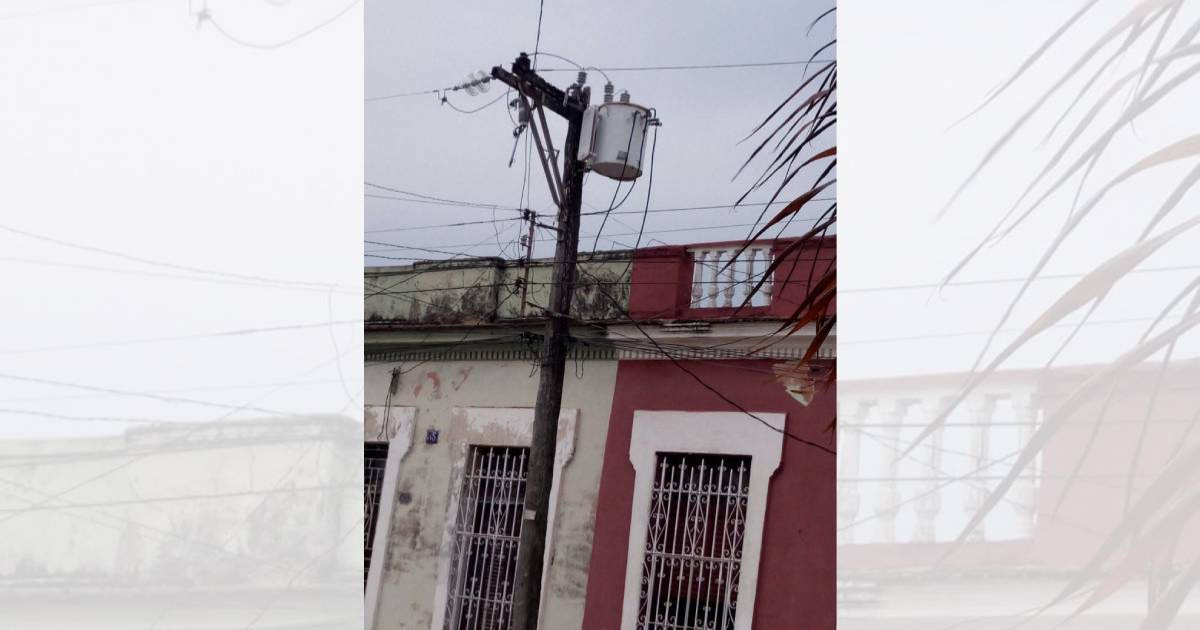
A neighborhood in Camagüey has been without electricity for more than 10 days due to a transformer malfunction that fails every time they attempt to reconnect it, publicly reported this Sunday the writer and journalist María Antonia Borroto Trujillo.
Through his Facebook profile, Borroto explained that the authorities took five days to determine that the equipment needed to be replaced with one of higher capacity, and that the official justification is that there are no transformers available to make the change.
The also doctor in Communication Sciences and member of the Union of Writers and Artists of Cuba (Uneac) contrasted that response with what is happening in Havana, where new poles and transformers have indeed been installed to reconnect hospitals.
"Is there something for that? But not to replace the one from Camagüey, right? Well, if there really isn't one, are they going to leave us in the dark forever? Is that the plan? Are there no other alternatives? Does anyone really care about us?" she questioned.
The citizen reaction to the publication mixes indignation and resignation. One comment noted: "If any family member of the leaders of the electric company and the government lived there... it would have already been solved."
Another expressed the collective exhaustion: "This town is a ship adrift, abandoned to its own fate... the path we must take is so sad."
A third voice, more pragmatic, advised: "Get strong, write letters, and request a meeting with the Party; sometimes it works. It's been a long time."
The blackout in that Camagüey neighborhood occurs against the backdrop of the most severe electrical crisis Cuba has faced in decades, with repeated total disconnections from the National Electroenergy System and blackouts exceeding 24 hours in various locations.
The shortage of transformers is a national issue. The Electric Union acknowledged in June that there was no physical availability of spare parts in any province of the country.
National production, spread across plants in Havana, Santa Clara, and Manzanillo, barely reaches around 70 units per day, well below the replacement demand.
This structural scarcity is compounded by the systematic theft of dielectric oil. The Minister of Energy and Mines, Vicente de la O Levy, admitted at the end of July before the National Assembly that "the amount of oil that has been stolen from us is almost similar to what we are producing in the same period that we are being robbed."
He also revealed that some communities have gone without electricity for up to 105 days due to damage to special transformers with outdated voltages, which are hard to obtain.
In Caimito, Artemisa, several towns were without electricity for 21 days due to the theft of dielectric oil, and in Holguín, this crime accounts for more than half of the 42 electrical incidents recorded by the end of July.
The situation in the province is further exacerbated because Unit 5 of the Diez de Octubre thermoelectric plant in Nuevitas has been under maintenance throughout August, which further decreases the availability of provincial power generation.
Borroto published two texts on Facebook this Thursday and Friday that went viral immediately. In the first, she described daily life under that prolonged blackout with irony and coined the phrase that sums up the crisis: "The Revolution has ended up being just that: to charge everything that needs to be charged."
In the second, he calculated with mathematical precision the time elapsed without electricity in his home: "7 days. 172 hours - 10,320 minutes. 619,200 seconds without power."
Related videos:
Filed under: