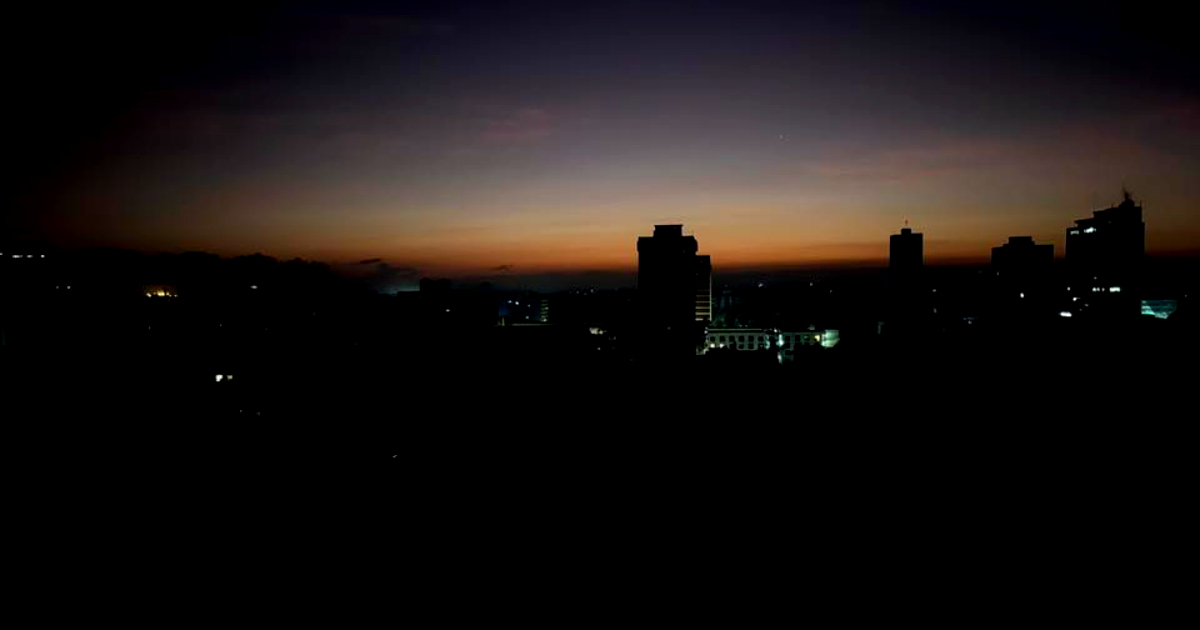
The images of her little daughters lying on the tiled floor trying to cool off accompany the complaint of a Cuban mother who claims to have gone four consecutive days without electricity, amid one of the worst blackouts the island has ever faced.
The Cuban woman, identified as Amelia Cabrera, posted a heartbreaking message on Facebook this Tuesday directed at the Electric Union (UNE) and the government, in which she described her family's exhaustion after days of cooking with firewood, enduring mosquitoes, and trying to cope with the high temperatures without fans or refrigeration.
"Until when do my daughters have to endure heat and mosquito bites for not living in a protected area, or rather, because no communist lives in this area, that's why we are not protected," he wrote.
His complaint points directly to one of the issues that causes the most indignation among Cubans during the current energy crisis: the differences between the so-called "protected circuits," which for certain reasons are exempt from scheduled blackouts, and the areas where power outages can last for practically the entire day.
Cabrera recounted that the desperation reached the point of considering going to the authorities with the soot-covered pots from cooking with firewood to show them the conditions in which his family is living.
Ultimately, he gave up, as he reported, out of fear of the consequences that a protest could have.
"I remembered that in this country there is no freedom, that we are imprisoned and bound hand and foot, and that if you complain or say anything, they put you in jail and throw away the key for being counter-revolutionary," he stated.
The testimony of the mother arrives in one of the most critical weeks of the year for the National Electric System (SEN).
For this Tuesday, the UNE forecasted an availability of only 933 MW during peak demand hours, against an estimated demand of 3,250 MW. The expected deficit was 2,317 MW, and the potential impact could reach 2,347 MW, figures that reflect the magnitude of the deterioration of the Cuban electrical system.
In practice, the anticipated availability was less than one third of the electricity that the country needed during peak consumption times.
The crisis has resulted in increasingly extreme scenes across various provinces. In Matanzas, interruptions have been reported for as long as 87 consecutive hours; in areas of Santiago de Cuba, residents claim to have only one or two hours of electricity service per day, while in Havana, unprotected circuits have faced blackouts lasting more than 20 hours a day.
This is accompanied by the repeated collapses of the SEN. Cuba has experienced at least seven total disconnections of the system in 2026, the most recent being on August 3, when the island once again plunged into total darkness.
"I remembered that in this country there is no freedom."
The fear expressed by Cabrera also appears in a context marked by reports from independent organizations about the repression against those who protest or publicly express their discontent.
The Cuban Observatory of Human Rights documented nearly 2,000 repressive actions during the first half of 2026, while Prisoners Defenders reported 1,306 political prisoners in July, according to their monthly report.
Power outages have been one of the main triggers for spontaneous protests in Cuba in recent years, amid the increasing deterioration of living conditions, food and fuel shortages, and the exhaustion of a population that spends entire days without electricity.
In Cabrera's case, the extent of the crisis is reflected not only in the official figures for the energy deficit but also in a much more everyday scene: two girls searching the floor of their home for some relief from the heat after days without power.
The mother concluded her post with a message directed at those who, as she denounced, remain oblivious to the hardships faced by many Cuban families:
"This message is for everyone who lives well in the upper echelons. Long live a Free Cuba, without blackouts or hunger."
Related videos:
Filed under: